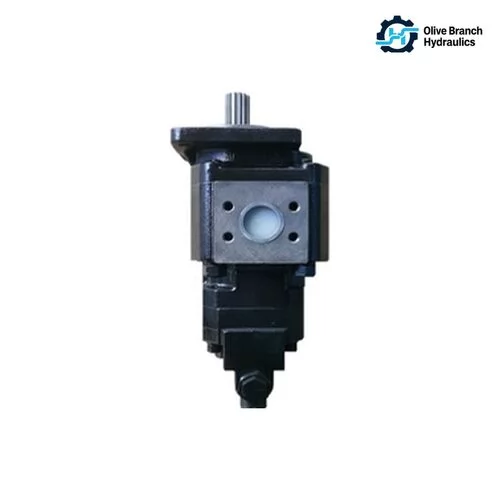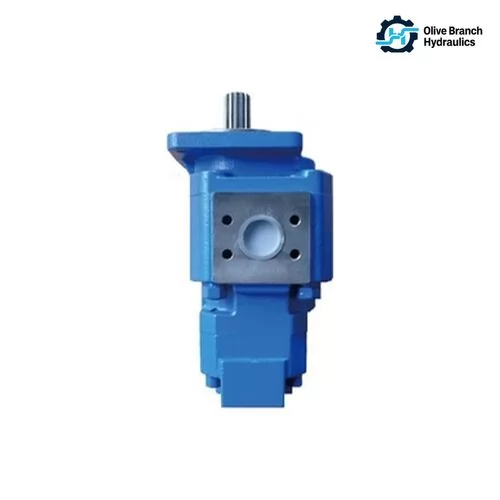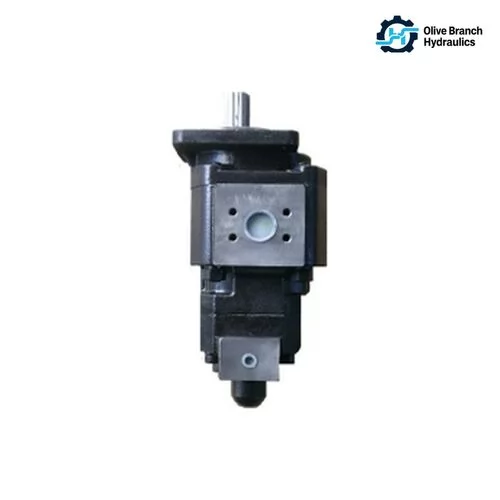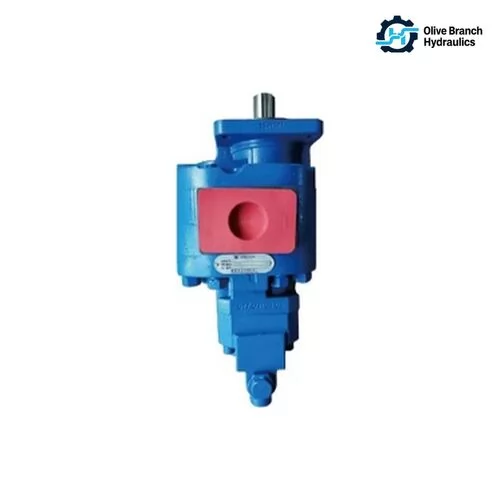

Cover illustration: tandem gear pump structure. Watch the workshop footage below.
Hands lift an intermediate body into place between two opened pump housings, and the on-screen subtitle reads "Install the intermediate." The short workshop clip, posted on 21 November 2026, shows tandem gear pump assembly and disassembly on a double-section unit. If you source replacement pumps, it shows how the two halves stack before you photograph or describe your own pump.
Tandem Gear Pump Assembly Close-Up: The Intermediate Body Between Two Sections
The key moment in the workshop clip is the intermediate body being fitted between the dismantled housings and gear sets. That part joins the front and rear pumping sections into one unit. How it passes drive, routes oil and seals the two sections depends on the exact pump design, and the footage alone does not settle those details.
What the Intermediate Housing Does in a Double Hydraulic Gear Pump
A tandem gear pump is a hydraulic pump with two gear pump sections mounted in line and driven from a single input shaft. One machine drive can then feed two separate circuits. The intermediate body, also called the center housing, sits between those two sections.
Depending on the design, it may provide sealing faces for both gear sets, carry a shared or separate inlet, and enclose the coupling that passes drive to the rear gears. Product series differ here. Any general description is a starting point, not a specification for your pump.
What You Can Take From the Footage
The clip lays out housings, gears and the intermediate body as separate parts, which makes the stacking order easy to picture. The order runs front section, intermediate body, rear section. Once you know that sequence, you can tell which end of your own pump is which and which faces to photograph.
That matters for remote matching. A photo of the wrong end, or a nameplate shot without the shaft, often leads to a second round of questions before any quote can be issued.
What the Clip Does Not Confirm
Use the video to understand the assembly layout. Confirm the full model code, section displacements, operating requirements and mounting dimensions against documentation for your exact pump. Assembly torque, seal orientation and acceptance tests must come from that configuration’s service information; a workshop demonstration cannot replace those instructions.
Can You Identify a Tandem Pump From Video or Photos Alone?
No. Video or photos from a double gear pump disassembly can narrow the search, but visual similarity cannot confirm interchangeability. Two tandem units can share housing shape and flange style and still differ in displacement, seals, bearings, rear-section porting or the coupling between sections. Matching still needs the code or measured data.
Displacement is set by gear width and bore geometry, and a picture shows neither reliably. Once the pump is closed, bushings, seal compounds and pressure-balance plates are hidden. A rear-section port may be relocated on one variant and standard on the next.
Brand names and model numbers serve only to identify a replacement. Compatibility depends on the complete assembly code, so a full pump code is needed before any match is confirmed.
When the code is worn off, other evidence has to carry the identification. A dimensioned drawing fixes flange, shaft and port geometry directly and is the most reliable basis. The original pump can be measured, and its section order and casting details checked. Photos help when they show the flange, shaft end, ports and nameplate from several angles.
Front and Rear Sections, Shaft, Flange, Ports and Rotation: What to Confirm
Confirm each pumping section separately, then confirm the mounting interface as one unit. The front and rear sections of a tandem pump can have different displacements and port layouts. Shaft, flange and rotation belong to the whole pump, and they decide whether it fits the drive at all.
Telling the Front Section From the Rear Section
The front section sits on the shaft-and-flange side. The rear section sits behind the intermediate body, at the end away from the drive. Record each section's displacement separately if it is stamped on the housing or listed in the machine documentation.
Then note how each section's ports connect to the circuit, for example which one feeds steering and which feeds a lift or auxiliary function. A reversed section order or a misread port can result in an incorrect replacement match.
Shaft, Flange, Port and Rotation Checks
Four interface points decide whether a replacement fits. The table shows how to check each one and what a missed mismatch leads to.
| Check point | How to check | Result of a mismatch |
|---|---|---|
| Shaft type and spline | Record spline count, pitch/profile, diameter and shaft extension | Coupling will not engage |
| Flange pattern | Measure pilot diameter and bolt spacing | Pump will not mount or align |
| Port type and thread | Identify thread form; measure port size | Fittings will not seal |
| Port position | Photograph each section side-on | Hoses need rerouting or new fittings |
| Rotation direction | Confirm arrow/code and the specified viewing end | No delivery; possible shaft seal damage |
Check rotation and shaft spline twice, because an error in either usually means the pump cannot run on that machine at all.
Confirm whether rotation is specified looking at the shaft end; use the same viewing direction when comparing the old and new pumps. Many gear pumps are built for one direction only. Turned the wrong way, the pump draws through what should be its pressure side, which can put the shaft seal under load it was not designed for.
Send Your Pump Details for a Match
Send the full old-pump code, a nameplate photo, shaft, flange and port photos, both section displacements if known, the machine model, quantity and destination. If you stock several series for resale, the wholesale gear pump supply page explains how replacement and OEM orders are handled.
Repair or Replace? Questions Before a Tandem Hydraulic Gear Pump Replacement
The repair-or-replace decision depends on what you can verify about the pump, not on a diagnosis made from a video. Noise, heat or pressure loss can come from the pump, a relief valve, filtration or elsewhere in the circuit. The pump code and your machine records count for more than how the pump looks.
Ask these questions before requesting a quote:
- Is the full assembly code still legible on the nameplate or housing?
- Are both sections affected, or only one circuit?
- Are seal kits available for this exact configuration?
- What does a day of machine downtime cost you?
- Have the ports or flange been modified from the original?
A readable code and original ports make a like-for-like replacement simpler to quote. If the interfaces were modified or the code is missing, matching moves to measurement or a drawing. That takes longer but avoids a wrong-fit unit on the shelf.
For reference only, the catalog shows a separate A45E7-10202 tandem hydraulic gear pump as an example of how tandem units are listed. This catalog reference does not identify the filmed pump or establish interchangeability.
RFQ Checklist for a Tandem Pump Replacement Quote
A complete first message is the fastest route to an accurate tandem pump quote. Send the code, photos, displacements, machine model, quantity and destination in one message. That avoids several rounds of questions and lowers the risk of a sample that does not fit your machine.
| What to send | Why it matters |
|---|---|
| Full assembly code | Defines the exact configuration |
| Nameplate photo | Confirms code and manufacturer markings |
| Shaft, flange and port photos | Shows mounting interface and port layout |
| Front and rear displacements | Sets flow for each circuit |
| Rotation direction | Determines inlet and outlet sides |
| Machine model and serial | Narrows possible factory variants |
| Quantity | Affects pricing and production planning |
| Destination port | Needed for freight arrangements and documents |
The code and the shaft-end photo give the most information. The other rows confirm what those two suggest.
At Olive Branch Hydraulics, replacements are matched from the original product code, machine model and equipment details, or against a confirmed drawing. Quality checks are tied to the approved drawing, and each pump is inspected before packaging.
Price, lead time, inspection documents and delivery terms are confirmed in the written quotation. Applicable checks, such as dimensional measurement, leak inspection or pressure and flow testing, are agreed in the same document.
FAQ
Is the pump in the video a specific brand or model?
The video is presented as a structure demonstration. To identify a replacement for your machine, send its full pump code, nameplate and installation photos.
Can you match a tandem pump from photos only?
Partly. Clear photos of the flange, shaft end, ports and nameplate help with identification. A full code or a dimensioned drawing is still needed to confirm the match.
What if only one section's displacement is known?
Send it anyway. Include the code and photos so the missing section can be checked from markings, measurements or the machine documentation.
Can port positions be changed for distributors?
Yes. Custom P/T port configurations are possible, with design drafts and 3D renders provided for approval before sampling. The final layout is confirmed against the approved drawing.
Send Your Old Pump Information
If you have a tandem pump to replace, send the full code, a nameplate photo, shaft, flange and port photos, both section displacements if known, the machine model, quantity and destination port. Use the contact page or WhatsApp +8615075996564, and matching will start from those details.
Video and Technical Reference
Workshop video: Olive Branch Hydraulics tandem gear pump demonstration, shared 21 November 2026. For a published example of configuration-specific displacement, rotation, flange, shaft and port options, see the Danfoss GearMe Aluminum Group 2 Compact Pump technical information. This reference does not identify the pump in the video or transfer its ratings to our products.