
It's surprisingly common — pumps get installed, run for a while, and then fail way sooner than anyone expected. Not because they're bad pumps, but because they were the wrong type for the job. When you're deciding between a piston pump and a diaphragm pump, forget about which one is "better." What actually matters is which one holds up under the conditions you're dealing with.
This technical analysis presents an evidence-based comparative assessment of the fundamental operational and performance distinctions between these pump technologies. Whether the application involves high-pressure fluid transfer, chemically aggressive media, or lifecycle cost optimization, selecting the appropriate positive displacement pump configuration is a critical engineering decision with significant long-term implications for system reliability and operational efficiency.
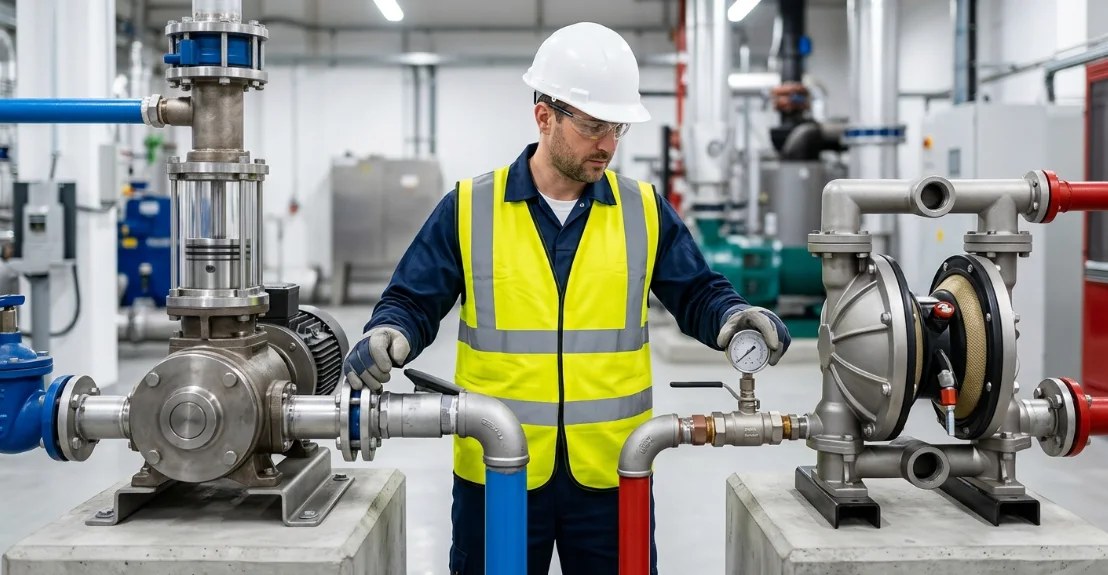
Understanding Positive Displacement Pump Types
Both piston and diaphragm pumps fall under the positive displacement pump category. Understanding how each mechanism converts energy into fluid movement is the first step toward choosing correctly.
How a Piston Pump Works
A piston pump uses a reciprocating piston inside a sealed cylinder to draw in and pressurize fluid. As the piston retracts, it creates a vacuum that opens the inlet valve and pulls fluid into the chamber. On the forward stroke, the inlet valve closes, the discharge valve opens, and the piston forces fluid out at high pressure.
Mechanical energy from a motor or crankshaft converts directly into fluid pressure through this piston-cylinder interface. The tight tolerances between piston and cylinder wall are what enable these pumps to achieve extreme pressures — often exceeding 10,000 PSI in industrial configurations.
How a Diaphragm Pump Works
A diaphragm pump displaces fluid using a flexible membrane that flexes back and forth within a chamber. This membrane can be driven by compressed air (air-operated double-diaphragm or AODD pumps), a mechanical linkage, or hydraulic fluid.
When the diaphragm pulls back, fluid enters through a check valve. When it pushes forward, fluid exits through the discharge valve. The key advantage is that the pumped fluid never contacts the drive mechanism — the diaphragm creates a complete seal between the two.
Most diaphragm pumps are self-priming, meaning they can draw fluid from below without manual filling. This makes them especially practical for remote or portable applications.
Where They Overlap as Positive Displacement Pumps
Despite their mechanical differences, piston and diaphragm pumps share core operating principles. Both deliver a fixed volume of fluid per cycle, making their flow rate proportional to speed rather than pressure.
Both types produce flow that is largely independent of downstream pressure — a defining trait of positive displacement pump types. They're also both suitable for viscous or shear-sensitive fluids where centrifugal pumps would struggle or cause product damage.
Piston vs Diaphragm Pump Comparison — Key Performance Metrics
Numbers tell the real story. Below is a detailed piston vs diaphragm pump comparison across the metrics that matter most for pump efficiency and performance in real-world operations.
Pressure Output and Range
| Metric | Piston Pump | Diaphragm Pump |
|---|---|---|
| Max Pressure (typical) | Up to 10,000+ PSI | Up to 1,200 PSI |
| Pressure Consistency | Very steady | Slight pulsation |
| Best For | High pressure pumping applications | Low-to-medium pressure tasks |
Piston pumps dominate when sustained, high-pressure output is non-negotiable. Their rigid cylinder-piston interface maintains tight sealing even at extreme pressures, delivering consistent flow with minimal pulsation.
Diaphragm pumps, by contrast, are limited by the mechanical strength of the membrane material. While adequate for many transfer and dosing applications, they cannot compete in high pressure pumping applications like waterjet cutting or hydraulic power units.
Flow Rate and Efficiency
| Metric | Piston Pump | Diaphragm Pump |
|---|---|---|
| Flow Rate Range | Moderate to high | Low to moderate |
| Volumetric Efficiency | 90–98% | 80–93% |
| Energy Efficiency | High under load | Moderate; air-driven models less efficient |
Pump efficiency and performance vary significantly between these two types, especially during continuous duty cycles. Piston pumps maintain high volumetric efficiency because the rigid piston minimizes internal leakage — nearly all displaced volume exits as useful flow.
Air-operated diaphragm pumps sacrifice energy efficiency for simplicity. Compressed air is an inherently inefficient power source, often converting only 10–25% of input energy into useful fluid work. Electrically driven diaphragm pumps perform better but still trail piston designs under sustained load.
For intermittent duty or applications where the pump frequently starts and stops, diaphragm pumps hold an advantage. They tolerate deadheading, dry running, and idle periods without damage — conditions that would wear piston seals prematurely.
Fluid Compatibility
| Factor | Piston Pump | Diaphragm Pump |
|---|---|---|
| Abrasive Fluids | Poor — causes seal wear | Excellent — no contact parts |
| Corrosive Chemicals | Limited by seal materials | Wide chemical compatibility |
| Viscous Fluids | Moderate | Good |
| Shear-Sensitive Media | Acceptable | Superior |
| Dry Running Tolerance | Damages seals | Safe for short periods |
Fluid compatibility is where diaphragm pumps pull ahead decisively. Because the fluid only contacts the diaphragm and wetted housing — with no sliding seals or metal-to-metal contact — they handle abrasive slurries, aggressive chemicals, and sensitive biologics without degradation.
Piston pumps require clean, lubricating fluids to protect their precision-machined seals. Any particulate contamination accelerates wear exponentially, leading to costly downtime and frequent seal replacement.
Pump Maintenance and Durability
The true cost of a pump isn't the purchase price — it's the total cost of ownership over its service life. Pump maintenance and durability differ dramatically between these two technologies.
Wear Components and Service Life
Piston pumps rely on seal kits, piston rings, packing sets, and check valves as their primary wear components. In clean-fluid applications with proper lubrication, piston seals can last 2,000–5,000 operating hours before replacement. Check valves typically last longer but require periodic inspection.
Diaphragm pumps have fewer wear components — primarily the diaphragm membrane itself and the check valves (ball or flap type). Diaphragm life varies widely based on material and application, ranging from 1,000 hours in aggressive chemical service to 8,000+ hours in mild transfer duties.
When maintained on schedule with clean fluids, piston pumps can achieve total service lives exceeding 20,000 hours. Diaphragm pumps typically reach 10,000–15,000 hours before requiring major overhaul, though individual membrane replacements are far simpler.
Maintenance Complexity and Downtime
Piston pump maintenance demands precision. Reassembly requires exact torque specifications, proper seal orientation, and careful alignment of piston-to-cylinder clearances. A trained technician and specialized tools are often necessary, making field repairs impractical.
Diaphragm pumps are designed for fast field service. A membrane swap on most AODD pumps takes 30–60 minutes with basic hand tools. This simplicity translates directly into reduced downtime and lower labor costs per service event.
Over a 5-year span, a piston pump in clean-fluid service may cost 40–60% of its purchase price in maintenance. A diaphragm pump in chemical service may cost 25–40% — but with more frequent, shorter service intervals rather than fewer, longer overhauls.
Common Failure Modes
| Failure Type | Piston Pump | Diaphragm Pump |
|---|---|---|
| Primary Wear Point | Piston seals/packings | Diaphragm membrane |
| Typical Cause | Abrasion, heat, misalignment | Fatigue, chemical attack |
| Avg. Repair Time | 2–4 hours | 30–60 minutes |
| Risk of Leakage | Moderate (seal degradation) | Low (hermetic separation) |
Piston pump failures tend to be gradual — increasing leakage past worn seals provides early warning. However, catastrophic failure from misalignment or thermal damage can occur without warning and requires extensive rebuild.
Diaphragm failures are typically sudden — the membrane ruptures, and flow stops or fluid enters the air chamber. Many modern diaphragm pumps include rupture detection sensors that trigger immediate shutdown to prevent contamination.
High Pressure Pumping Applications — Which Pump Wins?
Application context determines which pump type delivers the best return on investment. Here's how they perform across major industrial sectors.
Industrial and Manufacturing Use Cases
Piston pumps dominate in high pressure pumping applications where sustained force is essential. Waterjet cutting systems rely on triplex piston pumps to generate 40,000–90,000 PSI for precision material cutting. Hydraulic power units use piston pumps to maintain consistent system pressure across heavy machinery.
Paint spraying and coating systems favor piston pumps for their ability to atomize materials at 2,000–5,000 PSI with steady, pulsation-free delivery. Pressure washing equipment, concrete pumping, and oil field injection systems all leverage the piston pump's unmatched pressure capability.
Chemical Processing and Transfer
Diaphragm pumps excel in chemical processing environments where fluid compatibility and leak prevention outweigh pressure demands. Acid dosing, caustic transfer, solvent handling, and slurry pumping all favor the diaphragm's hermetic seal and broad material compatibility.
Wastewater treatment plants rely heavily on AODD pumps for their ability to handle variable solids content, run dry without damage, and operate in hazardous-classified areas without electrical ignition sources. Chemical metering applications benefit from the diaphragm pump's linear flow-to-speed relationship.
Food, Pharma, and Sanitary Applications
Both pump types serve food and pharmaceutical industries, but with different strengths. Diaphragm pumps offer zero-leakage containment and gentle handling of shear-sensitive products like emulsions, creams, and cell cultures. PTFE diaphragms meet FDA and USP Class VI requirements.
Piston pumps appear in high-pressure homogenization and aseptic filling where precise volume delivery at elevated pressure is required. However, their seal-based design introduces contamination risk that demands rigorous CIP (clean-in-place) protocols and frequent seal inspection.
For regulatory compliance, diaphragm pumps generally present a simpler validation path due to fewer potential contamination points and easier disassembly for inspection.
Decision Framework — Choosing the Right Pump
Rather than debating which pump is universally better, match your operating conditions to the pump that handles them best. Use the criteria below to guide your selection.
When to Choose a Piston Pump
- You need sustained pressure above 1,500 PSI — no diaphragm pump matches this range reliably
- Your fluid is clean and non-abrasive — protecting seal life and maintaining efficiency
- Continuous high-flow duty cycle — piston pumps maintain efficiency over long run times
- Precision metering at high pressure — tight volumetric control per stroke
- Maximum energy efficiency matters — 90–98% volumetric efficiency reduces operating costs
When to Choose a Diaphragm Pump
- Handling corrosive or abrasive media — the diaphragm isolates all drive components from fluid
- Leak-free operation is critical — hermetic separation eliminates external leakage paths
- Variable flow with simple controls — adjust air pressure or stroke length without complex VFDs
- Minimal maintenance budget or remote locations — fast field service with basic tools
- Dry-run or deadhead conditions are possible — diaphragm pumps tolerate both without damage
Quick Selection Table
| Your Priority | Recommended Pump |
|---|---|
| Maximum pressure | Piston |
| Chemical resistance | Diaphragm |
| Low maintenance | Diaphragm |
| High efficiency | Piston |
| Dry-run safety | Diaphragm |
| Precision flow control | Piston |
| Hazardous fluid containment | Diaphragm |
If your application requires both high pressure and chemical resistance, consider a hydraulically actuated diaphragm pump — a hybrid design that combines diaphragm isolation with piston-driven pressure capability up to 3,000+ PSI.
Frequently Asked Questions (FAQ)
Can a diaphragm pump replace a piston pump for high-pressure jobs?
Generally no. Standard diaphragm pumps cap around 1,200 PSI, while piston pumps routinely exceed 10,000 PSI. The exception is hydraulically actuated diaphragm pumps, which use a piston to pressurize hydraulic fluid behind the membrane, achieving 2,000–3,500 PSI for moderate-high pressure chemical service. For true high pressure pumping applications like waterjet cutting or hydraulic systems, piston pumps remain the only viable option.
Which pump lasts longer without maintenance?
Diaphragm pumps typically require less frequent service and tolerate neglect better than piston pumps. They can run dry, deadhead, and handle dirty fluids without immediate damage. However, piston pumps can achieve longer total service life — exceeding 20,000 hours — when maintained properly with clean, lubricating fluids. The answer depends on whether you prioritize maintenance interval length or total lifespan.
Is a piston pump or diaphragm pump more energy efficient?
Piston pumps deliver higher volumetric and mechanical efficiency, typically 90–98% compared to 80–93% for diaphragm designs. This gap widens significantly with air-operated diaphragm pumps, which convert only 10–25% of compressed air energy into useful fluid work. For applications where energy cost is a primary concern and the fluid is clean, piston pumps are the clear winner for pump efficiency and performance.
Which pump is safer for hazardous or toxic fluids?
Diaphragm pumps are the safer choice for hazardous or toxic fluids. The flexible membrane creates hermetic separation between the pumped fluid and the drive mechanism, eliminating the dynamic seal leak paths inherent in piston designs. Many diaphragm pumps also include containment chambers and rupture sensors that detect membrane failure before any fluid escapes to the environment.
What is the cost difference between piston and diaphragm pumps?
Piston pumps typically cost 2–5 times more than comparable-flow diaphragm pumps at purchase. Maintenance costs are also higher due to precision components and longer repair times. Diaphragm pumps are cheaper to buy and service, but may require more frequent membrane replacement in demanding applications — sometimes every 3–6 months in aggressive chemical service. Over a 5-year period, total cost of ownership depends heavily on fluid type and duty cycle.
Can either pump handle solids or slurries?
Diaphragm pumps handle suspended solids and slurries well, with some AODD models passing particles up to 3 inches in diameter. The lack of close-tolerance sliding parts means abrasive particles cause minimal damage. Piston pumps suffer rapid seal wear with abrasive particles unless fitted with specialized hardened components — and even then, service life drops dramatically compared to clean-fluid operation.