
Most people don't think twice about how a hydraulic motor actually works. But at its core, the idea is surprisingly straightforward: you take pressurized fluid, push it against a piston, and that piston moves. Do that a few thousand times a minute, and you've got serious mechanical force — enough to drive factory equipment, propel ships, or power heavy machinery. That's the basic job of a piston type motor, and once you understand how it operates, a lot of modern mechanical systems start to make a whole lot more sense.
If you've ever worked around hydraulic rigs on a job site or kept pneumatic tools running in a shop, you already know that understanding the piston motor mechanism makes troubleshooting and maintenance a whole lot easier. This guide walks through each stage of the process — from fluid entering the cylinder to the crankshaft spinning — so you can see for yourself how pressure actually turns into usable power.
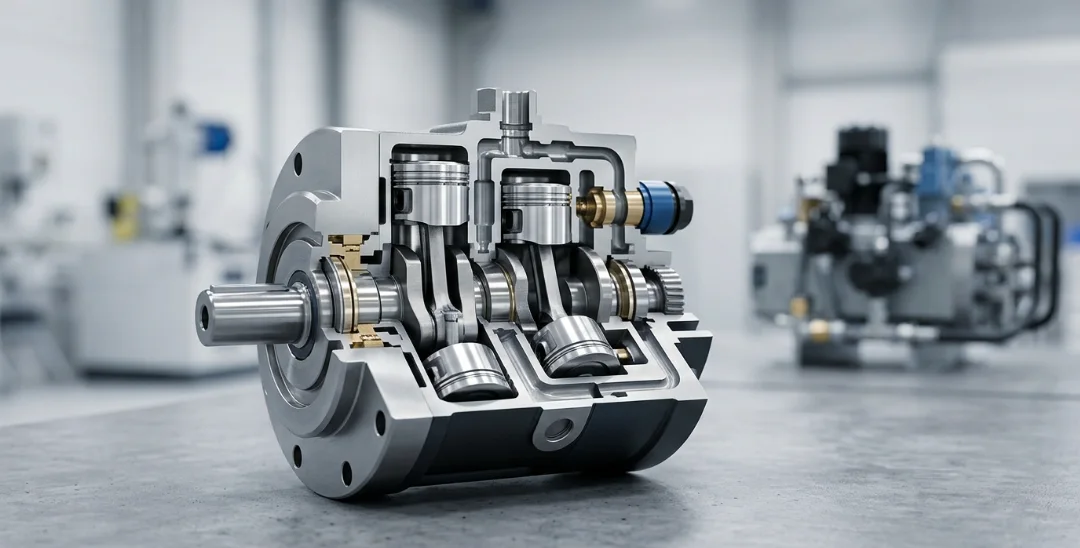
Fundamental Overview of Piston Type Motors
Definition and Core Function
A piston type motor is an actuator that transforms hydraulic or pneumatic energy into usable mechanical motion. Pressurized fluid enters a cylinder, pushes against a piston face, and generates linear force through reciprocating piston operation.
That linear force is then converted into rotary mechanical motion via a crankshaft, swashplate, or cam mechanism. This two-stage energy conversion — fluid pressure to linear thrust, then linear thrust to rotation — defines the core function of every hydraulic piston engine and its pneumatic counterpart.
Types of Piston Motors
Not all piston motors move fluid energy the same way. The three primary configurations each suit different torque, speed, and packaging requirements.
| Type | Motion Conversion | Common Application |
|---|---|---|
| Axial Piston Motor | Angled swashplate drives rotation | Mobile hydraulics, heavy equipment |
| Radial Piston Motor | Pistons push outward from center | Low-speed, high-torque drives |
| Inline Piston Motor | Direct linear reciprocating action | Industrial presses, compressors |
Axial designs dominate mobile machinery because of their compact size and variable displacement capability. Radial piston motors excel where slow, powerful rotation is needed — think ship winches and heavy conveyor drives.
Step-by-Step Working Principle of Piston Type Motor
The working cycle of a piston type motor can be broken into four distinct stages. Each stage flows directly into the next, creating continuous rotary output from pressurized fluid input.
Stage 1 — Fluid Intake and Pressure Build-Up
The cycle begins when pressurized fluid — typically hydraulic oil between 150 and 400 bar — enters the cylinder through a valve plate or port. This fluid acts directly on the exposed face of the piston, generating a force proportional to system pressure multiplied by piston area.
The valve plate timing ensures fluid enters only during the correct phase of rotation. This precise control of intake is what makes the piston motor mechanism so efficient compared to simpler vane or gear motors.
Stage 2 — Reciprocating Piston Operation
Once pressurized fluid fills the cylinder bore, it drives the piston through its full stroke length. The force generated equals system pressure multiplied by the piston's cross-sectional area, and the stroke defines the cylinder displacement volume per revolution.
In a multi-piston design, several pistons fire in sequence. This staggered firing produces smooth, overlapping power pulses rather than a single jerky thrust, resulting in consistent torque delivery throughout each rotation.
Stage 3 — Conversion to Crankshaft Rotary Motion
The linear force from each piston transfers through a connecting rod to a crankshaft, swashplate, or cam ring. This mechanical linkage converts straight-line piston travel into continuous crankshaft rotary motion.
In axial piston motors, pistons press against an angled swashplate, and the angular offset creates a rotational moment. In radial designs, pistons push against an eccentric cam ring that orbits around the output shaft. Both methods achieve the same result — reliable rotary output from reciprocating input.
Stage 4 — Exhaust and Fluid Return
After the piston completes its power stroke, the valve plate rotates to expose the cylinder bore to the low-pressure return port. Spent fluid exits the cylinder and flows back to the reservoir through the return line.
This exhaust phase resets the piston to its starting position, ready for the next intake charge. The speed at which fluid exits directly affects volumetric efficiency and maximum operating RPM of the motor.
Key Components and Their Roles
Every part inside a piston type motor serves a specific purpose within the working cycle. Understanding these components clarifies how the overall reciprocating piston operation produces reliable output.
| Component | Function | Relation to Working Principle |
|---|---|---|
| Piston | Receives fluid pressure | Converts pressure to linear force |
| Cylinder Block | Houses pistons | Defines cylinder displacement volume |
| Crankshaft / Cam Ring | Converts motion | Enables crankshaft rotary motion |
| Valve Plate / Port | Controls flow timing | Manages intake and exhaust phases |
| Connecting Rod | Links piston to shaft | Transfers reciprocating force |
The valve plate deserves special attention. Its timing determines when each cylinder receives and releases fluid, directly controlling torque smoothness and efficiency. A worn or misaligned valve plate causes pressure losses and erratic motor behavior.
Hydraulic Piston Engine vs. Pneumatic Piston Motor
Both hydraulic and pneumatic piston motors use the same fundamental piston motor mechanism, but the working fluid creates dramatically different performance characteristics. Choosing between them depends on your torque needs, precision requirements, and operating environment.
| Parameter | Hydraulic Piston Engine | Pneumatic Piston Motor |
|---|---|---|
| Working Fluid | Oil-based hydraulic fluid | Compressed air |
| Pressure Range | 150–400 bar | 4–10 bar |
| Torque Output | Very high | Moderate |
| Speed Control | Precise via flow regulation | Less precise |
| Typical Use | Construction, marine, mining | Light automation, hand tools |
Hydraulic systems deliver far greater force density because oil operates at pressures 20 to 100 times higher than compressed air. This makes the hydraulic piston engine the default choice for heavy-duty applications where compact size and high torque matter most.
Pneumatic motors, however, offer inherent safety advantages in explosive environments and require simpler infrastructure — no return lines, no fluid filtration, and no risk of oil leaks contaminating products.
Performance Factors and Efficiency
Displacement and Speed Relationship
The cylinder displacement volume — total fluid volume swept by all pistons per revolution — directly determines the motor's torque-speed balance. A larger displacement means more fluid acts on the pistons each cycle, producing higher torque at any given pressure.
However, larger displacement also requires more fluid flow to maintain the same rotational speed. This inverse relationship between torque and speed at constant flow is a defining characteristic of the piston motor mechanism that engineers use to match motors to specific load requirements.
Volumetric and Mechanical Efficiency
Real-world piston motors never achieve 100% efficiency. Volumetric efficiency — typically 92% to 98% in quality hydraulic piston motors — accounts for internal leakage past piston seals and through the valve plate interface.
Mechanical efficiency covers friction losses between moving parts: piston-to-bore contact, bearing drag, and seal friction. Combined overall efficiency for a well-maintained hydraulic piston engine usually falls between 85% and 95%, significantly higher than gear or vane motor alternatives.
Load Matching and Pressure Drop
Proper system design ensures the reciprocating piston operation matches the required load profile without excessive pressure drop. Undersized supply lines, restrictive fittings, or inadequate pump flow all reduce the pressure available at the motor inlet.
Every bar of pressure lost to system resistance is energy that never reaches the pistons. Engineers size hoses, valves, and fittings to keep total system pressure drop below 5% of working pressure for optimal motor performance.
Applications Across Industries
The versatility of piston type motors makes them indispensable across virtually every heavy industry. Their ability to deliver precise, high-torque rotation from fluid power suits applications where electric motors face size, weight, or environmental limitations.
| Industry | Application | Motor Type Preferred |
|---|---|---|
| Construction | Excavator swing drives | Axial piston |
| Marine | Winch and crane drives | Radial piston |
| Manufacturing | Conveyor systems | Inline piston |
| Agriculture | Harvester wheel motors | Hydraulic piston engine |
| Energy | Wind turbine pitch control | Axial piston |
In construction, axial piston motors power the swing mechanism on excavators, delivering instant torque reversal as operators rotate the cab. Marine applications favor radial piston motors for anchor winches because they produce enormous torque at very low speeds — exactly what's needed to haul heavy chain under load.
The agricultural sector relies on hydraulic piston engines as wheel motors in self-propelled harvesters, providing independent speed control to each wheel for field maneuverability without a mechanical transmission.
FAQ
What is the basic working principle of a piston type motor?
A piston type motor works by using pressurized fluid to push pistons inside cylinders, creating reciprocating piston operation that is converted into crankshaft rotary motion through mechanical linkages such as connecting rods, swashplates, or cam rings. The cycle repeats continuously as valve timing alternates between intake and exhaust phases.
What is the difference between a piston motor and a piston pump?
A piston motor receives pressurized fluid to produce mechanical output, while a piston pump uses mechanical input to pressurize fluid — they are functional inverses using the same piston motor mechanism. In many designs, the same physical unit can operate as either a motor or a pump depending on which port receives pressure.
How does cylinder displacement volume affect motor performance?
Larger cylinder displacement volume produces higher torque at lower speeds because more fluid acts on the pistons each revolution. Smaller displacement allows higher rotational speeds with reduced torque per revolution, making displacement selection a primary engineering decision when matching a motor to its load.
Where are hydraulic piston engines most commonly used?
Hydraulic piston engines are used in heavy-duty applications including construction equipment, marine winches, mining machinery, and industrial presses requiring high torque density. Their ability to operate at pressures up to 400 bar makes them the preferred choice wherever compact, powerful rotary actuation is needed.
Can a piston type motor run in both directions?
Yes — reversing the fluid flow direction through the valve plate reverses the crankshaft rotary motion, enabling bi-directional operation in most designs. This reversibility is a key advantage of the piston motor mechanism in applications like winch drives that must raise and lower loads.