If you've ever had to move something thick, abrasive, or downright uncooperative through a pipeline, you've probably crossed paths with an eccentric screw pump. These machines are quietly doing the heavy lifting in some of the most demanding fluid-handling environments on the planet — and most people outside the pump world have no idea how elegant the engineering really is.
Let's break down how they work, why they're designed the way they are, and when they're the right choice over other options.
What Is an Eccentric Screw Pump?
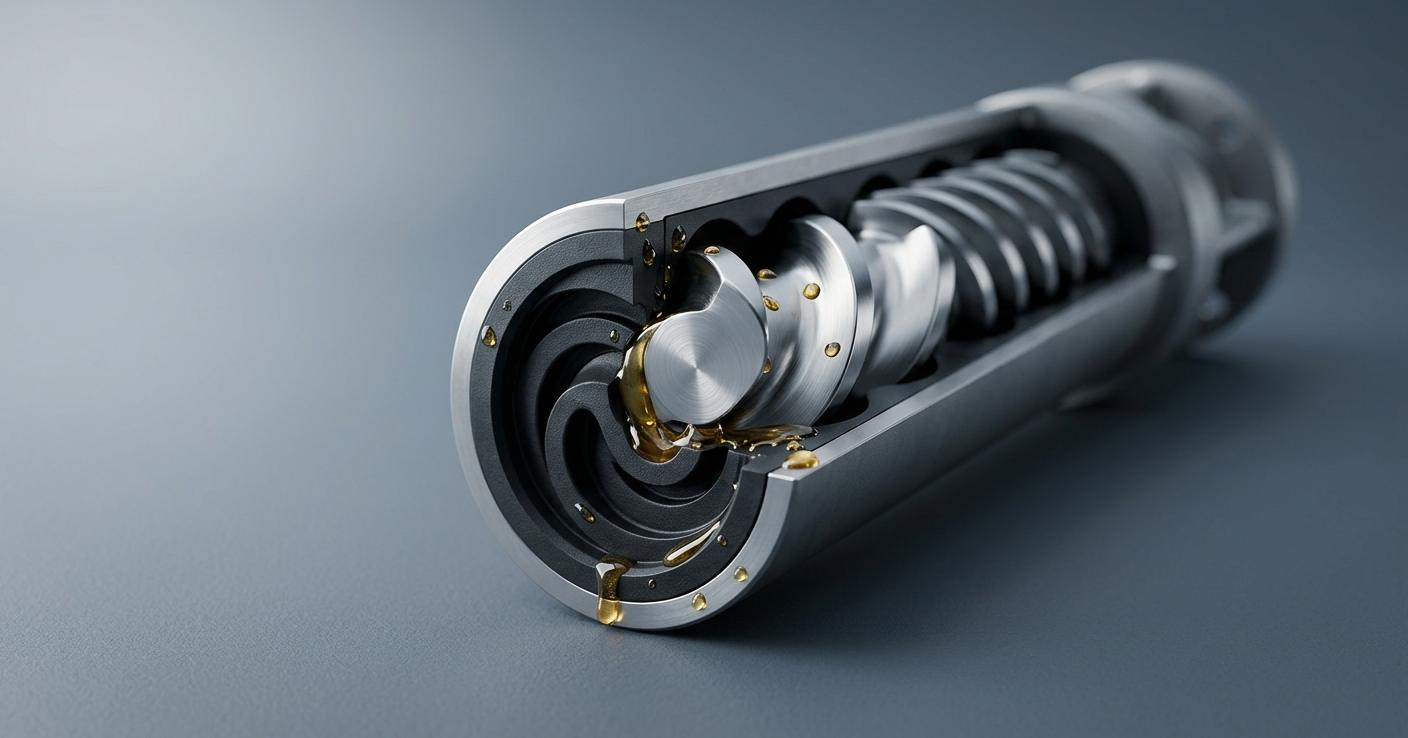
An eccentric screw pump — often called a progressive cavity pump — is a type of positive displacement pump that moves fluid by trapping it in sealed chambers and pushing it steadily from inlet to outlet. Unlike centrifugal pumps that spin fluid to generate flow, this design physically displaces a fixed volume with each rotation.
That distinction matters enormously when you're dealing with thick slurries, shear-sensitive emulsions, or fluids loaded with solids. Centrifugal pumps struggle (or outright fail) in those scenarios. Eccentric screw pumps thrive.
You'll find them across wastewater treatment, oil and gas production, food processing, chemical manufacturing, and mining operations — anywhere viscous fluid handling is a daily challenge rather than an occasional inconvenience.
The Working Principle Behind Eccentric Screw Pumps
Rotor-Stator Interaction Explained
The heart of the pump is a deceptively simple pairing: a single helical rotor turning inside a double-helix stator. The rotor is typically a metal screw with a single lobe, while the stator is an elastomer sleeve with a cavity shaped like a double helix — always one more lobe than the rotor.
Think of it like threading a corkscrew through a flexible rubber tube that has its own internal twist. As the rotor turns, the geometry creates a series of sealed cavities between rotor and stator surfaces. This rotor stator interaction is what makes the entire design work.
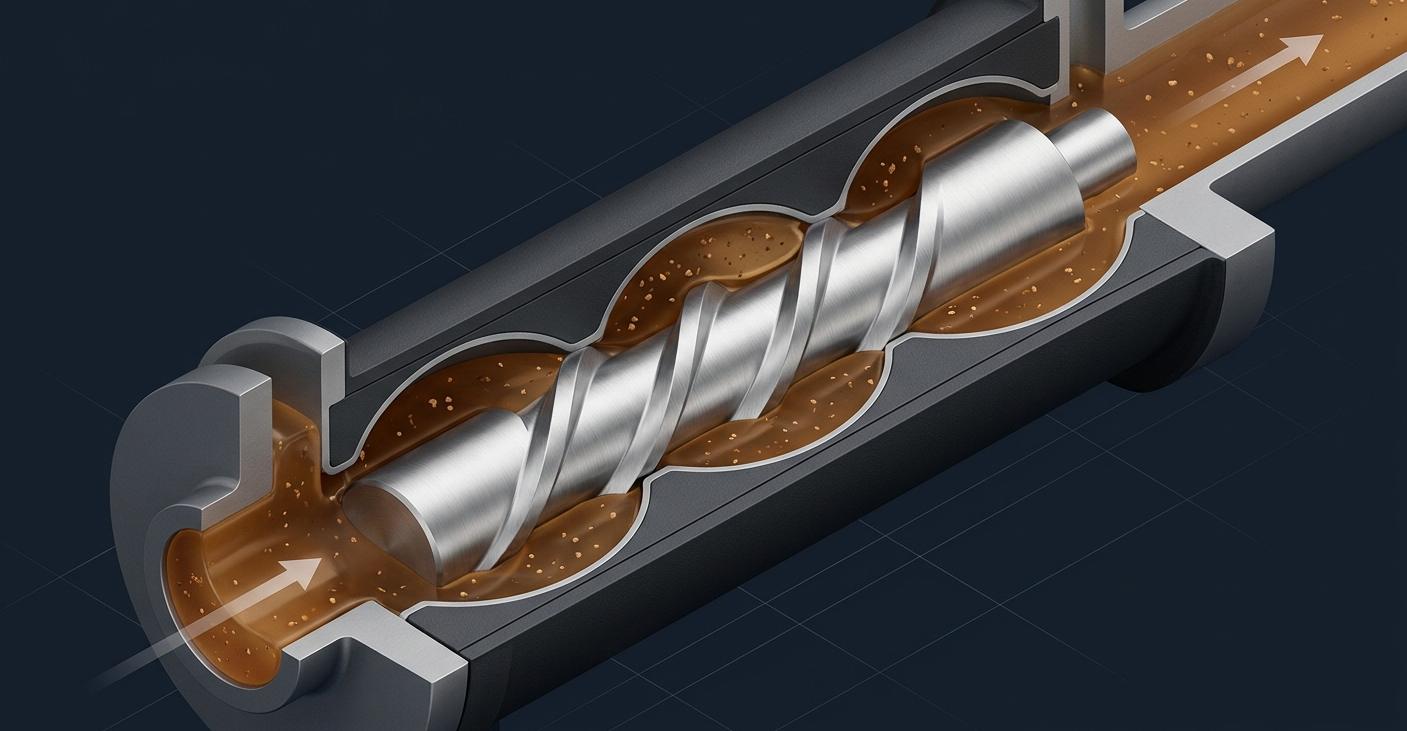
These cavities don't just sit there — they move. Each sealed pocket travels continuously from the suction end to the discharge end, carrying fluid with it. No valves, no check mechanisms, just geometry doing the work.
How Fluid Moves Through the Pump
Here's the step-by-step fluid displacement process:
- Cavity formation at suction: As the rotor turns, an opening forms at the inlet end, creating a low-pressure zone that draws fluid in.
- Sealed volumes trap the fluid: The rotor-stator contact lines close off the cavity, isolating a discrete volume of fluid.
- Continuous axial movement: The sealed pocket progresses along the pump's axis toward the discharge port as the rotor continues rotating.
- Steady, non-pulsating output: Because multiple cavities exist simultaneously at different stages of progression, the discharge flow is remarkably smooth.
This last point is a big deal. Many positive displacement pump designs produce pulsating flow. The progressive cavity pump delivers near-constant output, which reduces pipe stress and makes downstream process control much simpler.
The Role of Eccentric Motion
The word "eccentric" isn't just a name — it describes the fundamental motion that makes cavity sealing possible. The rotor doesn't spin on a central axis like a drill bit. Instead, its centerline traces an orbital path, offset from the stator's central axis.
This offset rotation allows the rotor's helical form to maintain continuous sealing contact with the stator at multiple points simultaneously. The relationship between rotor pitch (the distance for one full helical revolution) and stator geometry directly determines the volume of each cavity — and therefore the pump's output per revolution.
Longer pitch equals larger cavities and higher flow per RPM. Shorter pitch enables higher pressure capability per stage but reduces volume per turn. It's a core trade-off in helical rotor design that engineers balance based on application needs.
Key Design Features of Eccentric Screw Pumps
Helical Rotor Geometry
Rotors are precision-machined components, typically manufactured from hardened steel with a chrome-plated finish for wear resistance. Stainless steel versions serve corrosive environments, while tool steel rotors handle highly abrasive media.
Most standard eccentric screw pumps use a single-lobe rotor (one helical thread) paired with a two-lobe stator. Multi-lobe configurations (2:3 or 3:4 rotor-to-stator ratios) exist for applications requiring higher pressure per stage or reduced pulsation, though they're less common due to manufacturing complexity.
Surface finish matters more than you might expect. A rougher rotor surface increases friction against the elastomer, generating heat and accelerating wear. Chrome plating serves double duty — providing both hardness and a low-friction surface.
Stator Construction and Elastomer Selection
The stator is where most of the engineering nuance lives. It's an elastomer molded (or bonded) inside a steel tube, and the material choice directly dictates pump life in a given application.
Common elastomer options include:
- NBR (Nitrile): General-purpose, good for petroleum-based fluids and moderate temperatures.
- EPDM: Excellent chemical resistance for water-based fluids, acids, and alkalis.
- Viton (FKM): High-temperature and aggressive chemical resistance.
- HNBR: Enhanced temperature and abrasion resistance over standard nitrile.
The stator fits over the rotor with a slight interference — meaning it's dimensionally tighter than the rotor. This compression creates the seal between cavities. Too much interference and the pump runs hot; too little and it leaks internally, killing volumetric efficiency.
Seal and Bearing Arrangements
Shaft sealing typically uses mechanical seals for clean fluids or packed glands (with flush systems) for abrasive applications. The eccentric motion of the drive shaft creates radial loads that standard bearings aren't designed for, so pump designs incorporate heavy-duty bearing arrangements specifically rated for oscillating loads.
Recent advancements in ceramic and silicon carbide seal faces have extended service intervals significantly in abrasive slurry applications where traditional carbon-graphite faces wore rapidly.
Drive Configurations
Transferring rotary motion from a conventional motor shaft to an eccentrically orbiting rotor requires a flexible coupling mechanism. The three main approaches:
- Universal joint (cardan joint): Most common, handles the angular offset between drive shaft and rotor.
- Connecting rod assembly: Used in larger pumps, provides robust eccentric motion transfer.
- Direct drive with gearbox: Reduces speed from motor RPM to the 100–500 RPM operating range typical for these pumps.
The coupling is a wear item and a maintenance consideration. Misalignment or worn joints introduce vibration that propagates through the entire pump assembly.
Performance Characteristics at a Glance
| Parameter | Typical Range |
|---|---|
| Flow Rate | 0.1 – 500 m³/h |
| Max Pressure | Up to 48 bar (single pump) |
| Viscosity Handling | 1 – 1,000,000 cP |
| Solids Content | Up to 40% by volume |
| Temperature Range | -20°C to +180°C |
| Speed Range | 100 – 500 RPM |
| Volumetric Efficiency | 85% – 95% |
A few things worth noting here. The pressure figure of 48 bar applies to a single pump — staging multiple units in series can push well beyond that. Viscosity handling across six orders of magnitude is rare among pump families. And volumetric efficiency in the 85–95% range means what you put in is very close to what comes out, with minimal internal recirculation or slip.
For practical decision-making: if your fluid is thicker than honey and loaded with grit, these numbers should tell you this pump was designed for exactly that scenario.
Eccentric Screw Pump vs. Other Positive Displacement Pumps
| Feature | Eccentric Screw | Gear Pump | Lobe Pump | Diaphragm Pump |
|---|---|---|---|---|
| Viscous Fluid Handling | Excellent | Good | Good | Moderate |
| Solids Tolerance | High | Low | Moderate | High |
| Flow Pulsation | Very Low | Low | Moderate | High |
| Self-Priming | Yes | Limited | Limited | Yes |
| Shear Sensitivity | Low shear | High shear | Moderate | Low shear |
| Maintenance Complexity | Moderate | Low | Low | Moderate |
The eccentric screw pump wins decisively when your application combines high viscosity, solids content, and a need for smooth flow. Gear pumps are simpler but can't handle solids without rapid wear. Lobe pumps work well in hygienic applications but produce more pulsation. Diaphragm pumps tolerate solids and provide low shear, but their pulsating output and limited viscosity range narrow their suitability.
If your fluid would clog a gear pump, destroy a centrifugal impeller, or pulsate unacceptably through a diaphragm pump — the progressive cavity pump is likely your answer.
Common Applications Across Industries
Wastewater and Sludge Treatment
Municipal and industrial wastewater plants rely on eccentric screw pumps for primary sludge, thickened waste-activated sludge, and polymer dosing. The combination of high solids tolerance and gentle, low-shear pumping preserves floc structure — critical for downstream dewatering efficiency.
Oil and Gas — Crude and Multiphase Transfer
In upstream production, these pumps handle heavy crude, produced water with sand content, and multiphase mixtures. Their self-priming capability is particularly valuable at wellheads where suction conditions are unpredictable. Downhole progressive cavity pumps (driven by rod strings from surface) are a specialized variant used for artificial lift in heavy oil wells.
Food and Beverage Processing
Fruit purees, chocolate, meat emulsions, yogurt, and dough — all benefit from the low-shear, steady-flow characteristics. Sanitary designs with quick-disassembly features and FDA-compliant elastomers make these pumps CIP-ready for hygienic processing lines.
Chemical and Pharmaceutical Manufacturing
Precise dosing of viscous polymers, adhesives, paints, and pharmaceutical slurries demands the volumetric accuracy that positive displacement technology provides. The near-linear relationship between speed and flow rate simplifies process control considerably.
Mining and Mineral Processing
Tailings transfer, reagent dosing, and mineral concentrate pumping present extreme abrasion challenges. Heavy-duty rotor coatings and abrasion-resistant stator compounds (often HNBR or polyurethane) extend service life in these punishing environments.
Maintenance Considerations and Lifespan Optimization
Stator Wear — The Primary Wear Component
The stator elastomer is the component you'll replace most often. It's a deliberate design philosophy — concentrate wear on a replaceable, relatively inexpensive part rather than on precision-machined metal components.
Signs of stator degradation include reduced flow at constant speed (increased internal slip), higher motor current draw, and visible chunks of elastomer in the pumped fluid. Expected replacement intervals vary enormously — from a few months in highly abrasive mining slurries to several years in clean polymer applications.
The single fastest way to destroy a stator is running the pump dry. Without fluid lubrication, friction generates extreme heat that vulcanizes and tears the elastomer within minutes.
Rotor Inspection and Replacement
Rotor wear manifests as loss of chrome plating, scoring, and diameter reduction. Minor surface damage can sometimes be addressed by re-chroming, but once the base metal is significantly worn or scored, full replacement is the only option.
Inspect rotors at every stator change. A worn rotor installed with a new stator will accelerate stator degradation and waste the investment in the new part.
Best Practices for Extended Service Life
- Never run dry: Install dry-run protection (current monitoring, temperature sensors, or flow switches).
- Manage speed: Lower RPM reduces heat generation and extends stator life dramatically. Size the pump to operate at the lower end of its speed range.
- Verify fluid compatibility: Test elastomer samples with the actual process fluid before specifying a stator material.
- Check alignment regularly: Misalignment between drive and pump introduces vibration and accelerates coupling and bearing wear.
- Follow proper startup procedures: Ensure the pump cavity is wetted before starting. Use a suction flooded arrangement where possible.
Frequently Asked Questions (FAQ)
What makes an eccentric screw pump different from a standard screw pump?
A standard screw pump (such as a twin-screw or triple-screw pump) uses multiple intermeshing metal screws rotating on parallel axes. An eccentric screw pump uses a single helical rotor orbiting eccentrically inside an elastomer stator. The single-rotor progressive cavity design handles solids and abrasives that would damage the tight metal-to-metal clearances of multi-screw pumps, though multi-screw designs offer higher pressure capability in clean-fluid applications.
Can eccentric screw pumps run dry?
Standard designs cannot run dry without damage. The pumped fluid lubricates the rotor-stator interface, and dry running causes rapid heat buildup that destroys the elastomer stator — sometimes in under a minute. However, some manufacturers offer dry-run-tolerant designs with specialized stator materials or integrated lubrication systems. These come at a cost premium and still shouldn't be operated dry as a normal condition.
What viscosity range can an eccentric screw pump handle?
These pumps handle fluids from 1 cP (water-like) up to 1,000,000 cP (thick paste-like materials). At the low end, water and light solvents are pumped easily. In the middle range, you'll find paints, syrups, and sludges. At the extreme high end, think materials like bitumen, heavy grease, or concentrated food pastes that barely flow under gravity.
How do I choose the right stator material?
Three factors drive the decision: chemical compatibility with the pumped fluid, operating temperature, and abrasion resistance requirements. NBR works for petroleum-based fluids below 100°C. EPDM suits water-based chemicals and higher pH fluids. Viton handles aggressive chemicals and temperatures up to 180°C. For abrasive slurries, HNBR or specialized compounds provide the toughness needed. Always validate with immersion testing in the actual process fluid.
What causes premature failure in eccentric screw pumps?
The top five causes are: dry running (stator destruction from heat), excessive discharge pressure (stator deformation and blowout), incorrect elastomer selection (chemical attack or swelling), shaft misalignment (accelerated bearing and coupling wear), and over-speeding (heat generation exceeding the elastomer's thermal tolerance). Most premature failures trace back to installation or operational errors rather than manufacturing defects.
Are eccentric screw pumps suitable for hygienic applications?
Yes. Purpose-built sanitary versions feature polished rotor surfaces (Ra ≤ 0.8 µm), FDA-compliant and EU 1935/2004-approved elastomers, clamp-type connections, and CIP/SIP capability. These designs are widely used in dairy, beverage, pharmaceutical, and personal care manufacturing. Look for models with 3-A Sanitary Standards or EHEDG certification for validated hygienic performance.
Choosing the Right Eccentric Screw Pump for Your Application
Selecting the right pump comes down to matching the machine's capabilities to your specific process demands. The critical selection criteria are:
- Fluid viscosity and behavior: Newtonian vs. shear-thinning vs. shear-thickening fluids behave differently and affect sizing.
- Solids content, size, and hardness: Determines rotor coating and stator material requirements.
- Chemical compatibility: Drives elastomer and metallurgy selection.
- Required flow rate and discharge pressure: Defines pump size, speed, and number of stages.
- Temperature: Constrains elastomer options and may require thermal management.
- Installation constraints: Available footprint, suction conditions, and drive arrangement preferences.
Manufacturer sizing tools and application engineers exist for a reason — use them. The rotor-stator geometry matching is precise enough that a pump sized slightly wrong will either underperform or wear prematurely. Provide accurate fluid data (viscosity at pumping temperature, specific gravity, solids particle size distribution) and let the engineering team recommend the optimal configuration.
The eccentric screw pump isn't the right answer for every fluid-handling challenge. But when the fluid is thick, loaded with particulates, shear-sensitive, or all three at once, few other technologies come close to matching its combination of reliability, efficiency, and gentle handling.