
A gear pump rated for 250 bar continuous will scorch its own gears inside 800 operating hours if you drop it into a 40-ton truck crane running Gulf-summer ambient without correcting suction line diameter and viscosity. That single specification mismatch — not manufacturing defect — accounts for the majority of "warranty" returns we see on crane hydraulic pump replacements. This guide walks procurement engineers, fleet leads, and system designers through the parameters that actually determine whether a replacement pump survives its duty cycle or fails before the first oil change.
Key Takeaways
- Pressure envelope: Most crane auxiliary and boom circuits demand 210–320 bar continuous with 20–30% peak headroom for shock loading during load pickup.
- Displacement is derived, not guessed: Back-calculate from cylinder volume, target cycle time, and available PTO RPM — never copy the nameplate blindly.
- Four spec parameters cause ~90% of failures: wrong rotation direction, mismatched flange/shaft, undersized suction line, and ignored oil cleanliness class.
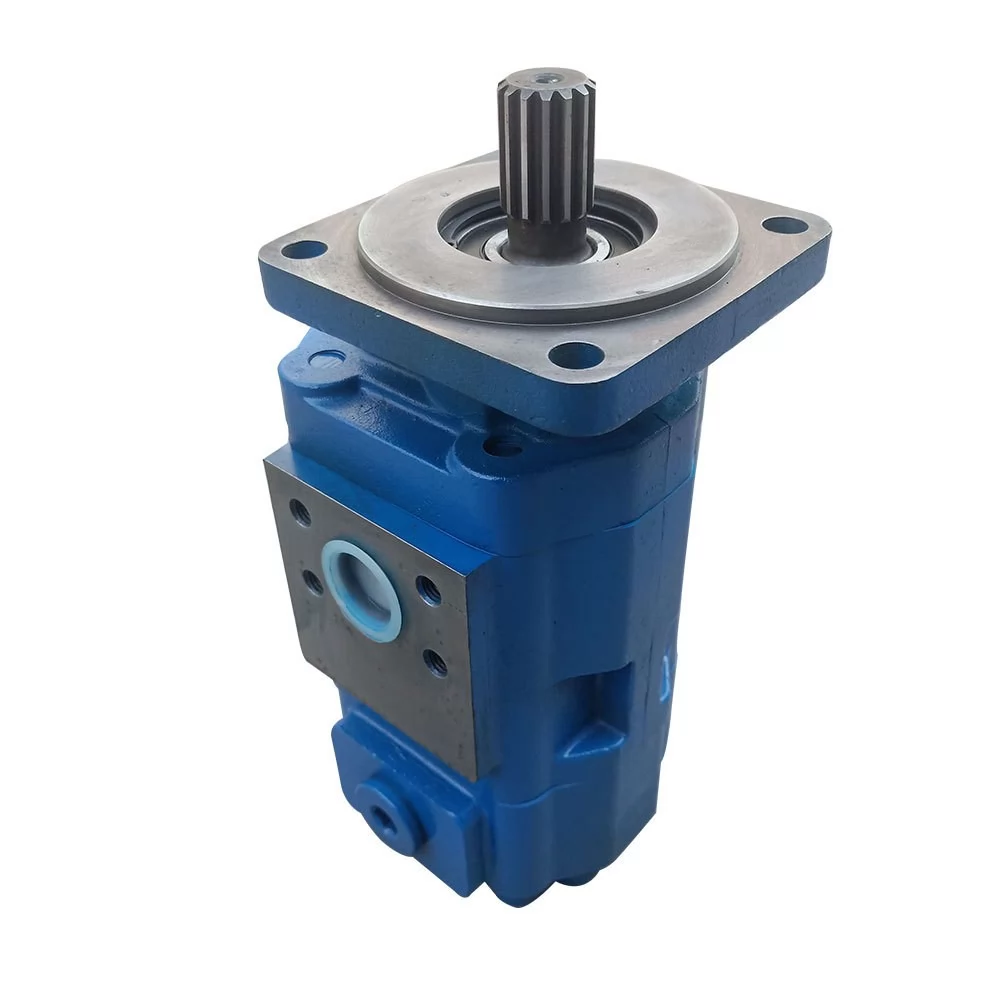
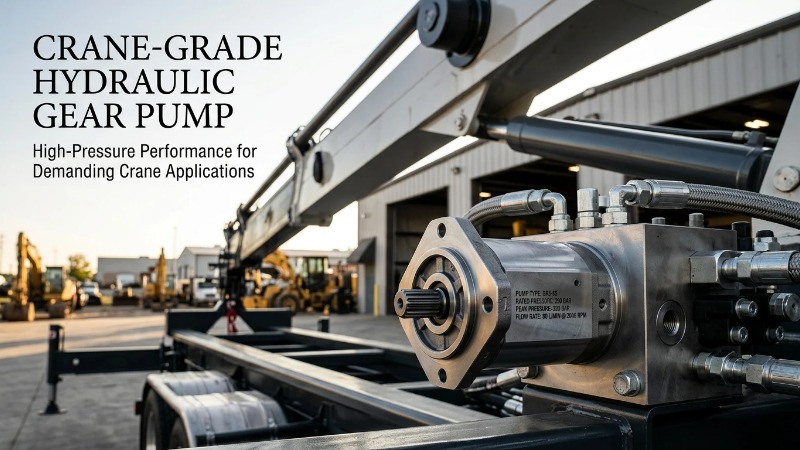
- For mobile crane booms: the CBHZ series (25–125 cc/rev, 250 bar continuous) is the standard-fit gear pump for truck-mounted crane boom extension circuits.
- MTBF reality: Properly filtered systems (ISO 4406 18/16/13) reach 6,000–10,000 hours; contaminated circuits fail below 1,500 hours.
Why Gear Pump Selection Decides Crane Uptime
The Hidden Cost of a Mis-Spec'd Pump
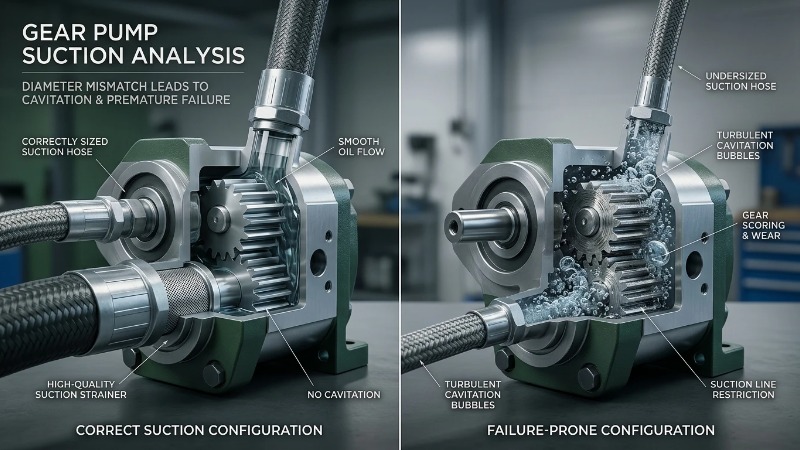
A wrong-displacement or under-rated pump doesn't announce itself with a dramatic failure. It starves the boom cylinder by two seconds per extension cycle, quietly pushes reservoir temperature past 75°C, and degrades volumetric efficiency until the operator complains about lift speed. By the time cavitation-driven gear scoring shows up in the oil sample, the pump is already terminal — and the crane has been off-hire for a week.
The pattern repeats across regions. In high-ambient Gulf climates, undersized suction ports combined with ISO VG 46 fluid (when VG 68 was appropriate) routinely destroy replacement pumps within the first quarter of expected service life. The root cause is almost never the pump itself.
Who This Guide Is For
Procurement engineers cross-referencing OEM part numbers against factory-direct alternatives. Fleet maintenance leads planning MTBF-driven overhaul intervals. Design engineers integrating replacement pumps into legacy crane hydraulic circuits where documentation is incomplete or lost.
Hydraulic Gear Pump Fundamentals for Lifting Applications
How an External Gear Pump Generates Lifting Pressure
Two meshing gears rotate inside a close-tolerance housing. Fluid trapped between gear teeth and the housing wall is carried from suction to discharge, where the meshing action forces displacement. What matters for cranes: this geometry produces near-constant flow regardless of downstream pressure, and tolerates the shock spikes that occur when a suspended load lands or a boom section catches.
Gear Pump vs. Piston Pump in Crane Circuits
Gear pumps dominate auxiliary circuits, outrigger extension, swing drives, and small-to-mid mobile cranes because they are compact, contamination-tolerant, and cost a fraction of variable-displacement piston units. Axial piston pumps take over on the main winch of heavy lift cranes and on load-sensing circuits above roughly 320 bar. The honest crossover point: if the circuit needs true variable displacement or continuous operation above 300 bar, specify piston. Below that, gear pumps win on TCO.
Quick Comparison Table
| Parameter | Gear Pump | Axial Piston Pump |
|---|---|---|
| Continuous pressure | 210–320 bar | 350–420 bar |
| Volumetric efficiency | 85–92% | 92–96% |
| Contamination tolerance | High | Moderate |
| Unit cost index | 1.0x | 3–5x |
| Typical crane use | Aux, outriggers, small mobile | Main winch, heavy lift |
Core Specifications That Matter for Crane Duty
Displacement (cc/rev) and Flow Rate Matching
Required displacement is derived from cylinder swept volume, target cycle time, and pump drive speed. Worked example: a 40-ton truck crane boom cylinder with 125 mm bore and 1,800 mm stroke has a swept volume of approximately 22 liters. To extend in 12 seconds, the circuit needs about 110 LPM. At a PTO speed of 1,500 RPM and 92% volumetric efficiency, required displacement is roughly 80 cc/rev — putting this squarely in CBHZ or CBGJ territory.
Always size for actual PTO RPM, not engine RPM, and always derate by expected volumetric efficiency at operating temperature — not the ideal-condition number on the datasheet.
Working Pressure vs. Peak Pressure Ratings
Three ratings matter: continuous (24/7 duty), intermittent (short-duration operation up to ~10% duty cycle), and peak (transient spikes only). Sizing a crane pump to its nameplate peak is the fastest way to void the manufacturer's fatigue life calculation. Crane duty involves repeated shock loading — a pump specified for 250 bar continuous with 280 bar peak will handle a 250 bar working circuit; a pump rated 250 bar peak will not.
Rotation Direction, Mounting Flange, and Shaft Standards
Rotation is viewed from the shaft end. Get it wrong and the pump destroys itself in minutes. Mounting flanges follow SAE-A (2-bolt, 82.5 mm pilot), SAE-B (2- or 4-bolt, 101.6 mm pilot), and SAE-BB conventions in most North American and Asian crane OEMs, while European builders often specify DIN or ISO equivalents. Splined shafts (9T 16/32 DP for SAE-A) and keyed tapered shafts each have their place — cross-reference carefully when moving between DIN and SAE OEM platforms.
Volumetric & Mechanical Efficiency at Operating Temperature
Published efficiency numbers assume 50°C oil. Real crane operation in summer conditions runs 65–85°C, and efficiency degrades measurably.
| Oil Temperature | Cast-Iron Body Volumetric Efficiency | Aluminum Body Volumetric Efficiency |
|---|---|---|
| 50°C | 91% | 89% |
| 70°C | 87% | 83% |
| 85°C | 82% | 76% |
For sustained high-ambient duty, specify cast-iron body construction and size displacement with the hot-oil efficiency in mind.
Common Gear Pump Series Used on Cranes
CBHZ Series — High-Pressure Boom Applications
Displacement from 25 to 125 cc/rev, 250 bar continuous with 280 bar peak. This is the workhorse for truck-mounted crane boom extension circuits and mid-range mobile lifting. Cast-iron body construction and generous bearing area suit the shock loading pattern of boom work.
HGP, CBK, and CB-FC Series — Auxiliary and Multi-Section Configurations
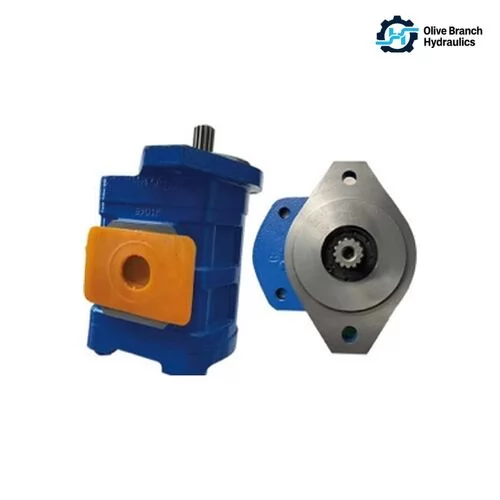
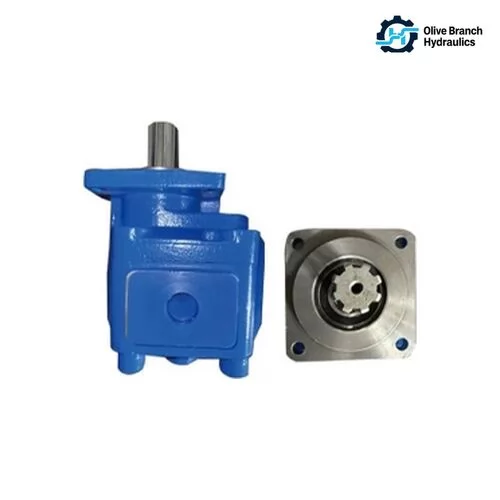
Multi-section (tandem) pumps make sense when a crane needs simultaneous outrigger extension, swing motor drive, and boom actuation off a single PTO shaft. CB-FC handles the higher-flow sections; CBK sits well on outrigger and swing circuits; HGP fills small auxiliary roles at 1–22 cc/rev.
JHP, CBGJ, CBT — Compact and Heavy-Duty Variants
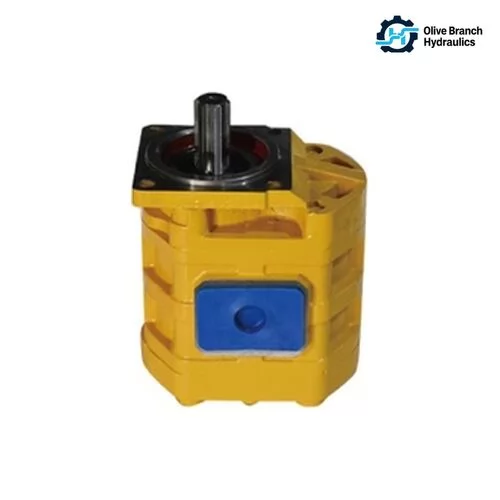
JHP is the compact-envelope choice for space-constrained mobile units. CBGJ and CBT cover continuous-duty industrial cranes, gantry systems, and shop overhead cranes where run-time hours per year far exceed mobile duty.
Series Selection Matrix
| Series | Displacement (cc/rev) | Max Pressure (bar) | Typical Crane Type |
|---|---|---|---|
| CBHZ | 25–125 | 250 continuous / 280 peak | Truck crane boom |
| HGP | 1–22 | 210 | Aux circuits, small mobile |
| CBK | 4–63 | 250 | Outrigger, swing |
| CB-FC | 40–125 | 210 | Multi-section duty |
| JHP | 4–50 | 250 | Compact mobile |
| CBGJ | 40–125 | 250 | Industrial / gantry |
| CBT | 6–80 | 210 | General crane aux |
Cross-Referencing OEM Part Numbers for Replacement
Reading the OEM Nameplate
Before contacting any supplier, record: displacement code (cc/rev), rotation direction viewed from shaft end, port configuration (SAE flange vs. BSPP or metric threaded), shaft profile (splined tooth count and DP, or key dimensions), and mounting bolt pattern with pilot diameter. A photograph of the nameplate plus a clean shot of the mounting face saves 48 hours of email back-and-forth.
Compatibility with Kawasaki, Rexroth, and Parker Reference Designs
OEM-compatible replacement pumps are engineered to match port-to-port dimensions, mounting bolt patterns, and shaft profiles of common crane OEM units so they drop in without modifying brackets, hoses, or drive couplings. The critical tolerances are pilot diameter (±0.05 mm), bolt-hole positional tolerance, and shaft concentricity relative to the pilot.
Custom P/T Port Configurations
Retrofit jobs often fail on hose routing, not on pump performance. Specifying custom pressure and tank port orientation — 90°, 180°, or side-outlet — during the OEM customization phase eliminates costly hose rerouting and hard-line refabrication on the crane chassis.
Duty Cycle, MTBF, and Maintenance Planning
Defining Crane Duty Cycle Classes
A tower crane on a construction site may run 10–14 hours per day at moderate load; a rough-terrain mobile crane may accumulate only 2–3 pump-load hours per shift but sees higher shock frequency. Expected service life scales with both hours and shock events, not hours alone.
Realistic MTBF Expectations
Gear pumps in properly filtered crane circuits maintained to ISO 4406 cleanliness class 18/16/13 or better commonly reach 6,000–10,000 operating hours before rebuild. Systems running dirty oil — visible discoloration, particle counts above 20/18/15 — routinely fail below 1,500 hours regardless of pump brand or price point.
Preventive Maintenance Intervals
- Oil sampling every 500 operating hours; track particle count trends, not just single readings.
- Filter element replacement per OEM schedule, halved for high-dust Middle East and mine-site environments.
- Annual pressure test at rated flow; any drop exceeding 8% from commissioning baseline warrants internal inspection.
- Suction strainer cleaning every 1,000 hours minimum.
Integrating a Replacement Pump Into an Existing Crane Circuit
Pre-Installation Checklist
Flush the reservoir and cooler before installation. Inspect the suction strainer — a collapsed mesh will kill the new pump within days. Measure inlet vacuum with the old pump still running if possible; anything worse than −0.3 bar indicates a suction restriction that must be resolved first. Confirm the main relief valve setting matches the new pump's continuous rating, not its peak.
Commissioning and Break-In
Run the pump at idle with the relief valve backed off for the first 10 minutes to prime and purge air. Stage pressure ramp-up in three steps to full working pressure over the first operating hour. Monitor case temperature and reservoir temperature continuously. Pull an initial oil sample at 50 hours to catch break-in wear metals.
Verifying Performance Against Load Chart
Measure actual flow at rated PTO RPM using an in-line flow meter. Deviation exceeding 5% from spec-sheet flow indicates internal leakage, drive coupling slip, or a suction problem — not necessarily a defective pump. Diagnose before returning.
Common Mistakes & Best Practices
Under-Sizing Suction Line Diameter
The single most common root cause of premature gear pump failure on retrofit projects. Suction line inside diameter should keep fluid velocity below 1.2 m/s. Sharing suction lines between multiple pumps or reusing an undersized line from a smaller original pump is a guaranteed cavitation event.
Ignoring Ambient Temperature Range
Viscosity selection is regional. ISO VG 68 or VG 100 for Gulf, Saudi, and equatorial Southeast Asia deployments; ISO VG 46 as a general-purpose grade; VG 32 or blended hydraulic fluids for Northern European winter operation. A single "universal" fluid does not exist for global crane fleets.
Mixing Hydraulic Fluids
Viscosity grade mismatches and additive package incompatibilities destroy seals and generate varnish deposits within weeks. Always drain-and-refill when changing fluid grades; do not top up across grades or brands.
Skipping Contamination Control
Filtration investment returns more service life per dollar than any other maintenance category in crane hydraulics. Beta-rated filters (β10 ≥ 200) at return and off-line kidney-loop filtration for continuous-duty applications are worth every unit of cost.
Total Cost of Ownership: OEM vs. Factory-Direct
Unit Cost, Freight, and Lead Time
Factory-direct sourcing of OEM-compatible pumps typically reduces landed unit cost by 30–50% versus OEM dealer channels, with 2–4 week lead times on standard configurations and 4–8 weeks on custom port or shaft variants. Freight adds a predictable 8–12% for containerized ocean shipping to Europe, the Gulf, and Southeast Asia.
Warranty, Testing Documentation, and Traceability
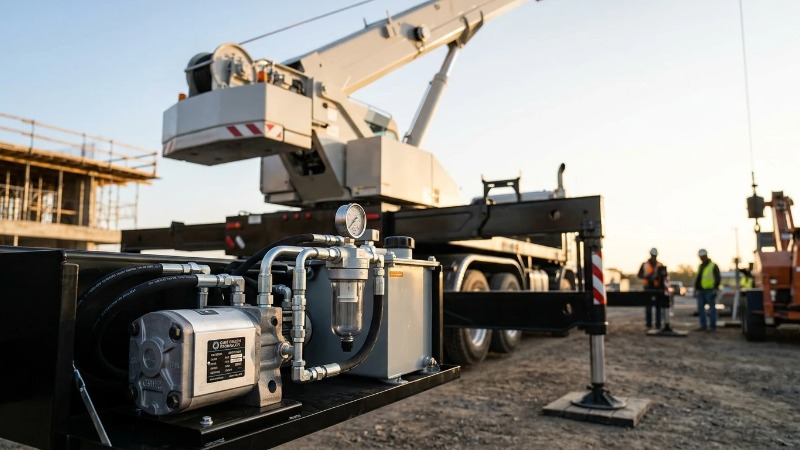
Serious buyers require: ISO 9001 quality-system certification, individual pressure and flow test reports for each unit shipped, leak-test verification, and material traceability certificates for housing and gear stock. Anything less introduces field-failure risk that erases the up-front savings.
5-Year TCO Scenario
| Cost Component | OEM Dealer Sourcing | Factory-Direct OEM-Compatible |
|---|---|---|
| Initial unit cost (index) | 1.0x | 0.55x |
| Freight & duties | Included | Add 8–12% |
| Installation labor | Equal | Equal |
| Expected service life | 8,000 hrs | 7,500–8,000 hrs |
| Replacement frequency (5 yr) | 1 unit | 1 unit |
| Indexed 5-year TCO | 1.0x | 0.62x |
Frequently Asked Questions
What pressure rating do I need for a mobile crane hydraulic gear pump?
Most mobile crane boom and outrigger circuits require 210–250 bar continuous rating with 280 bar peak capacity to absorb load-pickup shock. Heavier truck cranes and telescopic boom applications may require up to 320 bar continuous. Always match the pump's continuous rating to the circuit's relief valve setting, never to its peak.
Can I replace a Kawasaki K3V pump with a gear pump?
No. The K3V is a variable-displacement axial piston pump used on main circuits requiring load sensing and high pressure. Gear pumps are only appropriate substitutes on auxiliary functions — outriggers, swing, fan drives, or pilot circuits — not on the main winch or boom telescoping of pumps originally specified as K3V-class.
How do I know if my crane hydraulic pump is failing?
Watch for slow boom extension or lift speed at rated engine RPM, reservoir oil temperature climbing 10°C or more above historical baseline, audible whining or growling under load, visible external leakage at shaft seal or port faces, and pressure drop exceeding 8% during annual test. Multiple symptoms together indicate imminent failure.
What's the difference between CBHZ and CBGJ gear pumps?
CBHZ is optimized for mobile crane boom duty with 250 bar continuous / 280 bar peak ratings, tolerating the shock cycles of intermittent lifting. CBGJ suits industrial and gantry cranes where continuous-duty run hours dominate — similar displacement range, comparable pressure ceiling, different bearing and seal specification for sustained operation.
How long does a hydraulic gear pump last in crane service?
With ISO 4406 18/16/13 fluid cleanliness, correct viscosity for ambient conditions, and adequate suction geometry, expect 6,000–10,000 operating hours before rebuild. Contaminated systems or those running incorrect viscosity commonly fail below 1,500 hours. Service life is a function of maintenance discipline, not brand badge.
Do you offer OEM customization for crane manufacturers?
Yes. Olive Branch Hydraulics supports OEM programs with custom displacement builds, port orientation (SAE flange or threaded, 90°/180°/side-outlet), shaft profile (splined or keyed to customer print), and mounting flange adaptation for European DIN or North American SAE crane platforms. Sample units for fitment validation are available on standard series before production commitment.
Conclusion & Next Step
What to Do Before You Order
- Document the failed pump's nameplate: displacement, rotation, port configuration, shaft profile, and mounting bolt pattern — a clear photograph is sufficient.
- Confirm circuit pressure and flow requirements against the crane's load chart and hydraulic schematic, not against the old pump's rating alone.
- Request a spec-match review with test-bench data before committing to the order, particularly for retrofit or cross-brand replacement scenarios.
Request a Technical Consultation
Send your crane pump specifications or a photograph of the existing nameplate to Olive Branch Hydraulics for a same-week cross-reference, sample availability check, and OEM-customization quote. Every gear pump — CBHZ, HGP, CBK, CB-FC, JHP, CBGJ, CBT — ships with individual test-bench documentation covering pressure, flow, and leak verification under ISO 9001 protocol. 100% pre-shipment inspection. No exceptions.