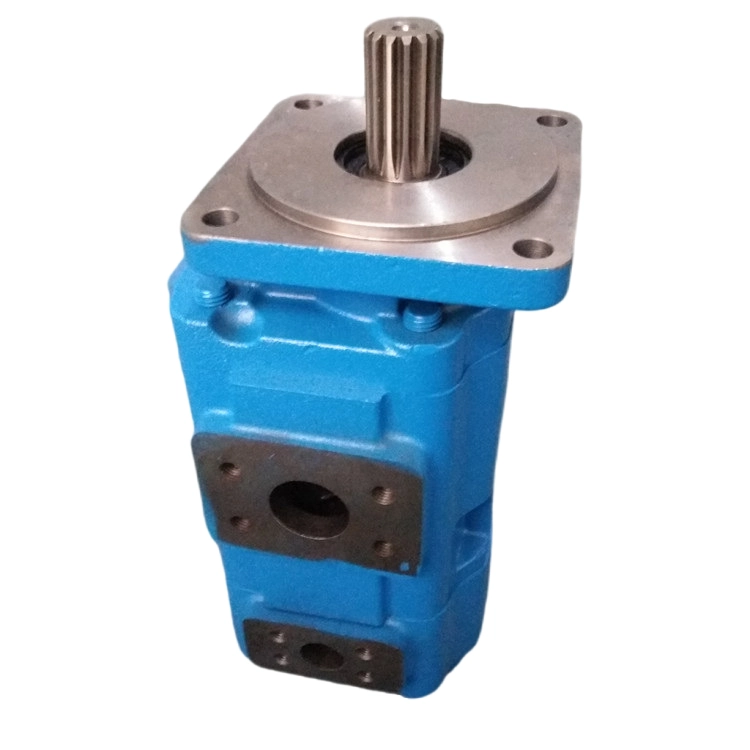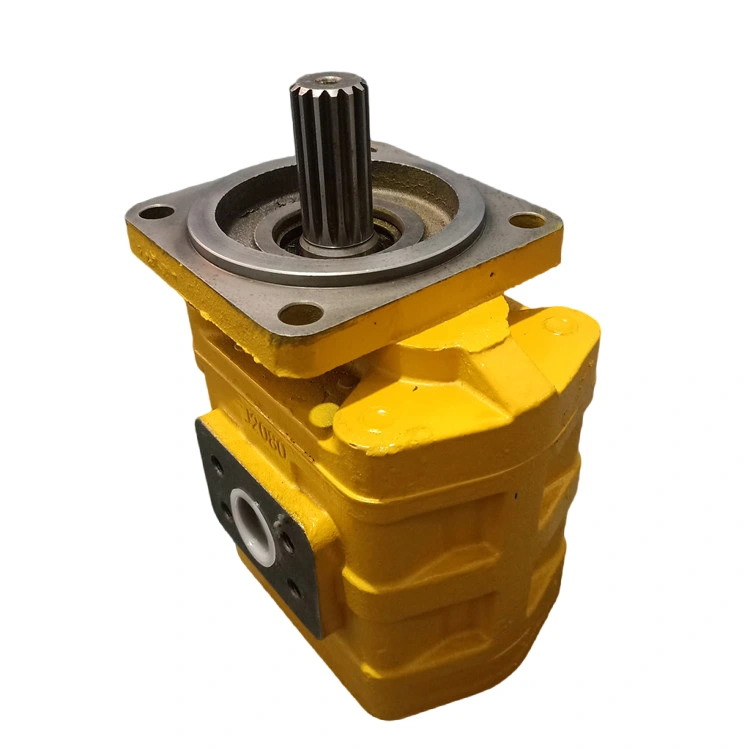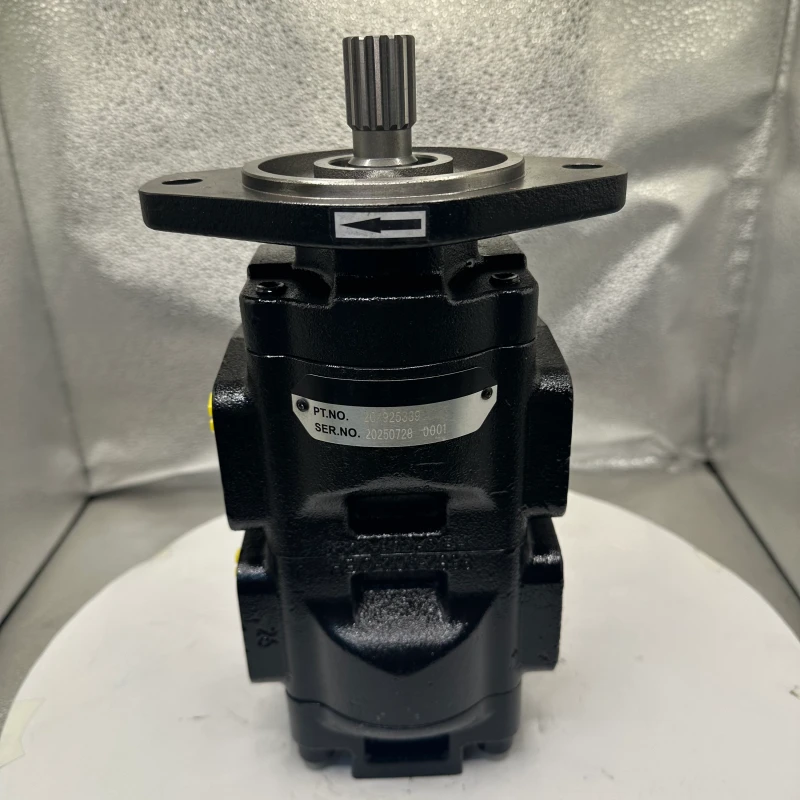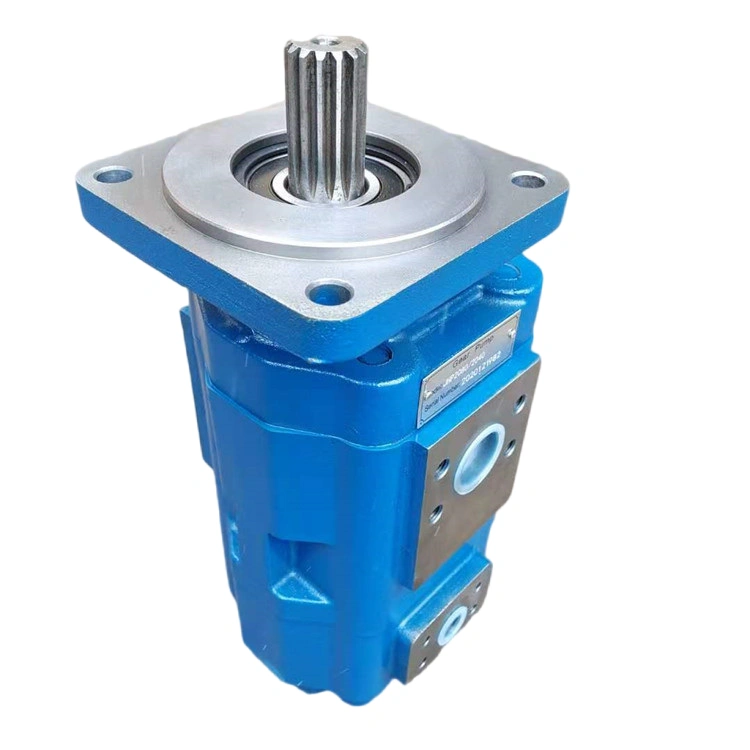
Every hour of downtime on a CAT excavator or loader costs operators $150–$500+ in lost productivity. The gear pump — often overlooked — is the heartbeat of the caterpillar hydraulic pump system. It drives pilot circuits, powers steering, transfers fuel, and keeps hydraulic fluid moving under pressure. Choosing the right replacement or upgrade determines whether your machine runs another 8,000 hours or fails mid-cycle.
This guide covers everything you need to know about CAT gear pump replacement: how these pumps work, which caterpillar pump part number fits your machine, how to diagnose failure, and where to source high-quality alternatives that match or exceed OEM specifications.
What Is a Caterpillar Gear Pump and How Does It Work
Core Operating Principle
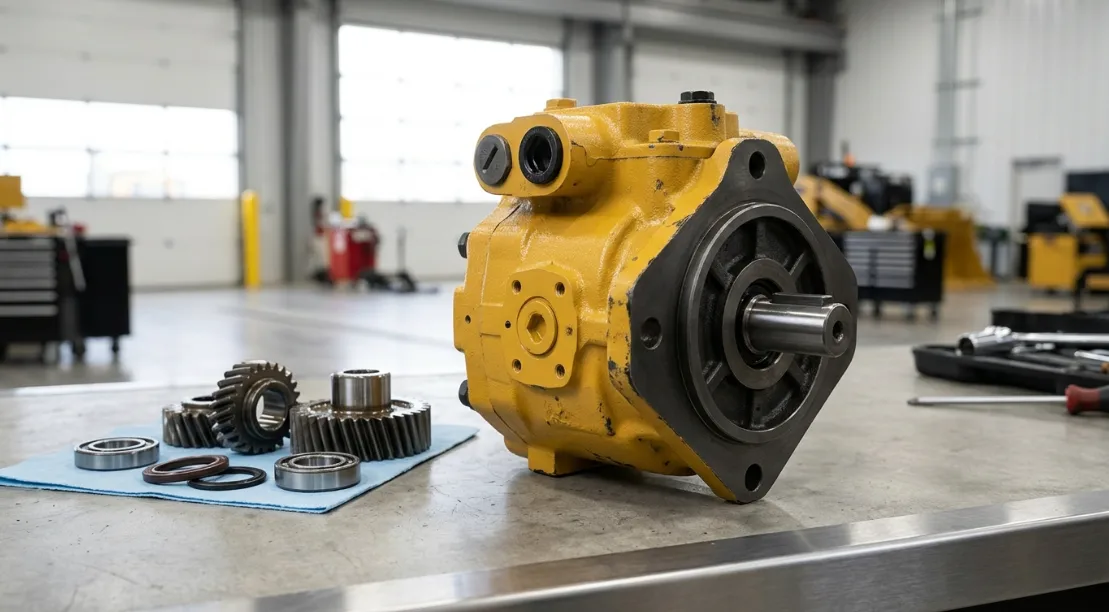
A caterpillar gear pump is a positive-displacement device that delivers a fixed volume of hydraulic fluid with every shaft revolution. Two precision-machined gears — a drive gear and a driven gear — mesh inside a tightly toleranced housing, trapping fluid between the gear teeth and the casing wall, then carrying it from the inlet port to the outlet port.
Because output volume is fixed per revolution, flow rate scales linearly with RPM. This predictability makes gear pumps ideal for circuits requiring consistent, reliable flow — pilot systems, charge pumps, and fuel transfer applications across the CAT equipment lineup.
The meshing zone between gears creates a seal that prevents backflow, generating pressure differentials up to 300 bar in heavy-duty configurations. Gear tooth geometry — typically involute profile with DIN Class 6 precision — determines volumetric efficiency, noise levels, and service life.
Where Gear Pumps Sit in the Heavy Equipment Hydraulic System
In a typical CAT machine, gear pumps serve multiple roles within the broader heavy equipment hydraulic system. Understanding their placement helps diagnose issues and select correct replacements.
- Pilot circuit pump: Mounted on the main pump drive, supplies low-flow, medium-pressure oil (typically 25–35 bar) to operate control valves on excavators and dozers.
- Charge pump: Bolted to the rear of piston pumps on machines like the 320 Excavator series, replenishes closed-loop circuits and maintains case pressure.
- Caterpillar fuel transfer pump: Engine-mounted gear pump (e.g., on 3406/C15 engines) that draws diesel from the tank and delivers it to the injection system at 210–350 kPa.
- Steering pump: Dedicated gear pump on graders (140H/140M) and large loaders providing priority flow to steering orbitrol valves.
- Implement circuit pump: On wheel loaders like the 950 series, a higher-displacement gear pump powers bucket lift and tilt functions.
Each position demands specific displacement, pressure rating, and port configuration — which is why matching the correct caterpillar pump part number matters.
Gear Pump vs. Piston Pump — When CAT Uses Each
Caterpillar engineers select pump types based on circuit demands. Here's how gear pumps compare to piston pumps in real-world CAT applications:
| Parameter | Gear Pump | Piston Pump |
|---|---|---|
| Typical max pressure | 250–310 bar | 350–450 bar |
| Volumetric efficiency | 88–94% | 95–98% |
| Cost (comparable displacement) | $800–$2,500 | $4,000–$15,000+ |
| Service life | 6,000–12,000 hours | 10,000–20,000 hours |
| Contamination tolerance | Moderate (ISO 20/18/15) | Low (ISO 18/16/13 required) |
| Variable displacement | No (fixed) | Yes |
| Maintenance complexity | Low | High |
| Typical CAT application | Pilot, steering, fuel transfer, charge | Main implement, swing, travel |
CAT uses gear pumps where simplicity, cost-effectiveness, and contamination tolerance outweigh the need for variable flow or ultra-high pressure. In pilot and steering circuits, a gear pump's fixed output and mechanical simplicity translate to fewer failure modes and lower replacement costs.
Common Caterpillar Gear Pump Models and Specifications
Cross-Reference Table by Caterpillar Pump Part Number
Below are widely used caterpillar pump part numbers with their specifications. This cross-reference helps identify the correct CAT gear pump replacement for your machine series.
| CAT Part Number | Machine Series | Displacement (cc/rev) | Max Pressure (bar) | Application |
|---|---|---|---|---|
| 2P-9239 | D6/D7 Dozers | 36 | 250 | Pilot/steering |
| 9T-1696 | 320 Excavator | 28 | 280 | Charge pump |
| 2W-8084 | 950 Loader | 45 | 300 | Implement circuit |
| 6E-4796 | 3406 Engine | 19 | 210 | Fuel transfer |
| 1U-2654 | 140H Grader | 33 | 260 | Steering |
These part numbers represent some of the most frequently replaced gear pumps in the CAT fleet. Machines operating in mining and heavy construction environments typically reach replacement intervals sooner due to elevated contamination and thermal loads.
Performance Benchmarks and Flow Ratings
Rated flow specifications assume standard operating conditions — typically 2,000 RPM shaft speed and fluid temperature of 50°C. Real-world performance varies based on wear state, fluid viscosity, and system back-pressure.
| CAT Part Number | Rated Flow at 2,000 RPM (L/min) | Minimum Acceptable Flow (L/min) | Efficiency Threshold |
|---|---|---|---|
| 2P-9239 | 72 | 66 | ≥92% |
| 9T-1696 | 56 | 51 | ≥92% |
| 2W-8084 | 90 | 83 | ≥92% |
| 6E-4796 | 38 | 35 | ≥92% |
| 1U-2654 | 66 | 61 | ≥92% |
When measured flow drops below 92% of rated output at operating pressure, the pump has entered its degradation zone. Below 85%, replacement is urgent — continued operation risks cascading damage to downstream valves and actuators.
Degradation indicators to watch: rising case drain flow (above 2 L/min on most CAT gear pumps), increasing fluid temperature under constant load, and measurable cycle-time slowdowns exceeding 10% from baseline.
Signs Your CAT Gear Pump Needs Replacement
Diagnostic Symptoms Table
Catching gear pump failure early prevents catastrophic secondary damage. The following symptoms, ranked by urgency, indicate your caterpillar hydraulic pump is approaching or past its service limit.
| Symptom | Likely Cause | Urgency Level |
|---|---|---|
| Slow hydraulic response | Internal wear/leakage past gear faces | Medium-High |
| Whining or cavitation noise | Inlet restriction or gear tooth wear | High |
| Overheating hydraulic fluid | Volumetric efficiency drop below 85% | High |
| Erratic steering | Worn bushings or shaft seal failure | Critical |
| Metal particles in filter | Gear tooth damage or bushing disintegration | Critical |
| External oil leakage at pump | Shaft seal or housing gasket failure | Medium |
| Pressure fluctuations under load | Worn gear tips allowing intermittent bypass | High |
Critical-level symptoms demand immediate shutdown. Metal contamination from a failing gear pump can destroy control valves, cylinders, and motors downstream — turning a $1,500 pump replacement into a $20,000+ system overhaul.
Measuring Wear — Flow Testing Procedures
Field-testing a suspect gear pump requires a calibrated flow meter, a pressure gauge, and a load valve. Follow this procedure to quantify internal wear:
- Warm the system: Run the machine until hydraulic fluid reaches 50°C (±5°C) to standardize viscosity conditions.
- Isolate the pump circuit: Disconnect the pump output from the system and route it through your flow meter and load valve back to tank.
- Measure unloaded flow: At rated RPM (typically 2,000–2,200), record flow with zero back-pressure. This establishes your baseline.
- Load incrementally: Increase back-pressure in 50-bar steps up to rated maximum. Record flow at each step.
- Calculate volumetric efficiency: Efficiency = (Flow at rated pressure ÷ Flow at zero pressure) × 100%.
Decision thresholds: Above 92% — pump is serviceable. Between 85–92% — plan replacement within 500 hours. Below 85% — replace immediately to prevent secondary damage.
Also measure case drain flow if the pump has a drain port. New CAT gear pumps typically show 0.3–0.8 L/min case drain. Above 2.0 L/min indicates significant internal bypass.
Choosing a High-Quality Replacement — OEM vs. Aftermarket
OEM Limitations — Lead Time, Cost, and Availability
Ordering directly through Caterpillar's parts network guarantees exact-spec components, but comes with practical constraints that cost operators money:
- Lead times: Standard OEM gear pump orders typically require 4–12 weeks for delivery, depending on part number and regional warehouse stock. Discontinued models can exceed 16 weeks.
- Price premiums: OEM caterpillar hydraulic pump components carry 30–60% markups over equivalent-specification aftermarket alternatives. A pump listing at $1,800 aftermarket may cost $2,600–$2,900 through OEM channels.
- Legacy availability: Machines older than 15–20 years often face "no longer available" status on critical pump components, forcing operators into expensive system redesigns.
For a fleet operator losing $300/hour per idle machine, a 6-week wait for an OEM pump translates to pressure to accept whatever is available — sometimes at the expense of proper specification matching.
What to Look for in an Aftermarket CAT Gear Pump
Not all aftermarket gear pumps are equal. When sourcing a CAT gear pump replacement outside OEM channels, verify these critical specifications:
- Gear material: 20CrMnTi carburized alloy steel with case hardness of HRC 58–62 and core hardness of HRC 33–38. This matches OEM metallurgy for wear resistance and fatigue life.
- Gear precision: DIN Class 6 or better (equivalent to AGMA 10-11). Lower precision grades increase noise, reduce efficiency, and shorten service life.
- Bearing/bushing material: Tin-bronze or PTFE-lined composite bushings rated for the pump's maximum pressure and speed combination.
- Seal compatibility: FKM (Viton) shaft seals rated for operating temperatures up to 120°C and compatible with mineral-based hydraulic fluids and biodegradable options.
- Port geometry: Exact SAE flange size, bolt pattern, and O-ring boss dimensions matching the original caterpillar pump part number.
- Shaft specifications: Spline count, pitch diameter, and engagement length must match the PTO or coupling on your machine — even 0.05mm deviation causes premature wear.
Quality certifications matter: ISO 9001 manufacturing processes and pressure testing to 110% of rated maximum provide baseline assurance. Request test reports showing volumetric efficiency above 94% at rated conditions.
Olive Branch Hydraulics — Precision-Engineered Alternatives Built for CAT Applications
Headquartered in Xinji, Hebei — one of China's premier equipment manufacturing hubs — Olive Branch Hydraulics specializes in non-standard customization of gear pumps that match or exceed OEM caterpillar hydraulic pump specifications.
Our in-house R&D and precision machining capabilities allow us to replicate exact port geometry, displacement, and pressure ratings for CAT machines across construction, mining, and agricultural sectors. Every pump undergoes full-pressure testing and volumetric efficiency verification before shipment.
What sets our approach apart for CAT gear pump replacement:
- 50% faster lead times compared to OEM channels — most standard CAT-equivalent pumps ship within 2–3 weeks.
- Reverse-engineering capability for discontinued part numbers that OEM no longer supplies.
- 20CrMnTi gears machined to DIN Class 6 with HRC 58–62 case hardness — matching or exceeding original specifications.
- Custom port configurations available for non-standard installations or system upgrades.
- Rigorous quality control: Each pump is tested at 110% rated pressure with flow and efficiency data recorded and supplied with the unit.
We don't just manufacture parts — we solve problems. When your machine needs a gear pump that the OEM can't deliver on time, or when a legacy caterpillar pump part number has been discontinued, our engineering team works from your specifications or a sample unit to produce an exact-fit replacement.
Installation and Maintenance Best Practices
Correct Mounting and Alignment Procedures
Improper installation is the second leading cause of premature gear pump failure (after contamination). Follow these procedures to maximize service life of your CAT gear pump replacement:
- Spline engagement: Ensure minimum 75% spline engagement depth. Partial engagement concentrates load on fewer teeth, causing accelerated wear and potential shaft fracture.
- Mounting bolt torque: Tighten SAE 4-bolt flange fasteners to 45–55 Nm (Grade 8 bolts) in a cross pattern. Over-torquing distorts the pump housing and reduces internal clearances.
- Coupling alignment: Maintain angular misalignment below 0.5° and parallel offset below 0.1mm. Use a dial indicator or laser alignment tool — visual alignment is insufficient.
- Inlet plumbing: Keep suction lines short, large-diameter (minimum 1.5× port size), and free of sharp bends. Inlet restriction above 0.3 bar vacuum causes cavitation damage within hours.
- Pre-fill the pump: Before first start, fill the pump housing with clean hydraulic fluid through the case drain port. Dry starts cause immediate bushing scoring.
After installation, run the machine at low RPM with no load for 5 minutes to allow the pump to self-prime and purge trapped air. Listen for cavitation noise — if present, check inlet restrictions immediately.
Fluid Specifications and Contamination Control
Contamination causes over 70% of hydraulic component failures. Maintaining proper fluid cleanliness is the single most effective way to extend gear pump life in any heavy equipment hydraulic system.
Target cleanliness: ISO 4406 code 18/16/13 for gear pump circuits. This means no more than 2,500 particles ≥4μm, 640 particles ≥6μm, and 80 particles ≥14μm per milliliter.
Fluid viscosity: Operate within 16–36 cSt at working temperature. Below 10 cSt, metal-to-metal contact increases dramatically. Above 50 cSt, cavitation risk rises due to poor inlet flow.
- Recommended fluid: ISO VG 46 hydraulic oil for most CAT applications operating in 10–40°C ambient. Use ISO VG 32 in cold climates or ISO VG 68 in sustained high-temperature environments.
- Filtration: Install 10-micron absolute (β₁₀ ≥ 200) return-line filters and 25-micron suction strainers. Replace filters when differential pressure reaches 2.5 bar or at scheduled intervals — whichever comes first.
- Breather caps: Use desiccant breathers on hydraulic tanks to prevent moisture and airborne particle ingestion. Standard vented caps allow 2–5 grams of contaminant per hour in dusty environments.
Preventive Maintenance Schedule
Following a structured maintenance schedule prevents unplanned failures and extends your caterpillar hydraulic pump well beyond minimum service life expectations.
| Interval | Action | Purpose |
|---|---|---|
| 250 hours | Inspect inlet hose condition and clamps | Prevent cavitation from collapsed or restricted suction lines |
| 500 hours | Sample hydraulic fluid for particle count and moisture | Monitor contamination trends before they cause damage |
| 1,000 hours | Check pump mounting bolt torque | Detect loosening from vibration that causes misalignment |
| 2,000 hours | Measure case drain flow rate | Quantify internal wear and predict remaining useful life |
| 2,000 hours | Replace return-line hydraulic filter | Maintain target ISO cleanliness code |
| 4,000 hours | Perform full flow test at rated pressure | Verify volumetric efficiency remains above 92% |
| 4,000 hours | Inspect gear teeth and bushings (if accessible) | Predict remaining life and plan replacement proactively |
Operators who follow this schedule consistently report gear pump service lives at the upper end of the 6,000–12,000 hour range. Skipping fluid sampling alone can reduce pump life by 30–40%.
Frequently Asked Questions
What is the typical lifespan of a caterpillar gear pump?
Under proper maintenance conditions — clean fluid (ISO 18/16/13), correct viscosity, and no inlet restrictions — a caterpillar gear pump typically lasts 6,000–12,000 operating hours. Machines in clean environments with disciplined fluid management routinely reach 10,000+ hours. Conversely, pumps in mining or demolition applications with poor contamination control may fail in as few as 3,000–4,000 hours. The single biggest factor is fluid cleanliness: every ISO code level improvement roughly doubles bearing and gear life.
Can I use a non-OEM gear pump without voiding my warranty?
In the United States, the Magnuson-Moss Warranty Act (15 U.S.C. §2302) prohibits manufacturers from conditioning warranty coverage on the use of branded parts unless the manufacturer provides those parts free of charge. This means installing an aftermarket CAT gear pump replacement that meets equivalent specifications cannot legally void your machine warranty — provided the aftermarket part did not cause the failure being claimed. Document the part specifications, installation procedure, and test results to support any warranty claim. Many fleet operators use equivalent-spec aftermarket pumps throughout their warranty period without issue.
How do I find the correct caterpillar pump part number for my machine?
Three reliable methods exist for identifying your exact caterpillar pump part number. First, locate your machine's serial number plate and use Caterpillar's SIS (Service Information System) online catalog to look up the hydraulic schematic for your specific serial number range — part numbers can change within the same model series. Second, check the pump itself for a stamped or engraved part number on the housing or mounting flange. Third, use aftermarket cross-reference databases that map machine model, serial number range, and application to the correct pump specification. If you have the old pump in hand, measuring displacement, port size, shaft spline count, and rotation direction provides enough data for an experienced supplier to identify or replicate the correct unit.
What's the difference between a caterpillar fuel transfer pump and a hydraulic gear pump?
While both use gear-on-gear positive displacement principles, caterpillar fuel transfer pumps and hydraulic gear pumps differ in several key ways. Fuel transfer pumps operate at much lower pressures (2