What Is a Hydraulic Gear Pump? A Plain-English Guide for Industry Pros
Discover how hydraulic gear pumps work, why they still dominate industry, and key components to watch when spe…

| Parameter | Specification |
|---|---|
| Pump type / housing | External gear pump, cast iron body |
| Displacement | 23–36 cm³/rev (1.40–2.20 in³/rev), 8 sizes |
| Pressure | 200 bar (2,900 psi) continuous; 250 bar (3,625 psi) intermittent |
| Speed range | 600–3000 rpm at catalogue conditions |
| Fluid temperature | –15 to 80 °C (5 to 176 °F) |
| Fluid viscosity | 20–100 mm²/s (cSt) |
| Shaft, rotation, flange, ports | Defined by complete assembly code |
| Incoterms | EXW Hebei, China |
| Warranty | One year |
| Packaging | Typically individual carton, plugged ports, palletised export cartons |
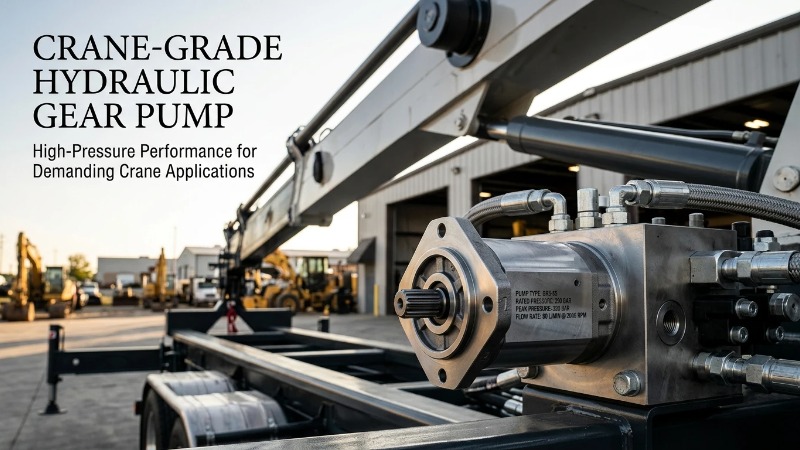
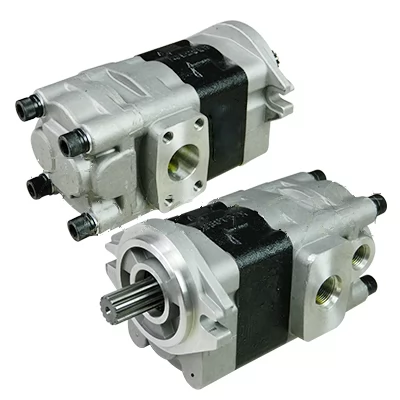
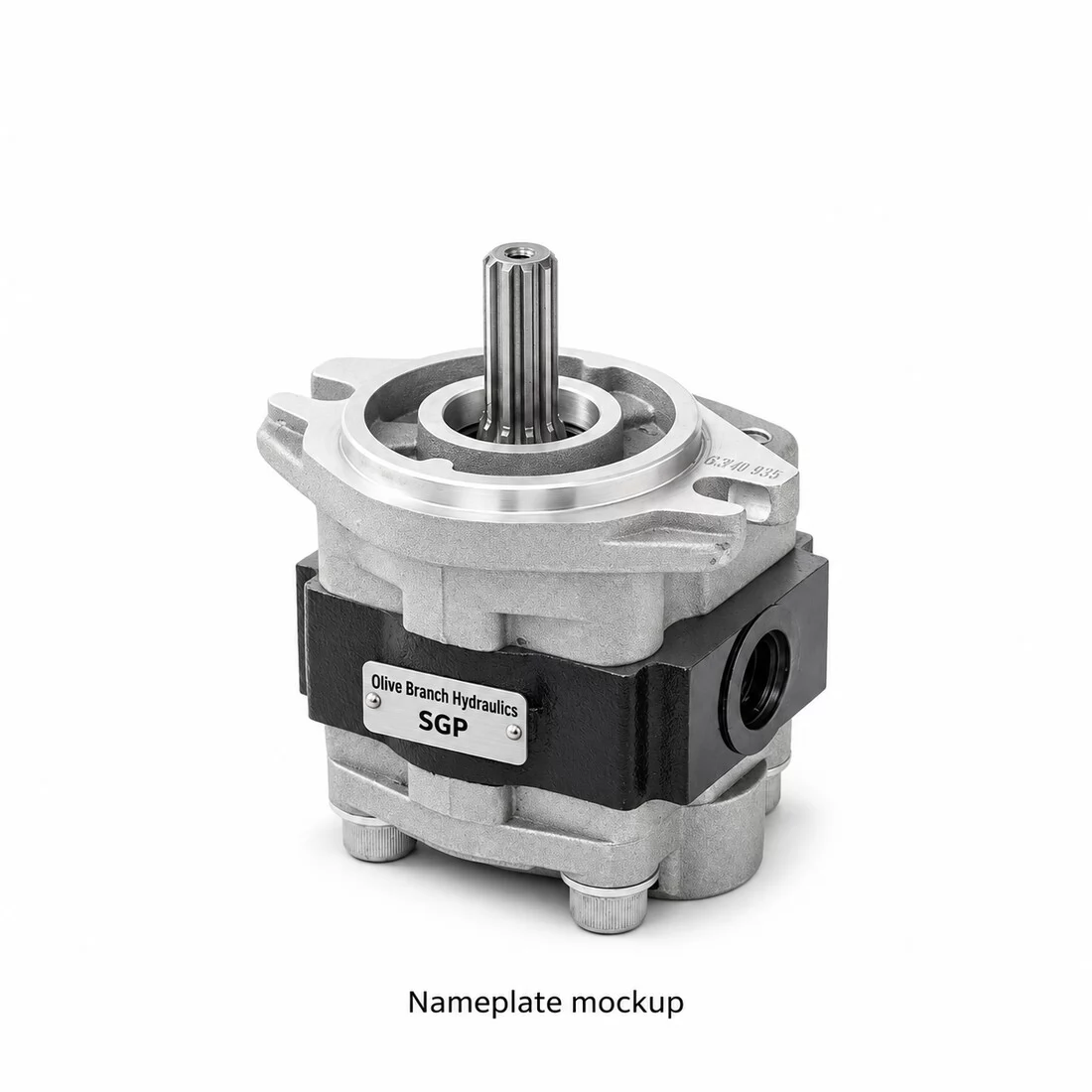
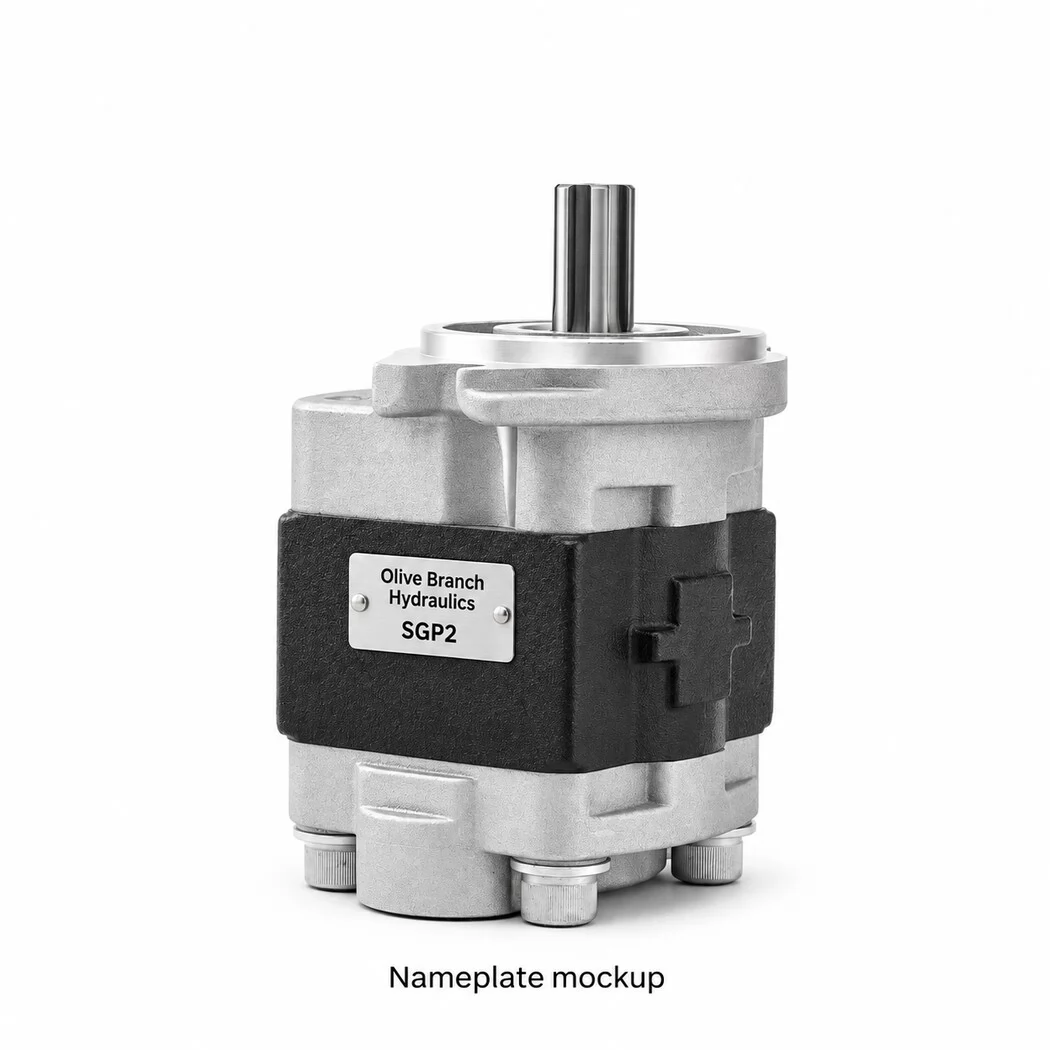
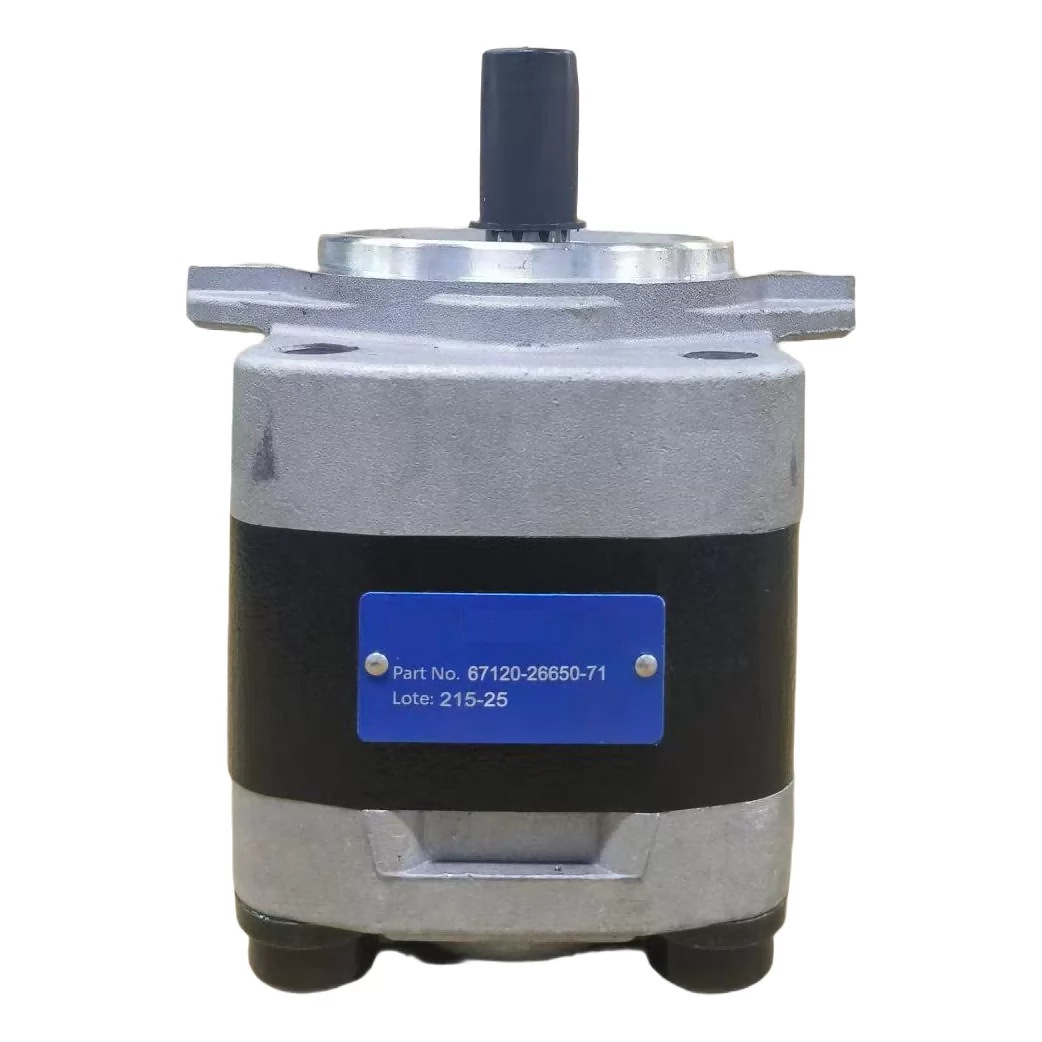
Image notes: The first image is an Olive Branch Hydraulics nameplate mockup. The other images are catalogue reference drawings. Confirm the drawing revision and dimensions for your specific pump before ordering.
Pressure rating, body material and internal leakage are linked, and the catalogue limits reflect that link.
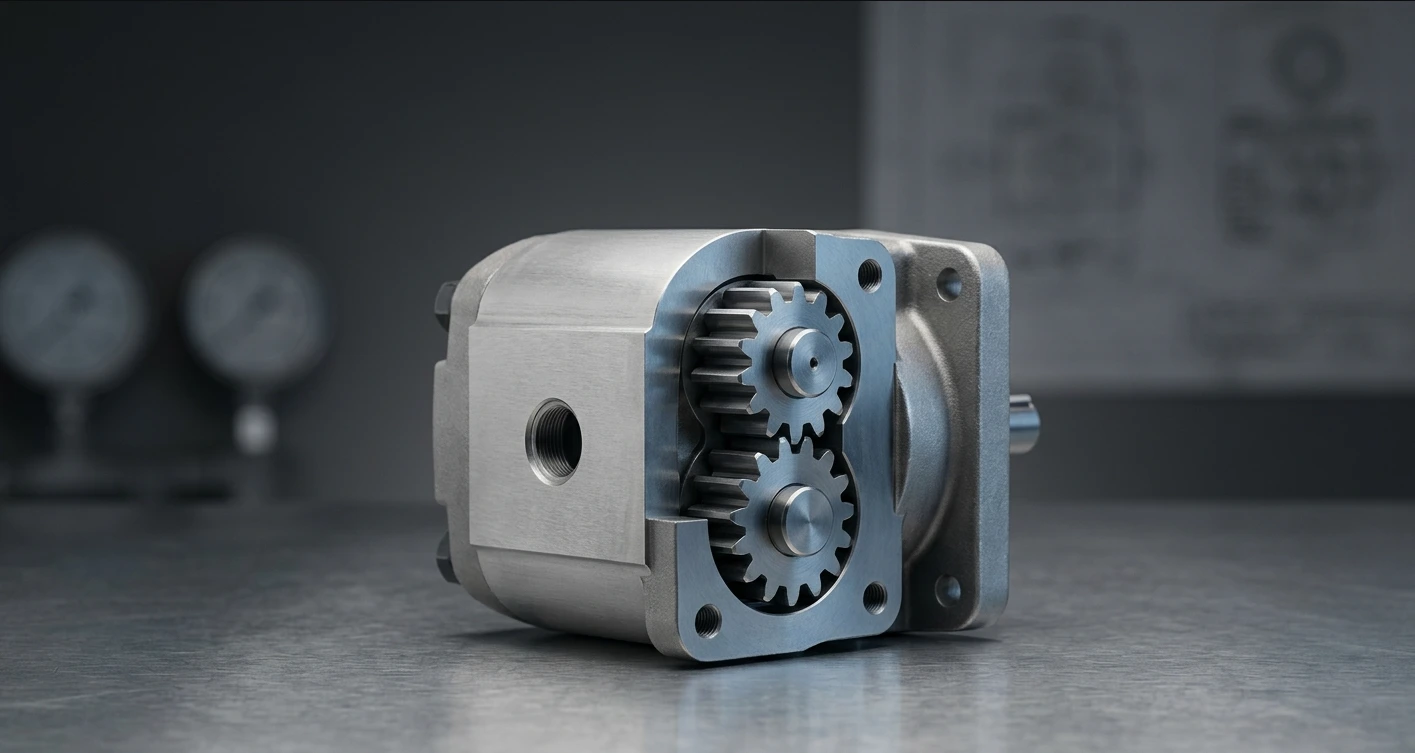
An external gear pump seals by tight radial clearance between the gear tips and the body bore, and by axial clearance at the gear faces. When pressure rises, the housing is loaded from the outlet side. Cast iron has higher stiffness and better damping than the aluminium bodies common in lighter-duty pumps, so the bore deflects less at 200 bar. That is the basis for the continuous rating. Cast iron also adds weight, which is the trade-off for mobile equipment where every kilogram is counted.
The 200 bar continuous figure is the pressure the pump can hold for sustained operation. The 250 bar intermittent figure covers short peaks, such as a cylinder reaching end of stroke before the relief valve opens. If your circuit sits near 250 bar for long periods, it is outside the catalogue duty, and the relief setting should be reviewed. Bearing and gear-face loading rise with pressure, so a relief valve set at or below 200 bar for normal working pressure is the usual practice for long service life.
The rated speed window is 600–3000 rpm. Below roughly 600 rpm, internal leakage becomes a large share of output, and flow at low engine idle can be lower than expected. Near the top of the range, the inlet must fill the gear spaces completely. A short, generously sized suction line and oil kept inside the 20–100 mm²/s viscosity window are typically what prevents cavitation noise and erosion at 3000 rpm.
Rate the pump on the working pressure your relief valve actually holds, not on the intermittent peak.
All eight catalogue sizes, with L taken from the catalogue drawing; theoretical flow is calculated as displacement × speed ÷ 1000, before volumetric losses.
| Displacement (cm³/rev) | in³/rev | Dimension L, mm (in) | Theoretical flow at 1500 rpm, L/min (US gpm) |
|---|---|---|---|
| 23 | 1.40 | 117 (4.61) | 34.5 (9.1) |
| 25 | 1.53 | 120 (4.72) | 37.5 (9.9) |
| 26.5 | 1.62 | 122 (4.80) | 39.8 (10.5) |
| 28.2 | 1.72 | 124 (4.88) | 42.3 (11.2) |
| 30 | 1.83 | 126 (4.96) | 45.0 (11.9) |
| 32 | 1.95 | 128 (5.04) | 48.0 (12.7) |
| 34 | 2.07 | 130.5 (5.14) | 51.0 (13.5) |
| 36 | 2.20 | 133 (5.24) | 54.0 (14.3) |
Four inputs decide the order: flow, pressure duty, fluid conditions and the assembly code.
In this guide
01
Start with the flow your actuators need at normal drive speed, then divide by speed and by volumetric efficiency. External gear pumps typically deliver 90–95% of theoretical flow at rated conditions. A circuit that needs 45 L/min at 1500 rpm therefore usually points to the 32 cm³/rev size rather than 30. Remember that L grows by only 16 mm from the smallest to the largest size, so stepping up one displacement rarely changes the installation envelope.
02
Check that the prime mover can drive the size you pick. Hydraulic power in kW is approximately pressure in bar × flow in L/min ÷ 600. At 200 bar and 54 L/min, that is about 18 kW of hydraulic output. With overall efficiency typically around 85%, input power is close to 21 kW (about 28 hp). A smaller displacement is the simpler fix when engine or motor power is the limit.
03
The catalogue limits are –15 to 80 °C (5 to 176 °F) and 20 to 100 mm²/s viscosity. Cold starts with thick oil starve the inlet, and hot thin oil increases slip and wear. Confirm the oil grade against both ends of your ambient range. Standard mineral hydraulic oils are the usual basis for these figures, so other fluid types should be stated at enquiry.
04
Shaft type (keyed, splined or tapered), rotation direction, mounting flange and port type are all defined by the assembly code. These are the items that decide whether a pump bolts on and runs. Specify rotation as viewed from the shaft end, and give port threads or flange standards in full.
Replacing an existing pump and unsure of the code?Send the original product code, machine model and equipment details, and we match the configuration before quoting; brand names and model numbers serve identification only, and fit depends on the complete assembly code.
Distributors can order custom variants, and so can equipment builders and aftermarket brands.
Configurations that need dedicated tooling start with a review of your original pump sample or approved drawing, which confirms the mounting interface, drive and ports before any tooling is made.
Pressure and tank port positions and connection types can be set to suit a distributor's stocking range. Port changes are checked against the approved drawing at inspection.
Drive shaft and mounting flange are built to customer specification for OEM and aftermarket use. Changing the drive end usually requires dedicated tooling.
Design drafts and 3D renders are provided for your sign-off before sampling. The approved drawing then becomes the basis for quality checks, rather than a general catalogue sheet.
Send the assembly code, drawing or sample with expected order quantity.
Drafts and 3D renders are issued for your approval.
Samples are built to the approved drawing for your fit and function test.
Batches run with in-process quality control. Each pump passes final inspection before packaging.
Packed goods are handed over at the Hebei facility for your forwarder.
All commercial terms are fixed in one written quotation before tooling or production begins.
MOQ and lead time
Stated in the written quotation
Based on confirmed configuration and order quantity; each stage's lead time is listed.
Pricing
Unit price by quantity tier
Tiered pricing suits distributors planning stock levels.
Tooling fee
Fully refundable
Refunded once cumulative purchases of that model reach the agreed quantity; multiple orders count toward the total.
Incoterms
EXW Hebei, China
Handed over at the manufacturer's facility; payment terms confirmed in the quotation.
Warranty
One year
Warranty terms are written into the quotation.
Packaging
Typically individual carton with port plugs
Export cartons palletised; required documents and test items agreed in the quotation.
Is this pump bidirectional?
No. Each pump is built for one rotation direction, set by the assembly code. State clockwise or counter-clockwise as viewed from the shaft end when you order. Reversing a single-direction gear pump typically damages the shaft seal.
Can the pump run outside 600–3000 rpm or above 80 °C?
Those conditions are outside the catalogue ratings, and performance is not stated for them. If your duty cycle approaches these limits, send the speed, pressure and oil temperature profile with your enquiry so the configuration can be reviewed.
What inspection is done before shipment?
Every pump receives a final inspection before packaging. Dimensional checks, leak inspection and pressure/flow testing where applicable are agreed item by item in the quotation, together with the documents you need.
Will the pump bolt onto my existing machine?
That depends on the complete assembly code, not on the displacement alone. Flange, shaft and ports must all match, which is why we confirm them from your original code, drawing or sample before quoting.
Send the assembly code or drawing, the displacement you need, your first-order quantity or annual volume and the destination port. You will receive a written quotation within 24 hours, with tiered pricing and stage-by-stage lead times.
Discover how hydraulic gear pumps work, why they still dominate industry, and key components to watch when spe…
Skip priming and your gear pump dies in seconds. Learn the 5-minute procedure that prevents scoring, cavitatio…
Compare the most trusted hydraulic gear pump brands with a data-driven ranking built for procurement teams who…
Engineer's guide to selecting a hydraulic gear pump for crane duty: pressure, displacement, MTBF, and the 4 sp…
Contact us now for a professional solution and fast quote.
Fill in your info to start a conversation.