
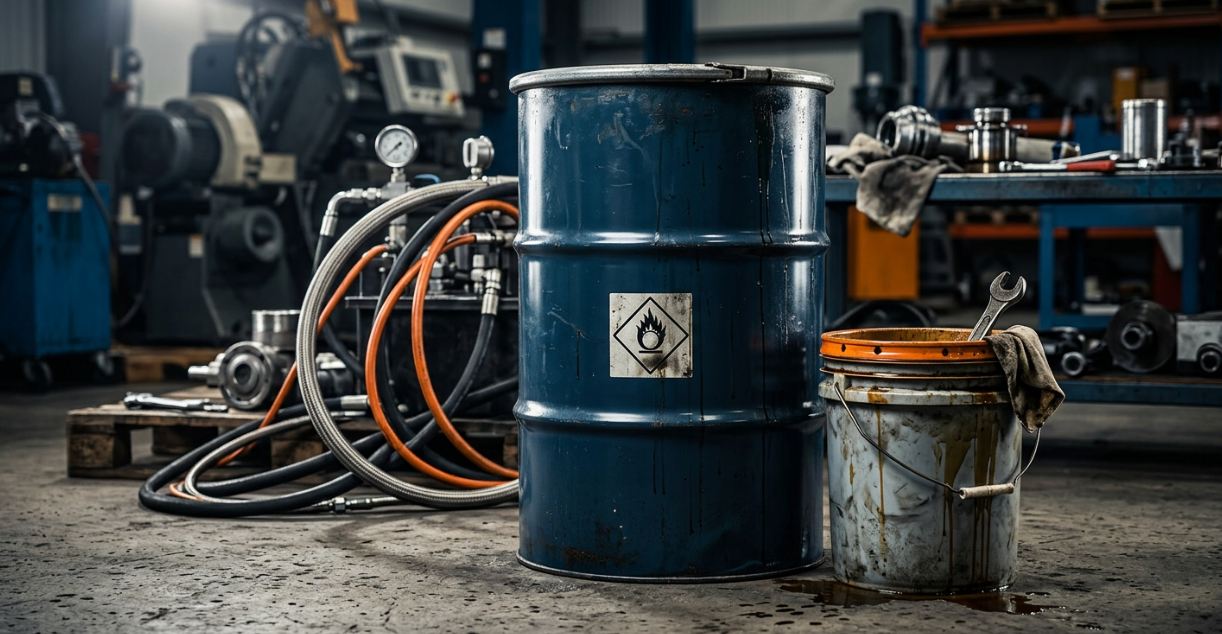
Walk into any busy shop and the scene repeats itself: a half-full drum marked "used oil," a leaky bucket of hydraulic fluid from this morning's cylinder rebuild, and a tech wondering whether tipping one into the other is going to bite somebody later. Search the internet and you get twelve answers. Your hauler hands you a thirteenth. Let me cut through it.
The Short Answer Nobody Wants to Give You
Yes. In most cases you can mix used motor oil and used hydraulic fluid for recycling. Both are petroleum-based, both feed the same re-refining process, and both end up in roughly the same place downstream.
The catch hides inside "most cases." There's a short, expensive list of exceptions, and getting one wrong turns a routine pickup into a hazardous waste invoice.
Why the "It Depends" Response Is Costing the Industry Money
Recycling centers love the safe non-answer because it shifts liability back to the generator. The result? Thoughtful operators over-segregate and burn through drums and labor. Careless ones under-segregate and contaminate loads.
Re-refiners I've talked with estimate 5 to 8 percent of incoming bulk loads arrive off-spec because of avoidable mixing decisions. That's millions of gallons a year getting bumped down to fuel blending, or worse.
What Actually Happens When These Two Fluids Meet
Chemically, used motor oil recycling and hydraulic fluid disposal are closer cousins than the labels suggest. Both start as base oil, whether Group I, II, or III mineral stock, or PAO synthetic. Both carry zinc dialkyldithiophosphate (ZDDP) as an anti-wear additive.
Pour them together and you get a slightly thinner, slightly dirtier petroleum mixture. The re-refining vacuum distillation columns don't care which drum it came from.
Understanding What's Actually in Your Drums
Used Motor Oil: A Familiar but Dirty Mix
Used motor oil is the dirtier of the two, by a wide margin. Combustion byproducts, fuel dilution from blow-by, soot, and wear metals (iron, copper, lead) all stack up across a typical drain interval.
The good news: re-refineries are designed around exactly that contamination profile. It's the baseline feedstock the entire industry was built on.
Hydraulic Fluid: Cleaner, but with Catches
Hydraulic fluid lives a gentler life. No combustion, lower operating temperatures, tighter filtration. The used fluid coming out of the system is cleaner.
The catches are real, though. Water ingress through worn seals is common, and some hydraulic systems run fire-resistant fluids that are chemically nothing like petroleum oil. More on those in a minute.
Side-by-Side Composition Comparison
| Property | Used Motor Oil | Used Hydraulic Fluid |
|---|---|---|
| Base Oil Type | Mineral / Synthetic blend | Mineral / Synthetic |
| Typical Viscosity (cSt @ 40°C) | 60–150 | 22–68 |
| Common Additives | Detergents, dispersants, ZDDP | Anti-wear (ZDDP), rust inhibitors |
| Water Content | Low to moderate | Often higher (system ingress) |
| Wear Metals | High (Fe, Cu, Pb) | Low to moderate |
| Soot/Combustion Byproducts | High | None |
| Re-refining Compatibility | Standard feedstock | Acceptable feedstock |
My Industry Opinion: Mixing Is Usually Fine, Until It Isn't
The Case for Allowing Mixed Petroleum Streams
Here's where I'll plant my flag. Modern re-refineries are built for blended petroleum feedstocks. Demanding rigid segregation between used motor oil and conventional hydraulic fluid creates logistical waste with no environmental upside.
Extra drums, extra pickups, extra paperwork, extra truck miles. Each carries its own footprint. For petroleum-based fluids, the smarter conversation is keeping incompatible substances out, not splitting hairs between two compatible ones.
The Hard No: Fluids That Should Never Touch Your Used Oil Drum
This is where the gray area ends. The following do not belong in your used oil drum, ever:
Chlorinated solvents (brake cleaner, degreasers, trichloroethylene)
Brake fluid (glycol ether-based, not petroleum)
Antifreeze and coolants
Gasoline, diesel, or kerosene contamination
Fire-resistant hydraulic fluids (covered below)
Anything you can't identify
Phosphate Ester and Water-Glycol Hydraulic Fluids
Fire-resistant hydraulic fluids are the silent killer of bulk used oil tanks. Phosphate esters (HFDR class) and water-glycol fluids (HFC class) are not petroleum. You'll find them in steel mills, die-casting, aerospace, and some mining equipment.
Even a few gallons in a clean used oil drum makes the whole batch problematic for re-refining. If your facility runs equipment in those sectors, label those reservoirs aggressively.
The PCB Legacy Problem
Older hydraulic equipment built before the late 1970s may still carry polychlorinated biphenyl (PCB) contamination. A single drum of contaminated oil recycling material from a decommissioned press can condemn an entire 6,000-gallon bulk tank.
Inheriting old equipment? Test before you drain. The cost of a halogen screen is rounding error next to a PCB cleanup.
What Recycling Centers Actually Want From You
Acceptance Criteria at a Typical Collection Facility
Most oil recycling center guidelines come down to a handful of testable parameters. Know the numbers and your loads won't get rejected.
| Parameter | Typical Acceptance Limit | Why It Matters |
|---|---|---|
| Total Halogens | < 1,000 ppm | Triggers hazardous waste classification |
| PCBs | < 50 ppm | Federal regulatory threshold (US) |
| Flash Point | > 100°F (38°C) | Indicates fuel or solvent contamination |
| Water Content | < 5% (preferred) | Affects processing economics |
| Visible Sediment | Minimal | Causes pump and filter wear at the receiving facility |
The Halogen Test Trap
The 1,000 ppm halogen threshold is where careers go sideways. One quart of brake cleaner tipped into a 55-gallon drum can push you past the line.
Once a load tests hot for halogens, the regulatory presumption flips on you. The burden shifts to the generator to prove the material isn't hazardous waste, and the costs follow right behind.
Documentation Habits That Save You Money
Label every drum with the open date, the source equipment, and the tech responsible. If a hauler tests a load and something comes back wrong, that paper trail is what separates a quick phone call from a generator fine.
I'd take a sloppy handwritten label over a pristine unmarked drum any day. Provenance beats presentation, every time.
The Real Cost of Getting It Wrong
Hazardous Waste Reclassification Fees
The dollar gap between recyclable used oil and hazardous waste is the most underestimated number in shop management. Current pricing tells the story.
| Disposal Category | Typical Cost (USD per gallon, 2026) | Approval Required |
|---|---|---|
| Used Oil (clean, recyclable) | $0.00 – $0.50 (pickup is often free) | None |
| Off-Spec Used Oil | $1.50 – $3.00 | Standard manifest |
| Hazardous Waste (contaminated) | $8.00 – $25.00+ | Hazardous waste manifest |
A single contaminated 275-gallon tote can swing from a free pickup to a $5,000 disposal bill. That's why careless mixing is the most expensive shortcut in the industry.
Liability That Follows the Generator
Under RCRA's cradle-to-grave doctrine, the generator stays legally responsible for the waste even after a licensed hauler takes possession. If your contaminated drum surfaces in a Superfund cleanup twenty years from now, your company name is still on the manifest.
The hauler's truck leaves your dock. Your liability doesn't.
Best Practices for Industry Professionals
The Two-Drum Rule (And Why I Still Recommend It)
Even though mixing is chemically fine, I still tell shops to keep separate drums for motor oil and hydraulic fluid when volume allows. Not for the chemistry. For the diagnostics.
If contamination shows up, separated streams let you pinpoint which side of the shop has the problem. Mixed drums turn every incident into a guessing game.
When Consolidation Makes Sense
Low-volume generators, mobile service trucks, and end-of-job site cleanouts are the legitimate cases for consolidation. If you're producing five gallons of hydraulic fluid a quarter, dedicating a drum to it is operationally absurd.
Combine it into the used oil drum, document it, and move on. Pragmatism matters here.
Building a Relationship With Your Hauler
The most underused resource in this whole conversation is your hauler. Pick up the phone, ask what their re-refiner will accept, and ask what they've rejected from your area lately.
Generic online guidance can't tell you the local processor stopped taking water-glycol last spring. Your hauler can.
FAQ: Quick Answers to Common Questions
Can I mix motor oil and hydraulic fluid in the same drum for recycling?
Yes, provided both are petroleum-based and free of solvents, brake fluid, antifreeze, and fire-resistant fluids. The two are chemically compatible and feed the same re-refining process.
Will my recycler reject a mixed drum?
Most won't, but they may sample for halogens, water content, and flash point before accepting bulk loads. Reputable recyclers reject loads that exceed their acceptance limits, regardless of how the mixture got there.
What about transmission fluid and gear oil?
Both are petroleum-based and accepted under the same used oil umbrella. Automatic transmission fluid, manual gear oil, even differential fluid can go in the same drum as motor oil and hydraulic fluid without issue.
Can I add hydraulic fluid to motor oil for use as a fuel?
Burning used oil in shop heaters is legal in many jurisdictions, but it's governed by EPA used oil burner regulations and state-specific rules. The fluid has to meet specification limits for halogens, lead, arsenic, cadmium, chromium, and flash point. Adding clean hydraulic fluid generally improves burn quality, though you're still on the hook for making sure the blended fuel meets spec.
How do I know if my hydraulic fluid is fire-resistant or synthetic-incompatible?
Check the safety data sheet. Look for ISO designations starting with HF. HFA, HFB, HFC, and HFDR are all fire-resistant and not compatible with petroleum recycling streams. HL, HM, HV, and HVLP are petroleum-based and fine to recycle alongside motor oil.
Does mixing affect the price recyclers pay for used oil?
It can. Clean, high-volume loads of pure used motor oil sometimes earn small rebates when crude prices run strong. Mixed loads with higher water content or lower viscosity typically don't qualify for premium pricing, though they still avoid disposal fees in most cases.
Final Take: Stop Overthinking, Start Documenting
The industry has spent two decades making this question more complicated than it needs to be. Here's the straight answer: mixing petroleum-based used motor oil with hydraulic fluid is a non-issue for the recycling chain. The real risks sit elsewhere. Chlorinated solvents. Fire-resistant fluids. Brake fluid. Mystery drums no one can identify.
Stop burning energy on whether two compatible fluids can share a drum. Put that effort into labeling, documentation, and training the people actually filling those drums. That's where the money lives, and that's where the liability lives.
Get the paperwork right and your hauler becomes your best friend. Get it wrong and even textbook-perfect segregation won't bail you out when a sample tests hot downstream.