
Few technologies have shaped industrial civilization as profoundly — and as invisibly — as hydraulics. From the irrigation canals of ancient Mesopotamia to the digitally controlled actuators in contemporary aerospace manufacturing, the story of fluid power spans more than five millennia of iterative engineering breakthroughs.
This comprehensive examination traces the full arc of hydraulic system history, connecting foundational scientific principles to the machines that professionals operate and maintain today. Understanding this lineage is not merely academic; it equips engineers, technicians, and procurement specialists with the contextual knowledge needed to evaluate modern systems intelligently.
The Ancient Origins of Hydraulic Principles
Early Water Management Systems (3000–500 BCE)
The earliest hydraulic engineering emerged not from laboratories but from agricultural necessity. Sumerian and Babylonian civilizations in Mesopotamia constructed elaborate irrigation channel networks as early as 3000 BCE, diverting the Tigris and Euphrates rivers through gravity-fed canals that sustained large-scale grain cultivation.

Egyptian engineers developed equally sophisticated approaches to Nile water management. The shaduf — a counterweighted lever for lifting water — appeared around 2000 BCE, representing an early understanding of mechanical advantage applied to fluid movement. By 1000 BCE, the qanat tunnel systems of Persia demonstrated that ancient engineers understood hydrostatic pressure and gravitational flow over considerable distances.
These systems did not employ enclosed pressurized fluids in the modern sense. However, they established the empirical foundation — observation of fluid behavior under gravity, containment, and directed flow — that later scientists would formalize into mathematical principles.
Greek and Roman Hydraulic Engineering Advances
The transition from purely empirical water management to proto-scientific hydraulics occurred in the Hellenistic world. Ctesibius of Alexandria, working around 270 BCE, invented the force pump — a dual-cylinder device using one-way valves to create continuous water flow under pressure. His design is recognizably ancestral to modern piston pumps.
Hero of Alexandria (circa 10–70 CE) expanded on this work with pneumatic and hydraulic devices that demonstrated pressure-driven motion, including automatic door openers and fountain mechanisms powered by trapped air and water pressure. While often dismissed as novelties, Hero's devices proved that enclosed fluids could transmit force and produce mechanical work.
Roman engineers scaled these principles to civilization-supporting infrastructure. Their aqueduct system — at its peak spanning over 400 kilometers serving Rome alone — incorporated inverted siphons that exploited pressure differentials to carry water across valleys. The Romans also deployed pressurized lead pipes within cities, managing distribution pressures that, while modest by modern standards, demonstrated systematic fluid power engineering at unprecedented scale.
| Era | Civilization | Innovation | Significance to Modern Hydraulics |
|---|---|---|---|
| ~3000 BCE | Mesopotamia (Sumer) | Gravity-fed irrigation canal networks | Established principles of controlled fluid direction and flow management |
| ~2000 BCE | Egypt | Shaduf counterweight water lifter | Applied mechanical advantage to move fluid against gravity |
| ~1000 BCE | Persia | Qanat underground tunnel systems | Demonstrated hydrostatic pressure and long-distance fluid transport |
| ~270 BCE | Hellenistic Egypt | Ctesibius's dual-cylinder force pump | First true positive-displacement pump; ancestor of piston hydraulics |
| ~60 CE | Roman Empire | Hero's pneumatic/hydraulic automata | Proved enclosed fluids could transmit force for mechanical work |
| ~100 CE | Roman Empire | Inverted siphon aqueduct crossings | Applied pressure differential principles at infrastructure scale |
Pascal's Law and the Birth of Hydraulic Science (1647–1653)
Blaise Pascal's Foundational Experiments
The leap from empirical water engineering to predictive hydraulic science occurred in mid-17th-century France. Blaise Pascal, conducting systematic experiments between 1647 and 1653, formulated the principle now universally known as Pascal's law: pressure applied to a confined fluid is transmitted equally in all directions throughout that fluid, with no diminishment.
Pascal's most dramatic demonstration — the barrel experiment of 1646 — involved inserting a long, narrow tube into a sealed barrel filled with water. By adding a small quantity of water to the tall tube, he generated sufficient hydrostatic pressure to burst the barrel, demonstrating that pressure in a fluid depends on height rather than volume. This counterintuitive result crystallized the relationship between force, area, and pressure that underpins all hydraulic machinery.
His treatise Traité de l'équilibre des liqueurs, published posthumously in 1663, presented these findings with mathematical rigor. The formulation — expressed in modern notation as F₁/A₁ = F₂/A₂ — established that a small force applied over a small area could generate a proportionally larger force over a larger area within a closed hydraulic system.
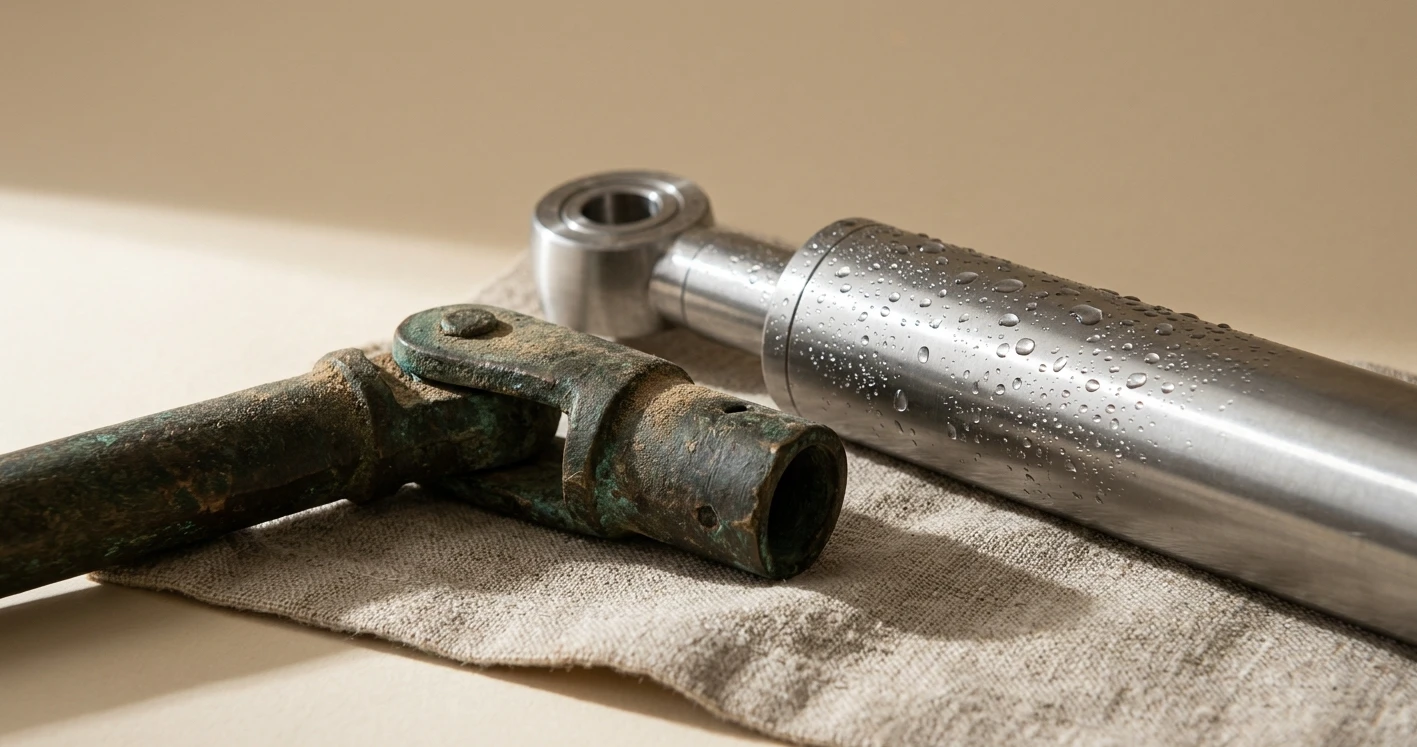
Why Pascal's Law Changed Fluid Power Technology Forever
The revolutionary implication of Pascal's work was force multiplication through geometry alone. Unlike mechanical lever systems, which require proportional displacement and rigid linkages, hydraulic force multiplication operates through fluid pressure in any configuration — around corners, over distances, and through complex routing.
Consider the principle in practical terms: a piston with a 1-square-centimeter area connected via fluid to a piston with a 100-square-centimeter area multiplies applied force by a factor of 100. The trade-off is displacement — the smaller piston must travel 100 times farther — but the ability to generate enormous forces from modest inputs transformed what machinery could accomplish.
This principle remains unchanged in every hydraulic system manufactured today. Whether operating a 500-ton forging press or a precision surgical robot, the underlying physics is identical to what Pascal described nearly four centuries ago. His work converted hydraulics from craft knowledge into engineering science.
Joseph Bramah and the First Hydraulic Press Patent (1795)
Bramah's Hydraulic Patent and Its Engineering Breakthrough
Nearly 150 years separated Pascal's theoretical framework from its first successful commercial application. The gap was not conceptual but material — no one could manufacture cylinders and seals precise enough to contain high-pressure fluid without catastrophic leakage. Joseph Bramah solved this problem.
Bramah's British patent of 1795 (Patent No. 2045) described a hydraulic press that directly applied Pascal's law for industrial force generation. The design specified two interconnected cylinders of different diameters, with a pump mechanism to pressurize the working fluid. The Joseph Bramah hydraulic patent is widely recognized as the birth of commercial hydraulic machinery.
The critical manufacturing challenge — producing sufficiently precise cylinder bores and leak-proof sealing — was overcome by Bramah's apprentice Henry Maudslay, who developed novel metal-cutting lathes capable of achieving previously impossible tolerances. Maudslay's self-sealing leather cup washer, which used system pressure itself to improve the seal, was an elegant solution that remained standard in hydraulic cylinders for over a century.
Early Industrial Applications of Bramah's Press
Bramah's hydraulic press invention found immediate application in industries requiring high compressive force. Paper manufacturers adopted it for baling, replacing screw presses that demanded enormous manual labor. Textile mills used hydraulic presses for packaging cotton bales. Metal forgers discovered that hydraulic pressing produced more uniform results than drop hammers.
By the 1820s, variations of Bramah's design were operating across British industry. The press demonstrated a pattern that would repeat throughout hydraulic history: once reliable sealing and pressure containment were achieved at one level, engineers immediately pushed toward higher pressures and larger scales. Bramah's original press operated at modest pressures by modern standards, but it proved the commercial viability of Pascal's theoretical work as practical fluid power technology.
| Year | Inventor | Patent/Invention | Industry Impact |
|---|---|---|---|
| 1795 | Joseph Bramah | Hydraulic press (British Patent No. 2045) | First commercial hydraulic machine; enabled industrial-scale force generation |
| 1812 | Joseph Bramah | Hydraulic press improvements for coining | Extended hydraulic pressing to precision metal forming |
| 1845 | William Armstrong | Hydraulic crane for Newcastle docks | Introduced variable-pressure water hydraulics to cargo handling |
| 1851 | William Armstrong | Hydraulic accumulator | Enabled stored hydraulic energy for intermittent high-demand operations |
| 1882 | Hydraulic Engineering Co. | Hydraulic rivet machines | Transformed shipbuilding and structural steel construction |
| 1906 | Harvey Hubbell (et al.) | Oil hydraulic system patents | Initiated transition from water to oil-based hydraulic media |
The Hydraulic Age — 19th Century Industrial Expansion
William Armstrong and Hydraulic Crane Systems (1845–1870)
William George Armstrong transformed hydraulics from a pressing technology into a comprehensive power transmission system. His 1845 hydraulic crane, designed for Newcastle's Quayside docks, used pressurized water to lift and slew cargo loads that previously required gangs of manual laborers. The crane's efficiency was immediately apparent: it could handle loads faster, more precisely, and at lower operating cost than any alternative.
Armstrong founded W.G. Armstrong & Company in 1847, rapidly scaling production. His key innovation beyond the crane itself was the hydraulic accumulator (patented 1851) — a weighted piston in a vertical cylinder that stored pressurized water, solving the intermittent-demand problem. A small pump running continuously could charge an accumulator that then delivered brief bursts of high-volume flow when cranes or other equipment cycled.
By 1870, Armstrong's systems equipped ports across Britain and continental Europe. His company supplied hydraulic machinery for warship gun turrets, dock gates, and swing bridges — establishing hydraulics as the dominant heavy actuation technology of the industrial era.
Public Hydraulic Power Networks in London and Beyond
The most ambitious application of Victorian hydraulic engineering was the public power network. The London Hydraulic Power Company, incorporated in 1883, operated a city-wide grid of pressurized water mains at approximately 700 PSI, supplying hydraulic power to subscribers much as electrical utilities would later supply current.
At its peak, the London network served over 8,000 machines across the city — powering lifts in hotels and office buildings, cranes at wharves, presses in printing houses, and even the stage machinery at West End theaters. Similar networks operated in Manchester, Liverpool, Glasgow, Melbourne, and Buenos Aires. This chapter in hydraulic system history demonstrates that centralized hydraulic power distribution was once a serious competitor to electrical power.
The London network continued operating until 1977, outlasting initial expectations by decades. Its eventual closure reflected not hydraulic failure but the superior flexibility of electrical motors for distributed applications.
The Tower Bridge Hydraulic Mechanism (1894)
London's Tower Bridge, completed in 1894, represents the pinnacle of Victorian hydraulic engineering. The bascule-lifting mechanism employed two hydraulic accumulators storing pressurized water at 750 PSI, driven by steam-powered pumping engines. The system could raise both 1,100-ton bascules in approximately one minute — a remarkable achievement for purely hydraulic actuation without electronic controls.
The original hydraulic system operated for over 80 years before electrification in 1976. Engineers who study this system note its extraordinary reliability, achieved through conservative design margins and high-quality materials. Tower Bridge remains a compelling case study in how properly engineered hydraulic systems deliver decades of service in demanding, high-cycle applications.
20th Century — Hydraulics Enter the Modern Era
Harry Vickers and the Balanced Vane Pump (1920s–1930s)
The transition from water hydraulics to oil hydraulics fundamentally changed what fluid power systems could achieve. Harry Vickers, founding the Vickers Company in the 1920s, pioneered the development of reliable high-pressure pumps designed specifically for petroleum-based hydraulic fluids.
Oil offered decisive advantages over water: superior lubrication of internal components, wider operating temperature range, corrosion prevention, and higher bulk modulus (resistance to compression) enabling crisper system response. Vickers's balanced vane pump design reduced bearing loads and increased service life, making oil hydraulics practical for continuous industrial operation.
This shift enabled compact, high-pressure systems impossible with water. By the late 1930s, operating pressures of 1,000–1,500 PSI were routine in oil hydraulic circuits — pressures that would have rapidly destroyed water-hydraulic seals and corroded system internals. The modern hydraulic industry as professionals know it dates from this period.
Hydraulic Systems in World War II Aviation and Armor
World War II accelerated hydraulic development at an extraordinary pace. Military aircraft required hydraulic actuation for landing gear retraction, flap deployment, bomb bay doors, and gun turret traverse — functions demanding high power density, reliability under extreme conditions, and rapid response. Every major combat aircraft of the war incorporated hydraulic systems.
Tank design similarly depended on hydraulics for turret rotation, gun elevation, and suspension systems. The demand for battlefield-reliable hydraulic components drove advances in seal materials, fluid formulations, filtration, and contamination control that directly transferred to postwar civilian applications.
The war also established standardized hydraulic specifications and testing protocols. Military procurement requirements forced manufacturers toward consistent quality standards that became the foundation for postwar industrial hydraulic specifications.
Post-War Expansion Into Construction and Heavy Industry
Between 1950 and 1975, hydraulic systems became ubiquitous in construction equipment, manufacturing, and heavy industry. Hydraulic excavators replaced cable-operated machines, offering superior control and digging force. Bulldozers, loaders, and cranes adopted hydraulic actuation as the standard power medium.
Manufacturing applications expanded rapidly: injection molding machines, stamping presses, die-casting equipment, and CNC machine tools all relied on hydraulic power for force generation and clamping. The mobile hydraulic sector — encompassing agricultural equipment, forestry machinery, and material handling — grew into a major industrial segment.
Operating pressures climbed steadily as metallurgy and seal technology improved. By the 1970s, 3,000–5,000 PSI systems were standard in industrial applications, with specialized equipment pushing beyond 10,000 PSI.
| Decade | Typical Operating Pressure (PSI) | Common Fluid Medium | Primary Applications |
|---|---|---|---|
| 1850s | 700–800 | Water | Dockyard cranes, hydraulic presses, lifts |
| 1900s | 750–1,000 | Water (oil emerging) | Power networks, bridge mechanisms, riveting |
| 1930s | 1,000–1,500 | Petroleum-based oil | Machine tools, aircraft prototypes, industrial presses |
| 1940s | 1,500–2,000 | MIL-spec hydraulic fluids | Military aircraft, tanks, naval gun systems |
| 1960s | 2,000–3,000 | Anti-wear hydraulic oils | Construction excavators, industrial automation, injection molding |
| 1980s | 3,000–5,000 | Synthetic and mineral oils | Aerospace, heavy manufacturing, mobile equipment |
| 2020s | 5,000–10,000+ | Bio-based, fire-resistant, and synthetic fluids | Digital hydraulics, energy recovery systems, precision robotics |
Contemporary Hydraulic Technology and Digital Integration
Electrohydraulic Systems and Proportional Valves
The integration of electronic controls with hydraulic actuators, beginning in earnest during the 1980s, produced electrohydraulic systems capable of precision impossible with purely mechanical valving. Proportional valves — which modulate flow and pressure in direct proportion to an electrical input signal — replaced on/off directional valves in applications requiring variable speed, controlled acceleration, and precise positioning.
Servo-hydraulic systems pushed this further, using closed-loop feedback from position and force sensors to achieve repeatability measured in micrometers. Applications in materials testing, flight simulation, active suspension, and precision manufacturing depend on this electronic-hydraulic fusion.
The principle remains Pascal's law; the advance lies entirely in control sophistication. Modern electrohydraulic systems combine hydraulic power density with electronic precision — a combination that neither technology achieves alone.
Current Innovations in Fluid Power Technology
Several parallel development tracks are reshaping hydraulic engineering. Digital displacement hydraulics, pioneered by companies such as Danfoss (through their Artemis acquisition), replace continuously variable pumps with arrays of small, electronically switched cylinders that engage or disengage digitally — achieving efficiencies exceeding 90% across a wide operating range.
Energy recuperation systems capture hydraulic energy during braking or boom-lowering cycles, storing it in accumulators or converting it to electrical energy for reuse. In mobile equipment, these systems demonstrate fuel savings of 15–30% in typical duty cycles.
Biodegradable hydraulic fluids — including synthetic esters and vegetable-oil-based formulations — address environmental compliance requirements in forestry, marine, and water-resource applications. IoT-enabled condition monitoring now provides real-time data on fluid cleanliness, temperature, pressure ripple, and component wear — enabling predictive maintenance that prevents unplanned downtime.
Industry Standards and Market Trajectory
The global hydraulic equipment market reached approximately $45 billion in 2025, with projections indicating continued growth driven by infrastructure investment, renewable energy installation equipment, and automation of heavy industry. ISO 4413 (general hydraulic system design) and ISO 4414 (pneumatic systems) continue to evolve, with increasing emphasis on energy efficiency and environmental impact.
Regulatory pressure for decarbonization is driving development of more efficient hydraulic circuits. The European Union's Ecodesign framework and comparable initiatives in other jurisdictions are establishing minimum efficiency standards for hydraulic power units — pushing the industry toward variable-speed drive pumps, load-sensing architectures, and intelligent power management.
| Period | Key Development | Underlying Principle | Modern Legacy |
|---|---|---|---|
| Ancient (3000 BCE–100 CE) | Gravity-fed water systems and force pumps | Fluid flow under gravity; positive displacement | Foundation of all fluid conveyance and pump design |
| Scientific Revolution (1647–1663) | Pascal's law formulated | Equal pressure transmission in confined fluids | Core operating principle of every hydraulic actuator |
| Early Industrial (1795–1850) | Bramah press and Armstrong accumulator | Force multiplication; energy storage in pressurized fluid | Basis for hydraulic presses and energy management systems |
| Late Industrial (1850–1910) | Public hydraulic power networks | Centralized pressure generation and distributed actuation | Conceptual precursor to modern hydraulic power units |
| Early Modern (1920–1945) | Oil hydraulics and military systems | Lubrication, compressibility control, high power density | Entire mobileand industrial hydraulic sector |
| Post-War (1945–1980) | High-pressure systems and construction hydraulics | Advanced metallurgy, precision sealing, contamination control | Standard power medium for earthmoving, manufacturing, and material handling |
| Digital Era (1980–Present) | Electrohydraulic controls and digital displacement | Closed-loop feedback, electronic modulation, energy recuperation | Precision actuation, predictive maintenance, efficiency optimization |
Why Understanding Hydraulic History Matters for Today's Engineers
Lessons From Three Centuries of Fluid Power Development
The progression from Bramah's leather-sealed press to digitally controlled servo-hydraulic systems was not a sequence of isolated inventions. It was a compounding process in which advances in one domain — sealing materials, fluid chemistry, metallurgy, machining precision, electronic controls — unlocked capability gains in all others simultaneously.
Consider sealing technology alone. Bramah's self-energizing leather cups enabled the first reliable hydraulic press. Synthetic elastomers developed in the 1940s permitted the high-pressure oil systems that powered postwar industry. Modern polytetrafluoroethylene (PTFE) composite seals enable 10,000+ PSI operation in compact envelopes. Each sealing advance directly expanded the performance envelope of every component in the system.
For practicing engineers, this historical awareness provides critical context for system design decisions. Understanding why certain pressure ratings, fluid types, and control architectures became standard — rather than merely accepting them as given — enables more informed specification, troubleshooting, and innovation. The hydraulic press invention by Bramah succeeded not because of a single breakthrough but because multiple supporting technologies converged at sufficient maturity.
Fluid power technology continues to evolve along multiple parallel axes. Professionals who understand the historical pattern — material science enabling pressure increases, enabling new applications, driving demand for better controls — can anticipate where the next capability gains will emerge.
Common Misconceptions About When Hydraulics Were Invented
Industry professionals frequently encounter the question: "When were hydraulics invented?" The honest answer is that no single date applies. The concept requires disaggregation into at least three distinct milestones.
Pascal's law (1647–1653) established the scientific principle. Bramah's patent (1795) created the first commercial hydraulic machine. Oil hydraulics (1920s) produced the high-performance systems that define modern practice. Each built upon its predecessors; none alone constitutes "the invention of hydraulics."
A further misconception conflates hydraulics with any water-related engineering. Ancient irrigation systems, while historically important as context, did not employ enclosed pressurized fluids for force transmission — the defining characteristic of hydraulic power systems. The distinction matters because it clarifies what Pascal's law actually contributed: the theoretical framework for force multiplication through confined fluid pressure, not merely fluid movement.
Similarly, attributing modern hydraulics solely to any single inventor overlooks the essential contributions of manufacturers, materials scientists, and control engineers whose work made theoretical principles commercially viable. The history of hydraulics is fundamentally a story of interdisciplinary convergence — and professionals who appreciate this complexity are better equipped to drive its next chapter forward.
For industry practitioners navigating an era of digital transformation, energy mandates, and sustainability requirements, the historical record offers a clear lesson: hydraulic technology has consistently adapted to meet each generation's demands. From water mains powering Victorian theaters to IoT-monitored circuits optimizing excavator fuel consumption, fluid power remains one of engineering's most adaptable and enduring technologies.