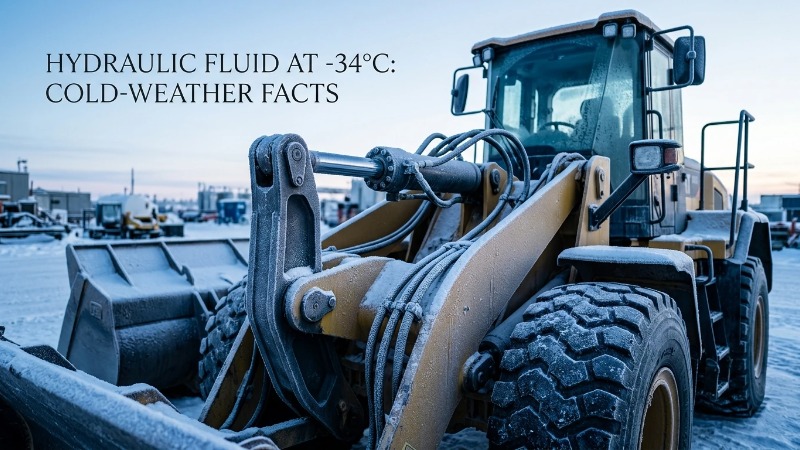
When a fleet supervisor in Fort McMurray radios in at -34°C to report "frozen hydraulics" on a wheel loader, what's actually happened inside that machine? Almost never true freezing. The oil has thickened past the point where the pump inlet can draw it — and by the time anyone diagnoses the issue, the gear set is already scored.
This guide reframes the question plant engineers and procurement teams keep asking. By the end, you'll know how to specify, test, and operate hydraulic fluids across the full temperature envelope your equipment will actually see — from Riyadh desert nights to Norwegian offshore decks.
Key Takeaways
- Hydraulic fluid does not "freeze" in the water-ice sense. It transitions through cloud point, pour point, and eventually a glass-like solid — a gradual, non-crystalline process.
- Pumps and motors typically fail from viscosity spikes long before true solidification. The practical failure threshold is inlet viscosity, not pour point.
- Pour points for common mineral hydraulic oils range roughly from -15°C to -40°C; synthetic PAO and specialty low-temp formulations extend usable range to -50°C or lower.
- Cold-start events account for a disproportionate share of hydraulic component wear — often referenced by OEMs as multiple hundreds of normal operating hours per bad start.
- Even 0.1% water contamination can create localized ice pockets that damage spools, seats, and check valves regardless of the base oil's rated pour point.
Introduction: Why "Freezing" Is the Wrong Question
Ask a maintenance crew in Alberta, an aggregate plant supervisor in Saudi Arabia's Al-Jouf region, or a rig hand on the North Sea whether hydraulic fluid freezes, and the answers vary — but the underlying failure mode is nearly identical. The fluid becomes too viscous to fill a pump inlet under atmospheric pressure. Cavitation begins in the first revolution. Damage is cumulative and often invisible until an unrelated failure exposes it.
Understanding the actual physics — not the folk term — is what separates a reliable cold-weather hydraulic program from a costly one. This is a viscosity problem masquerading as a phase-change problem, and the countermeasures differ accordingly.
What Actually Happens to Hydraulic Fluid at Low Temperatures
The Three Cold-Temperature Transition Points
Three thresholds matter for any hydrocarbon-based hydraulic fluid:
- Cloud point — the temperature at which dissolved paraffin waxes begin to precipitate, giving the fluid a hazy appearance. Flow is still possible but filter loading increases sharply.
- Pour point — the lowest temperature at which the fluid will still flow under its own weight in a standardized ASTM D97 test. Typically 3°C above the temperature at which it stops moving entirely.
- Glass transition — well below pour point, where the fluid behaves as an amorphous solid. Rare in field operation but relevant for arctic storage.
Between cloud point and pour point, fluid can still be inside a machine and appear liquid — yet be functionally unpumpable through a suction strainer.
Why Hydraulic Oil Doesn't Freeze Like Water
Water freezes crystalline at a sharp, fixed temperature. Hydraulic oil is a mixture of hydrocarbon chains of varying lengths, plus additives, so it has no single freeze point. Instead, longer-chain paraffins precipitate first, entangling with shorter chains and progressively raising apparent viscosity. The fluid behaves pseudo-plastically: it thickens under low shear, thins slightly under high shear, and never adopts a true crystalline lattice.

The Role of Base Oil Chemistry
Base oil selection determines the natural cold-flow envelope before any additive intervention:
- Mineral (Group I/II/III) — economical, well-understood, but wax-heavy. Pour points typically -15°C to -30°C.
- PAO synthetic (Group IV) — wax-free, excellent viscosity index, pour points commonly -45°C to -60°C.
- Ester-based (POE, HEES) — good cold flow and biodegradability, but seal compatibility must be verified.
- Water-glycol (HFC) — fire-resistant, limited by the water component's actual freezing behavior below roughly -20°C.
Pour point depressants and viscosity index improvers modify these baselines but cannot overcome fundamental base oil chemistry. A mineral oil dosed with PPD may pour at -40°C in a lab, but its viscosity at that temperature is still far too high for a gear pump inlet.
Pour Points and Freezing Behavior: The Data
Comparative Pour Point Ranges by Fluid Type
| Fluid Type | Typical Pour Point | Viscosity Index (typical) | Min. Recommended Ambient |
|---|---|---|---|
| ISO VG 32 Mineral (standard) | -24°C to -30°C | 95–105 | -10°C |
| ISO VG 46 Mineral (standard) | -18°C to -27°C | 95–105 | -5°C |
| ISO VG 32 HVLP (high VI) | -33°C to -42°C | 140–170 | -25°C |
| Synthetic PAO-based (VG 32) | -45°C to -60°C | 150–200 | -40°C |
| Water-glycol (HFC) | -20°C to -35°C | 140–180 | -20°C |
| Biodegradable (HEES, VG 46) | -30°C to -42°C | 170–200 | -25°C |
These are manufacturer-typical ranges; always confirm against the specific product data sheet. "Minimum recommended ambient" assumes an unheated reservoir and cold-start conditions — not steady-state operation.
Viscosity vs. Temperature: The Real Failure Curve
Pour point is a laboratory metric. What actually breaks pumps is startup viscosity. Most positive-displacement pump manufacturers cite a maximum inlet viscosity in the range of 800–1000 cSt for cold-start, with continuous operation preferred below 100 cSt. NFPA T2.24.1 and ISO 4406 provide the framework; individual pump OEM manuals set the actual numbers.
A mineral ISO VG 46 with a pour point of -24°C will already exceed 2000 cSt at -20°C — meaning the pour point rating is nearly meaningless as an operating limit. This gap between "flows in a beaker" and "fills a pump inlet" is where most cold-weather damage originates.
How Cold Temperatures Damage Hydraulic Systems
Cavitation from Starved Suction
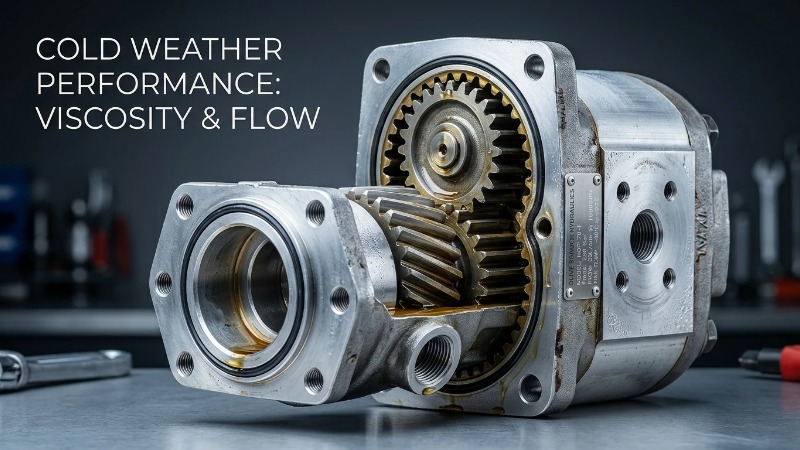
When fluid can't fill the inlet fast enough, atmospheric pressure inside the pump chamber drops below the fluid's vapor pressure. Micro-bubbles form and collapse under load, hammering gear teeth, piston shoes, and vane tips. On the K3V axial piston platform, cold-start cavitation typically shows up as slipper-face scoring; on HGP and CBHZ gear pumps, it appears as pitting on the driven gear's leading flank.
Seal Shrinkage and Micro-Leakage
NBR compounds contract measurably below their glass transition (roughly -35°C for standard nitrile). FKM is worse in the cold, typically stiffening near -20°C. The result is momentary loss of contact pressure on rotary shafts and static O-rings, producing weep leaks that self-heal once the system warms — but leave a stain the operator has to chase.
Component-Level Wear Patterns
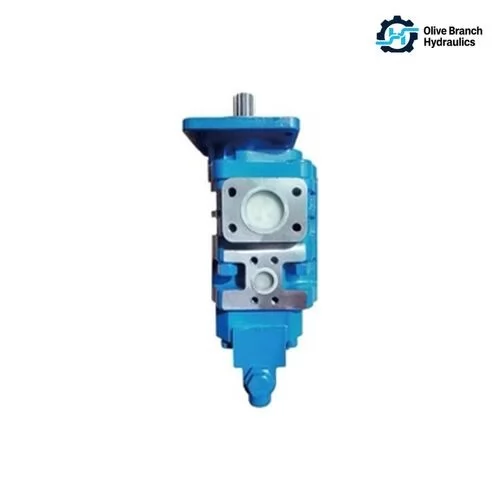
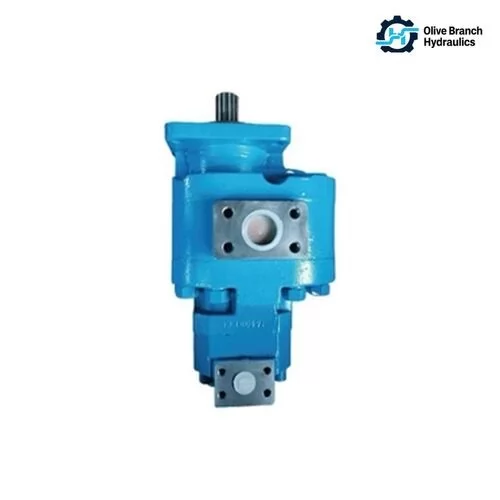
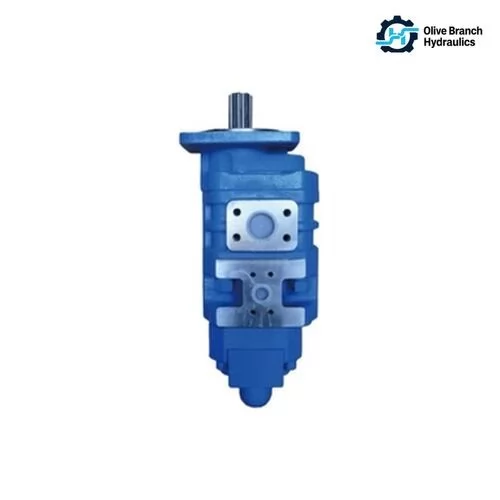
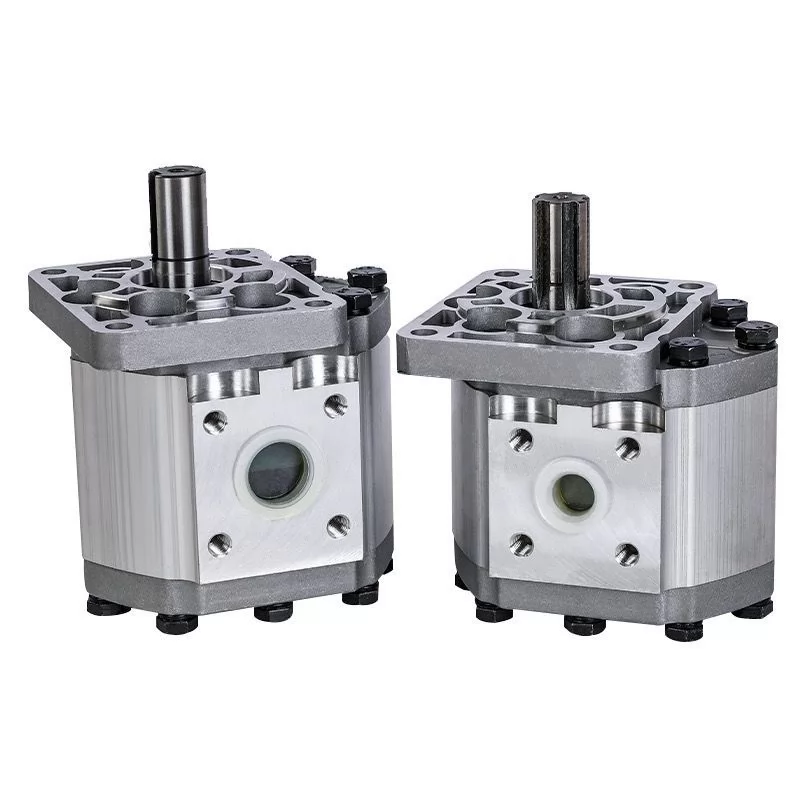
- Gear pumps (HGP, CBK, JHP series) — inlet cavitation, bushing scoring, and pressure-plate deflection.
- Piston pumps (K3V family) — slipper detachment, port plate wear, swashplate control lag.
- Cycloidal motors (BM, BMR) — geroler tooth wear from starved oil film; commutator scoring.
- Directional and multi-way valves — spool stick, delayed centering, elevated pilot pressures.
Spool valves are particularly vulnerable: a cold, thick oil film between spool and bore effectively glues the spool in position until warmed, which can trap an actuator mid-stroke.
MTBF Impact of Repeated Cold Starts
OEM maintenance literature across the mobile hydraulic sector consistently references cold-start events as disproportionate wear drivers — a single improper cold start under load is commonly equated to hundreds of hours of normal service life consumed. This is qualitative guidance rather than a single published statistic, but it aligns with what teardown inspections repeatedly show.
Selecting the Right Hydraulic Fluid for Cold Climates
Matching ISO VG Grade to Ambient Temperature Range
| Ambient Range | Recommended Grade | Notes |
|---|---|---|
| +15°C to +40°C | ISO VG 46 or 68 mineral | Standard industrial baseline |
| -5°C to +30°C | ISO VG 32 mineral or HVLP | Seasonal changeover territory |
| -20°C to +25°C | ISO VG 32 HVLP (high VI) | Pour point depressant required |
| -30°C to +20°C | ISO VG 32 semi-synthetic | Consider reservoir heater |
| Below -30°C | PAO synthetic VG 22 or 32 | Verify seal and paint compatibility |
High Viscosity Index (HVI) vs. Standard Mineral Oil
HVI fluids (VI > 140) hold viscosity more stably across a wide thermal band. The premium — typically 15–30% over standard mineral — pays back quickly in mobile equipment, outdoor-stored power units, and any duty cycle with frequent cold starts. For indoor, temperature-controlled plants, standard mineral remains the rational choice.
Fire-Resistant and Synthetic Options for Extreme Environments
HFC (water-glycol) is limited by its aqueous fraction: below roughly -20°C the water phase begins forming ice slush that will destroy any pump. HFDU (water-free polyol ester) extends fire resistance to genuinely cold applications. PAO synthetics dominate the true arctic space — cold-storage forklifts, oil-sands mining, and northern-latitude wind turbine pitch systems.
Every fluid switch demands a seal audit. Moving from mineral to phosphate ester without changing NBR seals to EPDM is a classic failure. Paints and hose inner liners deserve the same review.
Regional Considerations
- Northern Europe & North America — mandatory winter-grade specification, often with two-season fluid changeovers on mobile fleets.
- Middle East — commonly overlooked cold-desert nights. Al-Jouf, northern Iran, and parts of interior Saudi Arabia routinely drop below -5°C in winter despite the region's hot-climate reputation.
- Southeast Asia — high-altitude operations in northern Vietnam and Myanmar's Shan plateau see near-freezing overnights that catch equipment specified for tropical baseline.
Cold-Start Protocols for Industrial Hydraulic Systems
Pre-Start Warm-Up Procedure
- Verify reservoir temperature meets fluid manufacturer minimum (commonly -10°C above pour point).
- Start prime mover at low idle. Do not engage load.
- Circulate at zero pressure through an unloader or open-center valve for 3–10 minutes depending on ambient.
- Ramp system pressure in stages: 25%, 50%, 75%, then full.
- Cycle each actuator through full stroke at reduced speed before production loading.
- Confirm reservoir temperature has reached at least +10°C (mineral) or the fluid-specific operating window before applying rated load.
Reservoir Heaters and Immersion Elements
Immersion heaters should be sized to keep watt density below 0.8 W/cm² for mineral oils and 0.5 W/cm² for synthetic esters, to prevent localized coking and additive breakdown. A common rule of thumb for outdoor mineral-oil reservoirs is 40–60 W per liter of oil, thermostatically controlled with a low-limit cutout.
Line Insulation and Enclosure Heating
Suction lines carry the highest cold-start penalty and should be insulated first. Heat tracing return lines is a secondary measure. Full enclosure of the power unit — with thermostatic space heating — is justified whenever ambient regularly falls below the fluid's practical operating minimum and start-frequency exceeds twice daily.
Monitoring: Temperature and Viscosity Sensors
Inline temperature sensors interlocked with the load-application circuit are standard on modern PLC-integrated power units. Viscosity sensors are less common but increasingly cost-justified on high-value mobile fleets, where they can prevent a single cavitation event that would otherwise write off a pump.
Common Mistakes in Cold-Weather Hydraulic Operation
Mistake 1: Relying on Pour Point Alone
Pour point tells you the fluid still moves in a test tube. It tells you nothing about whether your pump can draw it.
Mistake 2: Using Summer-Grade Oil Year-Round
The saved changeover cost is trivial compared to a single scored piston pump. Fleets operating in climates that swing more than 40°C annually should plan two grades.
Mistake 3: Cold-Starting Under Load
The single most damaging habit in the industry. Full pressure on a cold, cavitating pump concentrates all the wear that should have been distributed over months into minutes.
Mistake 4: Ignoring Water Contamination
Even 0.1% dissolved water can precipitate as free water below +5°C, then freeze in localized pockets around valve seats and pilot orifices. ISO 4406 cleanliness classes and separate water-content targets (typically <200 ppm for mobile, <100 ppm for servo systems) are non-negotiable in cold operations.
Mistake 5: Mismatched Seal Compatibility After Fluid Switch
Switching from mineral to PAO, ester, or fire-resistant fluid without reviewing seal materials produces leaks that appear weeks later — long after anyone connects them to the change.
Testing and Verification
Standard Test Methods
- ASTM D97 — pour point, the temperature at which flow ceases in a controlled cool-down.
- ASTM D2270 — viscosity index, quantifying viscosity stability across temperature.
- ASTM D445 / ISO 3104 — kinematic viscosity at 40°C and 100°C, the two data points most often quoted on data sheets.
- ASTM D5133 — Scanning Brookfield viscosity, more useful than pour point for actual cold-pumpability prediction.
Specify D5133 data whenever cold-start reliability matters. It's the only common test that reveals viscosity behavior in the gap between cloud point and pour point where most field failures happen.
In-House QC Practices at the Component Level
Pump and motor manufacturers should validate cold-start behavior on the test stand, not just at ambient. At Olive Branch Hydraulics, every gear pump, piston pump, cycloidal motor, and directional valve is verified on instrumented pressure benches and flow meters as part of 100% pre-shipment inspection under ISO 9001 protocols. This OEM-side verification is what allows downstream buyers to trust that a K3V, HGP, or BM series unit will survive its first winter start rather than fail three months into service.
FAQ
At what temperature does hydraulic fluid freeze?
Hydraulic fluid does not freeze at a single point the way water does. It gradually thickens between its cloud point and pour point, then approaches a glass-like solid state below that. Typical pour points range from about -15°C for standard mineral oil to -60°C for PAO synthetic formulations.
Can hydraulic fluid freeze in a parked machine overnight?
The fluid will not solidify at typical outdoor temperatures, but it can thicken enough to make a cold start damaging. Equipment parked outdoors below -20°C on standard mineral oil should not be started under load without warm-up circulation or reservoir heating.
Does hydraulic oil expire in cold storage?
Sealed containers stored between -10°C and +30°C typically retain full spec for 2–5 years depending on additive package. Repeated freeze-thaw cycles can cause additive dropout, particularly in HVI mineral oils; visible cloudiness or sediment at room temperature warrants replacement rather than use.
What happens if I run a hydraulic pump with fluid that's too cold?
Inlet cavitation begins immediately, damaging gear teeth, pistons, or vanes. Seals may weep from thermal contraction. In severe cases, high inlet vacuum can pull air past shaft seals, aerating the system. Most OEM warranties explicitly exclude damage from cold-start operation outside specified viscosity limits.
Is synthetic hydraulic oil always betterfor cold weather?
Not universally. PAO synthetics dominate below -30°C, but at moderate cold (-10°C to -25°C) a high-VI mineral or semi-synthetic often delivers equivalent reliability at lower cost. Synthetics also demand seal and paint compatibility verification, and some ester-based formulations are hygroscopic — a liability in humid cold environments.
How do I know if my hydraulic fluid is too cold to operate?
Field indicators include unusual whining or knocking from the pump, sluggish or jerky actuator response, elevated inlet vacuum readings (above 0.3 bar absolute below atmospheric), delayed valve centering, and pressure gauges that overshoot setpoint before settling. Any one of these on cold-start is a signal to abort and warm up.
Can I mix winter and summer hydraulic oils?
Mixing is possible only when both fluids share base oil type, additive chemistry, and manufacturer approval. Even then, the blended viscosity index will fall between the two grades, defeating the purpose of the winter oil. Full drain-and-fill is the defensible practice for seasonal changeover.
Conclusion & Next Step
The question isn't whether hydraulic fluid freezes. It's whether the fluid in your system stays pumpable across every temperature your equipment will actually see — from the coldest overnight low in the parking yard to the peak reservoir temperature at full duty cycle. Pour point is a data-sheet number. Cold-start viscosity, seal behavior, water content, and warm-up discipline are what determine whether a pump reaches its rated service life.
For plant managers and procurement engineers specifying new hydraulic equipment — or replacing components in existing lines — climate-matched selection is not an upcharge item. It's the baseline. Olive Branch Hydraulics supports OEM and aftermarket buyers with pump, motor, and valve configurations verified against the fluid grades and ambient envelopes of the target deployment: K3V and HGP families for mobile fleets in variable climates, BM and BMR cycloidal motors for outdoor rotational duty, and multi-way and directional valves with custom P/T port configurations and SAE-standard interfaces for cold-region integration.
Contact our engineering team with your ambient temperature range, existing fluid grade, and duty cycle profile. We'll return a compatibility-verified specification — factory-direct, ISO 9001 built, and 100% pressure-bench tested before it ships. No exceptions.