
Most pumps need you to fill them with fluid before they'll work. Gear pumps are different—they can draw fluid in on their own. But here's the thing: that self-priming capability isn't guaranteed. It hinges on a handful of factors that tend to get overlooked during system design. Get them wrong, and you're looking at cavitation, lost prime, and parts wearing out way ahead of schedule.
This technical treatise provides a rigorous analysis of gear pump suction mechanisms, the governing parameters of self-priming performance, and the operational boundaries within which these pumps demonstrate efficacy or limitation. For engineers engaged in pump specification for viscous fluid transfer applications or conducting diagnostic evaluation of existing installations, this document delivers the requisite engineering fundamentals and empirical considerations.
What Makes a Pump Self Priming?
Definition of Self Priming in Pumps
A self-priming pump can evacuate air from its suction line and create enough vacuum to draw fluid into the pump chamber without external intervention. The self priming pump mechanism eliminates the need for manual filling, foot valves, or auxiliary vacuum systems before startup.
This capability is essential in applications where the pump sits above the fluid source. Without self-priming ability, the operator must flood the suction line before every start, adding labor and downtime to the process.
How Self Priming Differs From Standard Priming
Standard pumps, particularly centrifugal designs, require a flooded suction condition to operate. They cannot generate suction independently because their impeller needs continuous fluid contact to transfer energy.
Self-priming pumps, by contrast, can handle a suction line filled with air during initial startup. They compress and expel that air, progressively lowering pressure in the suction line until atmospheric pressure pushes fluid up into the pump. This dry-start capability is what separates positive displacement designs from most centrifugal alternatives.
Are Gear Pumps Self Priming? The Direct Answer
Yes, gear pumps are inherently self-priming. Their positive displacement design generates suction mechanically, making them capable of evacuating air and drawing fluid from below without external priming assistance.
Why Gear Pumps Are Considered Self Priming
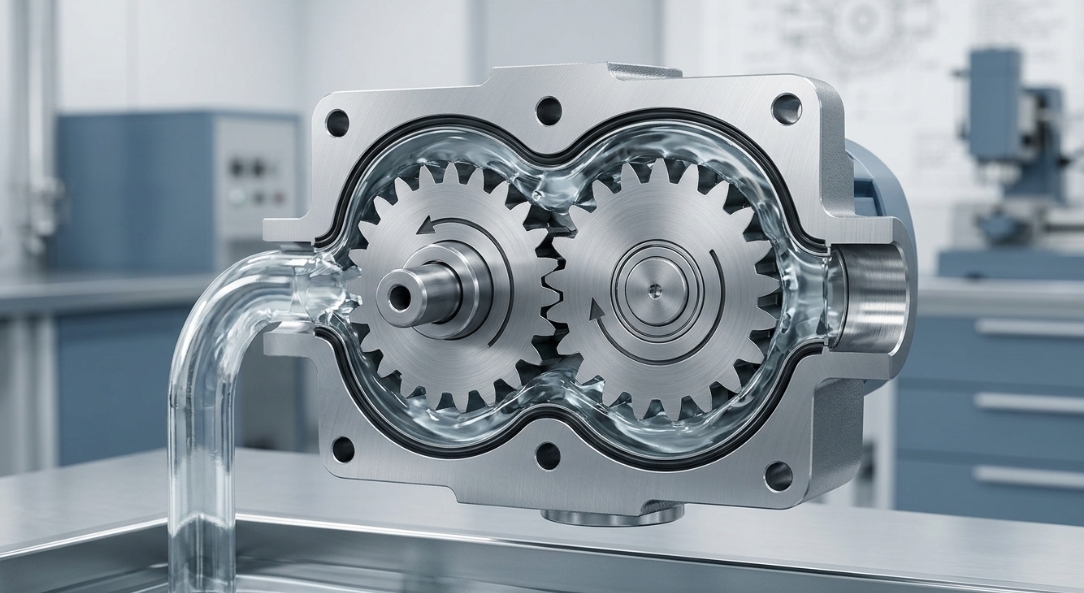
The positive displacement pump priming principle is straightforward. As meshing gears rotate and unmesh on the suction side, they create expanding cavities between the gear teeth. These expanding volumes generate a localized vacuum that pulls fluid into the pump housing.
Because the gears physically trap and move discrete volumes of fluid, the pump doesn't rely on fluid momentum or centrifugal force. This mechanical displacement action works whether the incoming medium is liquid, air, or a mixture of both. It's this fundamental operating principle that gives gear pumps their reliable self-priming characteristic.
External Gear Pumps vs. Internal Gear Pumps
Both external and internal gear pump designs are self-priming, but they differ in suction capability and application suitability.
| Characteristic | External Gear Pumps | Internal Gear Pumps |
|---|---|---|
| Typical Suction Lift | 3–5 meters | 4–6 meters |
| Priming Speed | Fast at higher RPM | Effective at lower RPM |
| Low-Viscosity Performance | Moderate | Better due to tighter sealing |
| Viscous Fluid Handling | Good | Excellent |
| Wear Impact on Priming | More sensitive | More tolerant |
Internal gear pumps generally offer superior gear pump suction capability because their crescent seal and rotor-idler geometry maintain tighter internal clearances. External gear pumps compensate with higher speed capability and simpler construction.
How the Self Priming Mechanism Works in Gear Pumps
The Role of Tight Tolerances
The self-priming ability of a gear pump depends directly on the clearances between the gear teeth, the housing bore, and the side plates. These gaps must be small enough to prevent air from leaking back from the discharge side to the suction side during the priming phase.
When tolerances are tight, the expanding cavities on the suction side maintain their vacuum effectively. Even small increases in clearance — as little as 0.05 mm — can significantly reduce the pump's ability to evacuate air and establish prime.
Fluid Viscosity and Priming Efficiency
Viscous fluid pumping dramatically improves self-priming performance. Higher-viscosity fluids act as a natural sealant between the gear teeth and housing walls, filling microscopic gaps that would otherwise allow air to slip past.
A gear pump handling 100 cSt hydraulic oil will prime far more reliably than the same pump attempting to draw water at 1 cSt. This is why gear pumps are the dominant choice for oil transfer, lubricant circulation, and resin handling — the fluid itself enhances the pump's sealing and suction capability.
Conversely, thin fluids like solvents and light fuels reduce the effective seal between moving parts. In these applications, tighter manufacturing tolerances or flooded suction conditions may be necessary to ensure reliable priming.
Suction Lift Limitations
While gear pumps are self-priming, they are not unlimited in their suction reach. Practical suction lift for most gear pumps falls between 3 and 6 meters, depending on pump condition, fluid properties, and system design.
Key factors influencing maximum suction lift include:
- Fluid viscosity — higher viscosity supports greater lift
- Pump speed — optimal RPM range varies by design
- Internal wear state — new pumps outperform worn units
- Altitude and atmospheric pressure — lower ambient pressure reduces available NPSH
- Suction line diameter and length — friction losses reduce effective suction
Exceeding these limits doesn't just prevent priming. It creates conditions for gear pump cavitation, which causes progressive damage to internal components.
Factors That Affect Gear Pump Self Priming Performance
Wear and Internal Clearances
As gear pumps accumulate operating hours, internal clearances increase due to abrasive wear, corrosion, and fatigue. This wear directly reduces the pump's ability to maintain vacuum on the suction side during priming.
A pump that originally self-primed from 5 meters may struggle at 2 meters after significant wear. Regular inspection of gear tooth profiles, housing bores, and side plate flatness is essential for maintaining reliable gear pump suction capability over the pump's service life.
Fluid Properties and Temperature
Temperature changes affect viscosity, which in turn affects priming. A pump that primes easily with cold, thick oil may lose that ability when the same oil thins out at elevated operating temperatures.
Vapor pressure is equally critical. Fluids with high vapor pressure — volatile solvents, hot hydrocarbons — are more prone to flashing into vapor under suction conditions. This vapor formation prevents the pump from establishing a continuous liquid column, effectively defeating the self-priming mechanism.
Suction Line Design and Length
Even the best gear pump cannot overcome poor suction piping design. Long suction lines, excessive fittings, undersized pipe diameters, and high points that trap air all reduce priming reliability.
Best practices for maximizing self-priming success include:
- Keep suction lines as short and direct as possible
- Size suction piping one size larger than the pump inlet port
- Eliminate high points where air pockets can form
- Use eccentric reducers (flat side up) at the pump inlet
- Ensure all joints are airtight — even minor leaks defeat priming
Speed and RPM Considerations
Rotational speed has a complex relationship with self-priming. Higher speeds generate more suction events per second, which can accelerate air evacuation. However, excessive speed can also outpace the fluid's ability to fill the expanding cavities, creating localized vacuum that triggers cavitation.
Most gear pump manufacturers specify an optimal priming speed range, often lower than the normal operating speed. Starting the pump at reduced RPM during priming, then ramping up once flow is established, is a common and effective strategy.
Gear Pump Cavitation — When Self Priming Fails
What Causes Gear Pump Cavitation
Gear pump cavitation occurs when suction demand exceeds the pump's ability to draw fluid into the expanding gear cavities. When local pressure drops below the fluid's vapor pressure, dissolved gases come out of solution and vapor bubbles form in the low-pressure zones.
These bubbles collapse violently when they reach the high-pressure discharge side, generating intense localized shock waves. Common causes include excessive suction lift, high pump speed, restricted suction lines, cold starts with highly viscous fluids, and clogged inlet strainers.
Signs of Cavitation Damage
Cavitation rarely appears without warning. Recognizing early symptoms prevents catastrophic failure:
- Noise — crackling, rattling, or gravel-like sounds from the pump
- Vibration — irregular vibration patterns, especially at the suction side
- Reduced flow — output drops below expected values at normal speed
- Pressure instability — erratic discharge pressure readings
- Surface pitting — microscopic craters on gear tooth surfaces and housing bores visible during inspection
Left unchecked, cavitation erodes gear teeth, damages bearings, and destroys seals. The resulting increase in internal clearances further degrades suction capability, creating a self-reinforcing failure cycle.
How to Prevent Cavitation in Gear Pumps
Preventing cavitation requires ensuring that Net Positive Suction Head available (NPSHa) always exceeds the pump's Net Positive Suction Head required (NPSHr). Practical prevention steps include:
- Reduce suction lift or elevate the fluid source relative to the pump
- Increase suction line diameter to reduce friction losses
- Lower pump speed to reduce suction demand
- Maintain inlet strainers and filters to prevent restriction buildup
- Pre-heat highly viscous fluids to reduce flow resistance in suction piping
- Install a vacuum gauge on the suction port to monitor conditions in real time
Applications Where Gear Pump Self Priming Excels
Oil and Lubricant Transfer
Gear pumps dominate petroleum and hydraulic fluid handling precisely because of their self-priming capability combined with excellent performance in viscous fluid pumping. Lube oil transfer, fuel delivery, hydraulic power units, and engine oil circulation all rely on gear pumps to draw fluid from tanks and reservoirs positioned below the pump centerline.
The moderate viscosity of these fluids (typically 30–300 cSt at operating temperature) sits in the ideal range for gear pump self-priming, providing natural internal sealing without excessive flow resistance.
Chemical Processing
Batch chemical operations frequently require pumps to empty drums, totes, and reactors where flooded suction isn't practical. Gear pumps self-prime reliably in these scenarios, handling resins, polymers, adhesives, and coating materials without auxiliary priming systems.
Their ability to start dry and establish flow independently makes them ideal for intermittent duty cycles where the suction line drains between batches. This reduces operator intervention and speeds up changeover times.
Food and Beverage Industry
Viscous food products like chocolate, caramel, syrups, peanut butter, and tomato paste are well-suited to gear pump transfer. The self-priming capability allows pumps to draw product from mixing vessels, storage tanks, and processing kettles without pre-flooding.
Sanitary gear pump designs with CIP-compatible construction maintain self-priming performance while meeting food safety standards. The gentle, low-shear pumping action also preserves product quality during transfer.
Limitations of Gear Pump Self Priming
Dry Running Risks
While gear pumps can handle brief dry running during the priming phase, prolonged operation without fluid causes serious damage. The pumped fluid serves as both lubricant and coolant for internal components. Without it, metal-to-metal contact generates excessive heat, scoring gear surfaces and destroying shaft seals.
Most manufacturers recommend limiting dry running to 30–60 seconds maximum. Systems with long suction lines or uncertain fluid availability should incorporate dry-run protection such as level switches or current monitoring to shut down the pump if prime isn't established within a safe timeframe.
Low-Viscosity Fluid Challenges
Gear pumps struggle to maintain prime with water-like fluids below 5 cSt. The thin fluid cannot adequately seal the clearances between gears and housing, allowing air to recirculate internally rather than being expelled through the discharge.
For low-viscosity applications requiring self-priming, options include selecting pumps with tighter tolerances, reducing suction lift to near zero, or choosing alternative pump types better suited to thin fluids.
When to Choose an Alternative Pump Type
Gear pumps aren't always the right self-priming solution. Consider alternatives in these scenarios:
- Abrasive slurries — peristaltic or diaphragm pumps avoid internal wear from solids
- High suction lift with thin fluids — self-priming centrifugal pumps with recirculation chambers handle water-like fluids at greater lifts
- Shear-sensitive fluids — progressive cavity or lobe pumps offer gentler handling
- Dry running expected — diaphragm and peristaltic pumps tolerate indefinite dry operation
- Solids or large particulates — gear pump clearances cannot pass solid debris without damage
Frequently Asked Questions (FAQ)
Can a gear pump run dry?
Gear pumps can tolerate short periods of dry running during initial priming, typically 30 to 60 seconds. However, extended dry operation causes rapid wear, overheating, and seal failure because the pumped fluid provides essential lubrication and cooling. Always install dry-run protection on systems where fluid availability is uncertain.
How high can a gear pump self-prime?
Most gear pumps can self-prime from suction lifts of 3 to 6 meters, depending on fluid viscosity, pump condition, and speed. Higher-viscosity fluids and new pumps with tight clearances achieve the upper end of this range. Thin fluids, worn pumps, and long suction lines reduce practical lift to the lower end or below.
Do gear pumps need a foot valve?
Foot valves are optional for gear pumps in most applications because the pump can re-prime itself after the suction line drains. However, foot valves are recommended when suction lines are very long, when minimizing startup time is critical, or when frequent dry-start cycles would accelerate wear. They keep the suction line flooded and reduce stress on the pump during each restart.
What is the best fluid viscosity for gear pump self priming?
The optimal viscosity range for reliable self-priming is typically 50 to 500 cSt. Within this range, the fluid provides excellent internal sealing without creating excessive resistance to flow in the suction line. Fluids below 10 cSt may not seal adequately for reliable priming, while fluids above 2000 cSt may resist flow into the pump fast enough to fill the expanding cavities.
How do I know if my gear pump has lost its prime?
Common symptoms of a lost prime include sudden increase in noise (air entrainment sounds), erratic or zero discharge pressure, visible air bubbles in transparent discharge lines, and the pump motor drawing less current than normal. If the pump cycles between primed and unprimed states, check for suction line air leaks, a depleted fluid source, or excessive suction lift conditions.
Are internal gear pumps better at self priming than external gear pumps?
Internal gear pumps generally offer slightly better self-priming capability due to their tighter internal sealing geometry and lower internal leakage rates. They also perform better with lower-viscosity fluids during priming. However, external gear pumps prime faster at higher speeds and are more cost-effective for straightforward viscous fluid applications. The best choice depends on your specific fluid properties, suction conditions, and performance requirements.