
The hydraulic drive partner you choose will shape equipment performance, plant uptime, and total cost of ownership for a decade or more. This guide profiles ten global leaders, benchmarks their technical capabilities, and hands procurement and engineering teams a practical framework for vendor evaluation.
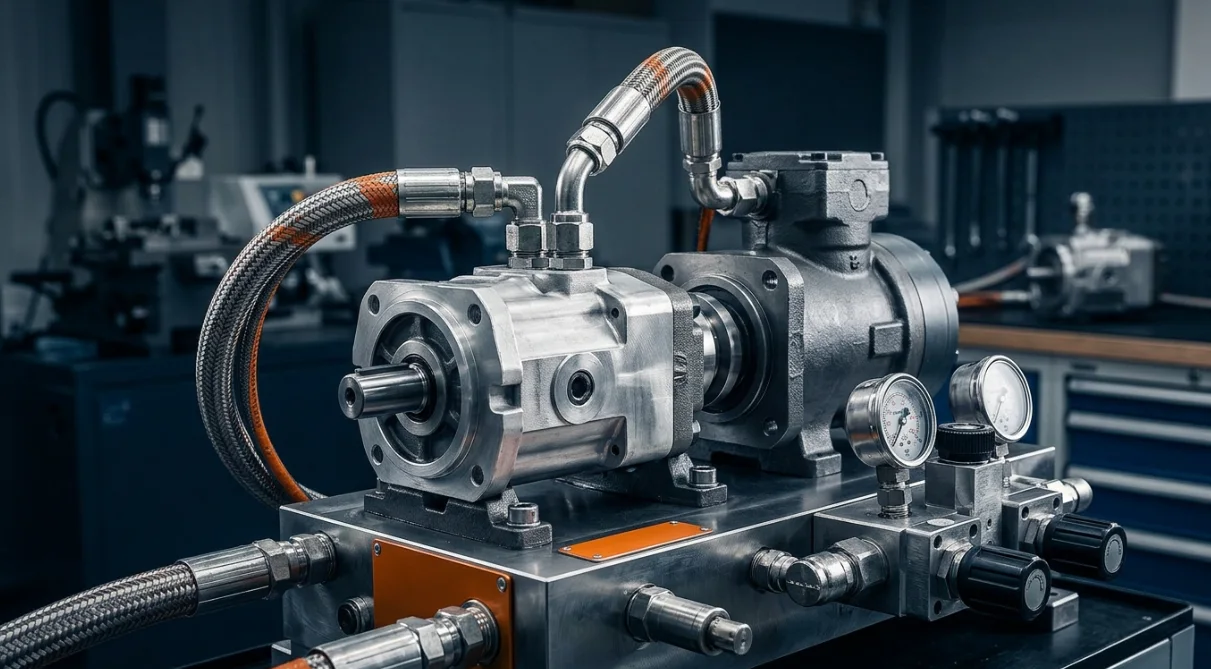
Executive Summary: The Hydraulic Drive System Market Landscape
Fluid power is still the backbone of high-force motion control across construction equipment, marine propulsion, metal forming, and aerospace actuation. Electrification dominates the headlines, yet hydraulic drive systems keep growing in absolute terms, especially where applications demand extreme power density and environmental robustness.
Market Size and Growth Projections
The global hydraulic systems market was valued at approximately USD 42 billion in 2024, according to multiple industry analyst reports, with forecasts pointing to a compound annual growth rate (CAGR) of 4.8% to 5.6% through 2030. Asia-Pacific leads regional demand, driven by infrastructure spending in India, Indonesia, and the Middle East.
Demand clusters around four sectors: off-highway construction equipment, industrial automation retrofits, offshore wind installation vessels, and defense modernization programs. Each segment imposes distinct technical requirements that decide which hydraulic power unit manufacturer can credibly compete.
Why Vendor Selection Matters for Industry Professionals
Hydraulic systems typically account for 8% to 15% of capital cost on heavy machinery, yet they drive a disproportionate share of unplanned downtime. Any mismatch between vendor strengths and application requirements compounds across the asset lifecycle through energy waste, premature seal failures, and parts unavailability.
A credible fluid power systems supplier with regional engineering presence cuts mean time to repair (MTTR), unlocks firmware-level diagnostics, and preserves resale value. The wrong choice often surfaces only three to five years into operation, once warranty support has lapsed.
Evaluation Criteria: How We Ranked These Companies
The rankings below are not based on revenue alone. They reflect a weighted assessment across three pillars that matter to specifying engineers and OEM procurement teams.
Technical Capability Benchmarks
We evaluated each manufacturer against operating pressure ranges (typically 250 to 700 bar for industrial applications), flow rate envelopes, volumetric and overall efficiency, and conformance to ISO 4413 safety standards for fluid power systems. Proprietary technologies, such as variable displacement axial piston pumps and closed-loop servo-hydraulic systems, weighed heavily in scoring.
Global Service Footprint and Support
Field support depth was scored against documented service center counts, average regional spare parts availability, MTTR benchmarks reported in industry studies, and the presence of in-country application engineering teams. Manufacturers with thin service coverage in a buyer's region lost points regardless of technical merit.
R&D Investment and Innovation Index
The third evaluation pillar looked at R&D-to-revenue ratios, annual patent filings, and contributions to electrohydraulic actuators and IoT-enabled condition monitoring. Companies reinvesting 4% or more of revenue into R&D consistently outpaced peers on smart hydraulics roadmap delivery.
Top 10 Hydraulic Drive System Companies Compared
1. Bosch Rexroth (Germany)
Bosch Rexroth sets the global benchmark in industrial hydraulic equipment, pairing deep engineering heritage with aggressive Industry 4.0 integration. Its CytroPac compact power units and Sytronix variable-speed pump drives consistently rank among the most energy-efficient solutions on the market.
Core Product Lines and Specifications
Flagship offerings include A4VSO and A10VSO axial piston pumps rated up to 350 bar, 4WRPEH proportional valves with integrated electronics, and turnkey hydraulic power units for mobile and stationary deployments alike. The ODiN condition-monitoring platform brings predictive maintenance to distributed fleets.
Notable Industry Deployments
Reference projects span hot-strip rolling mills for major European steel producers, pitch and yaw systems on offshore wind turbines above 14 MW, and motion control for tunnel boring machines on the Brenner Base Tunnel.
2. Parker Hannifin (USA)
Headquartered in Cleveland, Ohio, Parker Hannifin runs one of the deepest motion and control technology portfolios in the industry. Its hydraulics business draws on a distribution network of more than 13,000 partners worldwide. For OEMs that need rapid global aftermarket coverage, that reach is a meaningful advantage.
Core Product Lines and Specifications
The GOLD CUP P2 and P3 piston pump series, rated to 414 bar continuous pressure, anchor heavy industrial applications. Parker also builds precision hydraulic cylinders, integrated electrohydraulic actuators (EHAs), and the IQAN mobile electronic control platform.
Notable Industry Deployments
Aerospace primary flight controls on commercial widebody aircraft, defense vehicle suspension systems, and subsea blowout preventer actuation in deepwater oil and gas operations all run on Parker fluid power components.
3. Eaton (Ireland/USA)
Eaton's hydraulics legacy carried decades of weight across mobile and industrial markets. After the 2021 divestiture of its hydraulics business to Danfoss, the Eaton brand persists in legacy install bases while Danfoss now stewards forward development of the former Vickers, Char-Lynn, and Aeroquip product families.
For procurement teams managing existing Eaton-branded hydraulic pump and motor company assets, parts continuity has been preserved under Danfoss ownership, though specifying engineers should check current data sheets for any rebranded equivalents.
4. Danfoss Power Solutions (Denmark)
Post-acquisition, Danfoss Power Solutions ranks among the broadest mobile hydraulics portfolios globally. Pair Danfoss's electronic controls expertise with Eaton's mechanical heritage and you get a credible counterweight to Bosch Rexroth in off-highway equipment.
The H1 family of axial piston pumps and motors, PVG proportional valves, and the Plus+1 controller platform together form an integrated solution stack for agricultural machinery, telehandlers, and compact construction equipment. The investment in Editron electrified powertrains points to a long-term hybridization strategy.
5. Kawasaki Precision Machinery (Japan)
Kawasaki Precision Machinery anchors Asian hydraulic supply for excavators and industrial robotics. Its K3V and K7V swash-plate axial piston pump families sit on the majority of Japanese and Korean excavator OEM platforms and have settled in as a de facto standard in mid-tonnage construction equipment.
A hydraulic cylinder solutions house with adjacent depth in motors and valves, Kawasaki holds particular leadership in marine deck machinery, steering gear, and high-precision industrial robot wrist actuators.
6. HAWE Hydraulik (Germany)
HAWE Hydraulik owns a distinctive niche: compact, high-pressure systems often rated to 700 bar in modular power pack form factors. Where space is tight and force density matters, HAWE routinely outperforms larger generalist competitors.
Its radial piston pumps, valve banks, and pre-engineered compact power units serve machine tool builders, material handling OEMs, and special-purpose machinery integrators across Europe, with a growing footprint in North America.
7. Hydac International (Germany)
Hydac differentiates through deep expertise in filtration, accumulators, and cooling, then layers complete hydraulic drive systems on top. The bottom-up approach yields particularly strong fluid conditioning, a frequently underweighted factor that disproportionately affects component longevity.
The product range spans bladder and piston accumulators, condition-monitoring sensors, and CompactPower Units that integrate pump, reservoir, valves, and electronics into a single skid-mounted package.
8. Moog Inc. (USA)
Moog operates at the high-precision extreme of the hydraulic spectrum. Its servo-hydraulic systems power flight simulators, fatigue testing rigs for aerospace structures, seismic shake tables, and the actuation systems of the most demanding industrial robots.
Moog's addressable market is narrower than Bosch Rexroth's or Parker's, but its dominance in performance-critical servo applications is essentially uncontested. Procurement teams specifying closed-loop force or position control at sub-micron precision will encounter Moog by default.
9. Yuken Kogyo (Japan)
Yuken Kogyo holds a respected position as an industrial hydraulic equipment provider across Asian manufacturing markets, with particular strength in stationary industrial applications such as plastic injection molding machines, presses, and machine tools.
Variable vane pumps, proportional valves, and modular stack valve assemblies form the core catalog. Yuken pricing typically lands 10% to 20% below European equivalents at comparable specification, an advantage that resonates with cost-sensitive Asian OEMs.
10. SUN Hydraulics (Helios Technologies, USA)
SUN Hydraulics, now part of Helios Technologies, has built a formidable business around screw-in cartridge valves and floating-construction manifold designs. The modular philosophy lets OEM circuit designers assemble complex hydraulic logic from standard building blocks instead of cutting custom castings.
For machine builders that put design flexibility, short prototyping cycles, and global parts availability first, SUN cartridges have become a near-universal currency in mobile and industrial circuit design.
Comparative Data Tables
Table 1: Company Headquarters, Founded Year, and Annual Hydraulics Revenue
| Company | HQ Country | Founded | Approx. Annual Hydraulics Revenue |
|---|---|---|---|
| Bosch Rexroth | Germany | 1795 | ~€7.0B |
| Parker Hannifin | USA | 1917 | ~$8.5B (Motion & Control) |
| Danfoss Power Solutions | Denmark | 1933 | ~€4.2B |
| Kawasaki Precision Machinery | Japan | 1916 | ~¥120B |
| HAWE Hydraulik | Germany | 1949 | ~€450M |
| Hydac | Germany | 1963 | ~€1.4B |
| Moog Inc. | USA | 1951 | ~$3.3B (total) |
| Yuken Kogyo | Japan | 1929 | ~¥45B |
| SUN Hydraulics (Helios) | USA | 1970 | ~$890M (Helios) |
Table 2: Product Specification Comparison (Flagship Pump Lines)
| Company | Max Pressure (bar) | Flow Range (L/min) | Overall Efficiency | Noise Level (dB(A)) |
|---|---|---|---|---|
| Bosch Rexroth A4VSO | 350 | 71–1000 | 92% | 72–78 |
| Parker GOLD CUP P3 | 414 | 60–500 | 91% | 74–80 |
| Danfoss H1 | 480 | 45–280 | 93% | 70–76 |
| Kawasaki K3V | 350 | 112–280 | 91% | 73–79 |
| HAWE V60N | 400 | 60–250 | 90% | 70–75 |
| Hydac PPV | 350 | 20–250 | 90% | 72–78 |
| Moog Servo Pump | 280 | 30–500 | 89% | 68–74 |
| Yuken AR Series | 250 | 16–22 | 88% | 65–70 |
Table 3: Industry Application Coverage Matrix
| Company | Mobile | Industrial | Marine | Aerospace | Energy | Agriculture |
|---|---|---|---|---|---|---|
| Bosch Rexroth | Strong | Strong | Strong | Moderate | Strong | Strong |
| Parker Hannifin | Strong | Strong | Strong | Strong | Strong | Strong |
| Danfoss Power Solutions | Strong | Moderate | Moderate | Limited | Moderate | Strong |
| Kawasaki | Strong | Moderate | Strong | Limited | Limited | Limited |
| HAWE Hydraulik | Moderate | Strong | Limited | Limited | Moderate | Limited |
| Hydac | Moderate | Strong | Strong | Limited | Strong | Moderate |
| Moog | Limited | Strong | Limited | Strong | Moderate | Limited |
| Yuken | Limited | Strong | Moderate | Limited | Limited | Limited |
| SUN Hydraulics | Strong | Strong | Moderate | Limited | Moderate | Strong |
Selection Framework: Choosing the Right Hydraulic Drive System Partner
Matching Vendor Strengths to Application Requirements
Application fit should drive shortlist construction before any commercial negotiation begins. High-cycle industrial presses with closed-loop force feedback gravitate toward Moog or Bosch Rexroth servo solutions, while telehandlers and skid steers sit more naturally inside the Danfoss or Kawasaki mobile portfolios.
Compact, space-constrained machinery favors HAWE high-pressure modular systems. OEM circuit designers chasing maximum flexibility usually build around SUN cartridge ecosystems. Misaligning these strengths almost always produces avoidable engineering rework.
Total Cost of Ownership Considerations
Acquisition cost rarely exceeds 20% of lifetime spend on a hydraulic drive system. Energy consumption, scheduled maintenance, seal and filter replacement intervals, and end-of-life remanufacturing carry far more weight in ten-year economics.
Variable-speed pump drives, such as those offered under the Sytronix and similar platforms, can cut hydraulic energy consumption by 30% to 70% in part-load applications. Payback typically lands inside three years for two-shift operations.
Sustainability and Energy Efficiency Standards
EU Ecodesign regulations, tightening noise directives, and corporate decarbonization commitments are reshaping specifications. Procurement teams increasingly require biodegradable HEES hydraulic fluids, leakage-free quick-connect couplings, and documented energy efficiency data per ISO 4409.
Leading manufacturers publish energy maps for variable displacement pumps and provide simulation tools that quantify CO₂ impact across duty cycles. Vendors without that transparency increasingly fail enterprise sustainability procurement gates.
Emerging Trends Reshaping the Hydraulic Drive Industry
Electrohydraulic Hybrid Systems
Self-contained electrohydraulic actuators (EHAs) integrate a servo motor, pump, reservoir, and cylinder into a single sealed unit. They are progressively replacing centralized hydraulic power units in applications such as aircraft flight controls, industrial robots, and increasingly mobile work tools where flexible energy routing matters more than absolute power density.
Predictive Maintenance and IIoT Integration
Condition monitoring has shifted from optional accessory to baseline expectation. Embedded pressure, temperature, vibration, and oil-quality sensors feed edge analytics platforms that flag degradation patterns well before failure, often stretching component life by 20% or more in field deployments.
Bosch Rexroth's ODiN, Parker's Voice of the Machine, and Hydac's CMU platforms point to where the market is converging. Buyers should weigh not only the sensor hardware itself but how openly data exports into enterprise CMMS and digital twin environments.
Decarbonization and Energy Recovery
Energy-recuperation circuits, accumulator-based hybrids, and regenerative crane and excavator architectures recover braking and lowering energy that used to bleed off as heat. Demonstrated fuel savings of 15% to 25% on hybrid excavators are reshaping fleet procurement math, especially in markets with heavy emissions taxation.
Frequently Asked Questions
What distinguishes a hydraulic drive system company from a general hydraulic component supplier?
A hydraulic drive system company delivers integrated solutions: pump, valve, actuator, controls, and software tuned together as a closed loop. Component suppliers ship discrete parts that customers must integrate themselves. System-level vendors back that up with custom manifold design, simulation support, commissioning services, and full-loop performance guarantees that component-only firms simply cannot match.
How do I verify the technical credibility of a hydraulic power unit manufacturer?
Ask for ISO 9001 quality management certification, ISO 4413 safety conformance documentation, and the regional marks that apply, such as CE for Europe or UL for North America. Independent test reports from TÜV, DNV, or comparable bodies carry real weight. So do reference site visits where you can watch equipment run under representative duty cycles.
What lead times should I expect from top hydraulic drive system suppliers?
Standard catalog components from major manufacturers typically ship within 4 to 12 weeks. Custom-engineered hydraulic power units and large-bore cylinders stretch out to 16 to 28 weeks, with longer windows during semiconductor or casting supply constraints. Mitigation strategies include early supplier involvement at design freeze, framework agreements with consignment stock, and dual-sourcing standardized cartridge valves.
Are European or Asian manufacturers better for OEM integration?
Neither region holds a universal advantage. European manufacturers generally bring deeper application engineering, broader documentation, and stronger compliance with EU directives. Asian suppliers often offer more competitive pricing and faster turnaround on high-volume catalog items. The right call depends on volume, target market regulatory requirements, and the OEM's internal engineering bandwidth.
How is the shift to electrification affecting hydraulic system procurement decisions?
Hydraulics still dominate wherever force density, shock tolerance, and harsh-environment reliability matter most: heavy construction, marine deck equipment, presses, and primary metals. Electromechanical alternatives are gaining ground in light-duty actuation, indoor industrial automation, and applications where precise position control outweighs raw force. Procurement teams should evaluate hybrid architectures rather than treat the choice as binary.
What should be included in a hydraulic drive system RFQ?
A complete RFQ specifies operating pressure and flow envelopes, duty cycle profiles, ambient temperature and ingress conditions, fluid type and cleanliness targets per ISO 4406, noise and vibration limits, applicable safety standards, controls interface requirements, and aftermarket support expectations. Submit a representative load profile rather than peak-only numbers. Quote accuracy and lifecycle cost predictions improve dramatically when you do.
Key Takeaways for Procurement and Engineering Teams
In fluid power, vendor selection is a strategic call with decade-long consequences. Bosch Rexroth and Parker Hannifin set the breadth benchmarks. Danfoss leads consolidated mobile hydraulics. Specialists like Moog, HAWE, and SUN Hydraulics deliver superior outcomes inside their defined niches.
The most defensible procurement decisions start with rigorous application-fit analysis, weigh total cost of ownership over acquisition price, and explicitly account for the trajectory of electrohydraulic hybridization and IIoT-enabled condition monitoring. Treat the shortlist as a structured evaluation, not a brand preference exercise.
Recommended next steps: define application requirements in measurable terms, request reference deployments from each shortlisted hydraulic drive system company, validate regional service coverage against your operational footprint, and pilot at least one IIoT-enabled unit before committing to fleet-wide procurement. Done well, this process turns a commodity purchase into a durable competitive advantage.