
One wrong digit in a gear pump code can leave you with a machine that won't start, a blown shaft seal, or a container of stock that fits nothing in your customers' fleets. An external gear pump looks simple, but the details on its nameplate decide whether it fits. Below: how the pump works, where it suits, and what to confirm before you send an RFQ.
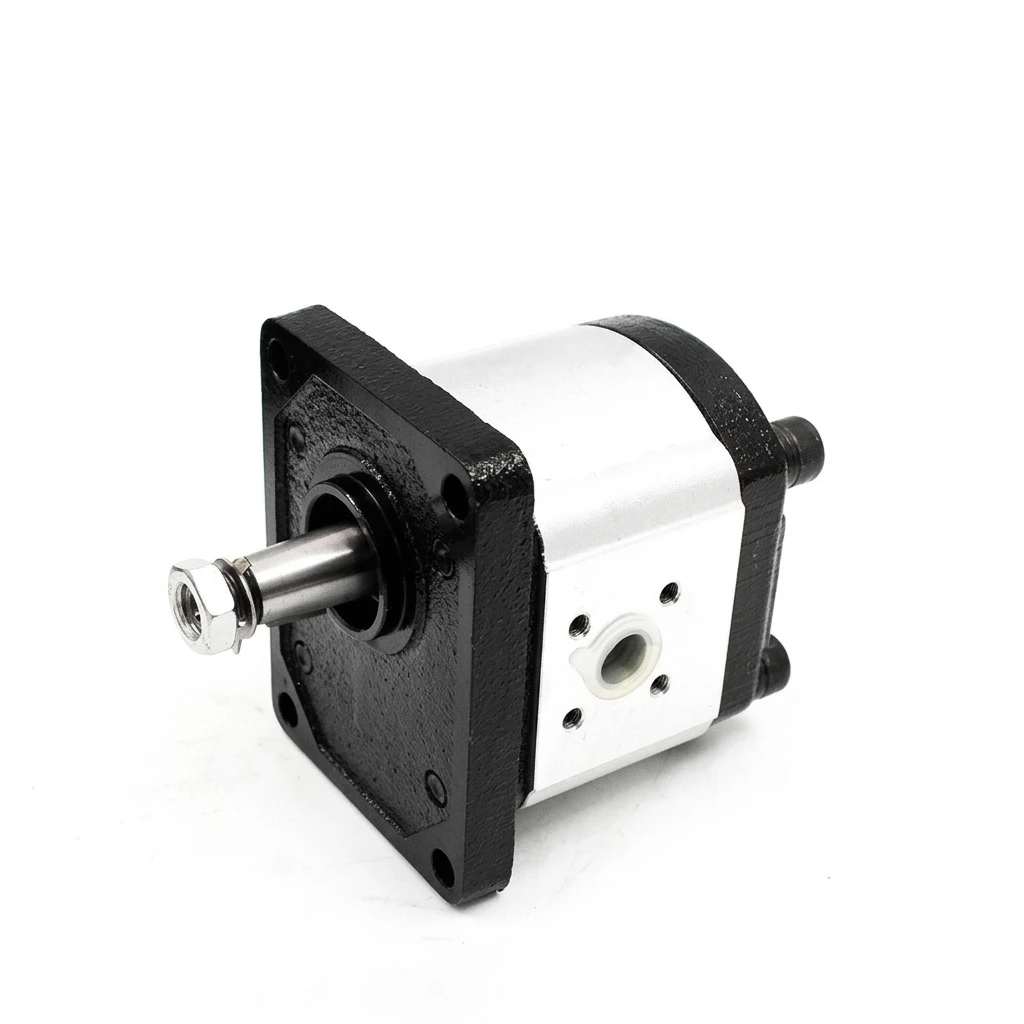
An external gear pump is a fixed-displacement hydraulic pump in which two meshing gears carry oil from the inlet to the outlet. It suits auxiliary, steering, pilot and constant-flow circuits on mobile and industrial machines. Before you source one, confirm displacement, pressure, rotation, flange, shaft and ports against the full model code.
What Is a Gear Pump and How Does It Work?
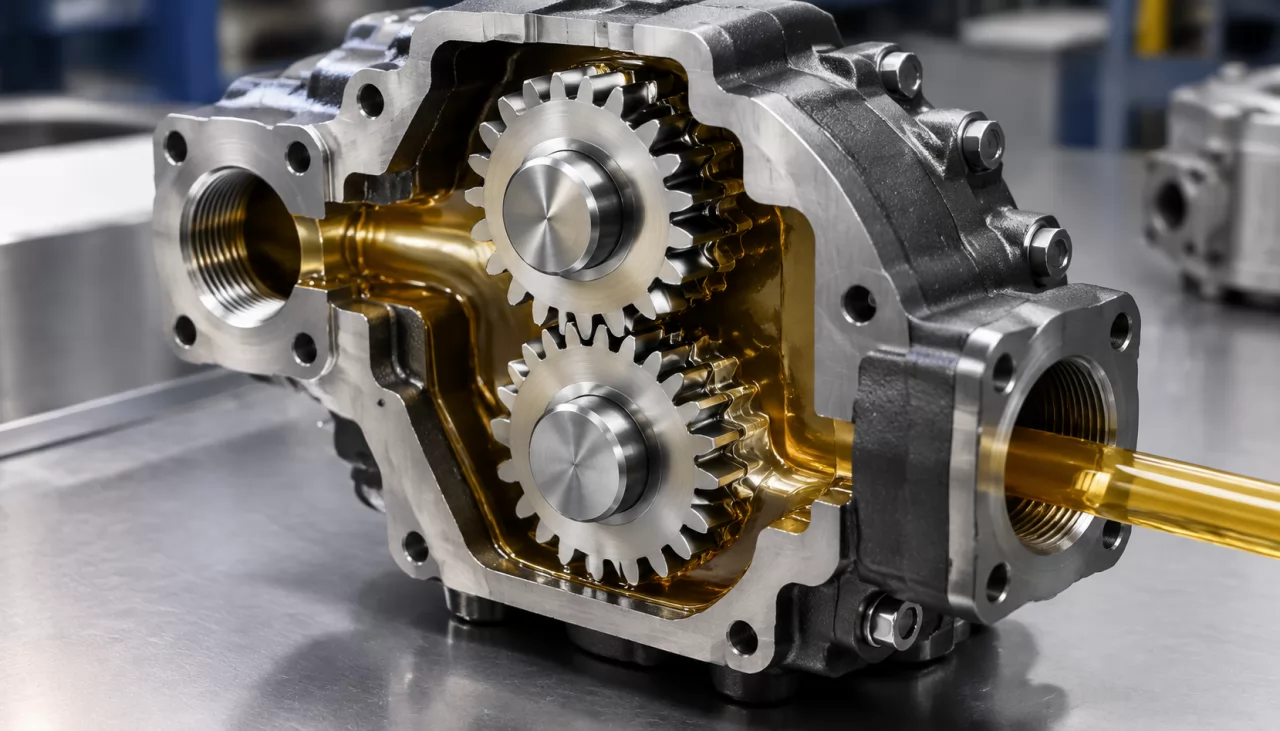
A gear pump uses two meshing gears to move a fixed volume of oil per revolution from the inlet to the outlet. The oil travels around the inside of the housing, not through the gear mesh. Because the volume per turn cannot change, the gear pump is a compact fixed-displacement design that is simple to build and to service.
How Does an External Gear Pump Work, Step by Step?
- Inlet: as the teeth come out of mesh on the suction side, the space between them grows. The low pressure this creates draws oil in from the reservoir.
- Transfer: oil is trapped in the pockets between each tooth and the housing bore, then carried around the outside of both gears.
- Discharge: on the pressure side the teeth mesh again and push the oil out of each pocket into the outlet port.
- Sealing: the tight contact at the mesh point stops oil from flowing back to the inlet. Close clearances at the tooth tips and the gear faces limit internal leakage.
Most leakage happens across the gear faces, so this is where design quality shows. Higher-pressure designs use side plates or pressure-balanced bushings. These are bearing blocks that are pushed against the gear faces by outlet pressure, so the axial gap closes up as the load goes up. Volumetric efficiency then holds up much better than with fixed clearances.
Gear Pump Displacement, Speed and Flow in Plain Terms
Displacement is the volume of oil the pump delivers in one shaft revolution, given in cubic centimetres per revolution (cc/rev). Flow is roughly displacement × speed, less volumetric losses. A 16 cc/rev pump at 1,500 rpm has a theoretical output of 24 L/min. Actual flow is a little lower, and the gap widens as pressure, temperature and wear go up.
That makes cc/rev the starting point of any spec. If you know it, along with the drive speed, you can check whether a replacement will give the same cylinder speeds and motor rpm as the original.
External Gear Pump vs Internal Gear Pump: Which Fits Your Application?
The external gear pump is usually the cheaper, sturdier and more easily repaired choice for mobile hydraulics. Internal gear pumps usually run quieter, deliver lower pressure pulsation and handle thicker fluids better. That makes them common on industrial machines that run near operators or need smooth flow at the actuator.
An internal gear pump has a small external gear running inside a larger ring gear. A crescent-shaped filler or a gerotor profile separates the suction side from the pressure side. That geometry gives longer, gentler tooth engagement, which lowers noise. The trade-off is more machined parts and a higher price.
Side-by-Side Comparison: Gear, Vane and Piston Pumps
| Attribute | External gear | Internal gear | Vane | Piston |
|---|---|---|---|---|
| Pressure capability | Moderate to high (high-pressure designs) | Moderate to high | Moderate | Highest |
| Noise level | Higher | Lower | Lower | Moderate |
| Contamination tolerance | Good | Moderate | Lower | Lowest; needs clean oil |
| Efficiency | Moderate; falls with wear | Moderate to good | Good | Highest; variable displacement possible |
| Typical cost level and use | Lowest; auxiliary, steering, tractor, fan circuits | Medium; injection molding, presses, lubrication | Medium; machine tools, industrial power units | Highest; main drives, load-sensing, closed loops |
In short, choose a gear pump for low cost and tolerance of dirty oil, and pay for a piston pump only when the circuit needs very high pressure or variable flow.
Which Specifications Decide the Right Gear Pump?
The right gear pump is defined by six specifications: displacement, pressure rating, rotation direction, mounting flange, shaft type and port configuration. Lock all six down before you discuss price. Most fit problems, returns and warranty disputes in gear pump orders come back to one of these items being assumed rather than confirmed.
- Displacement: check the cc/rev against the original code. Even a small change shifts actuator speed and the power the pump draws.
- Pressure rating: compare continuous and peak ratings with the real relief valve setting, not the machine brochure.
- Rotation: confirm clockwise or counter-clockwise, viewed from the shaft end. A pump driven the wrong way will not deliver flow and can damage its seals.
- Mounting flange: match the flange standard, pilot diameter and bolt pattern exactly.
- Shaft: match the profile, length and spline or key dimensions to the drive coupling.
- Ports: confirm port position, size and thread standard so existing hoses connect without adapters.
Rule of thumb: if any of the six cannot be confirmed from the code, a drawing or a measured sample, do not place a volume order yet.
Pressure Rating and When You Need a High-Pressure Gear Pump
Continuous pressure is the level the pump can hold for long periods. Peak pressure is a short-term limit for spikes, such as a cylinder reaching the end of its stroke. Datasheets usually list both. A pump that runs near its peak rating all day will wear its bushings and shaft seal early.
Duty cycle matters more than the nameplate maximum. A high-pressure gear pump with pressure-balanced bushings and a cast iron or reinforced body is worth specifying when the circuit regularly works near its relief setting. Examples include vibration drives, hydraulic hammers and heavy steering on articulated machines. For light, intermittent loads, a standard aluminum-bodied pump is usually enough.
Mounting, Shaft and Port Details That Cause Returns
Flange standards come in two broad families. SAE flanges, such as the two-bolt SAE A and SAE B, are common on North American and many Asian machines. European flanges, often four-bolt patterns sized by gear pump group, dominate on European equipment. The two families look alike in photos and do not interchange.
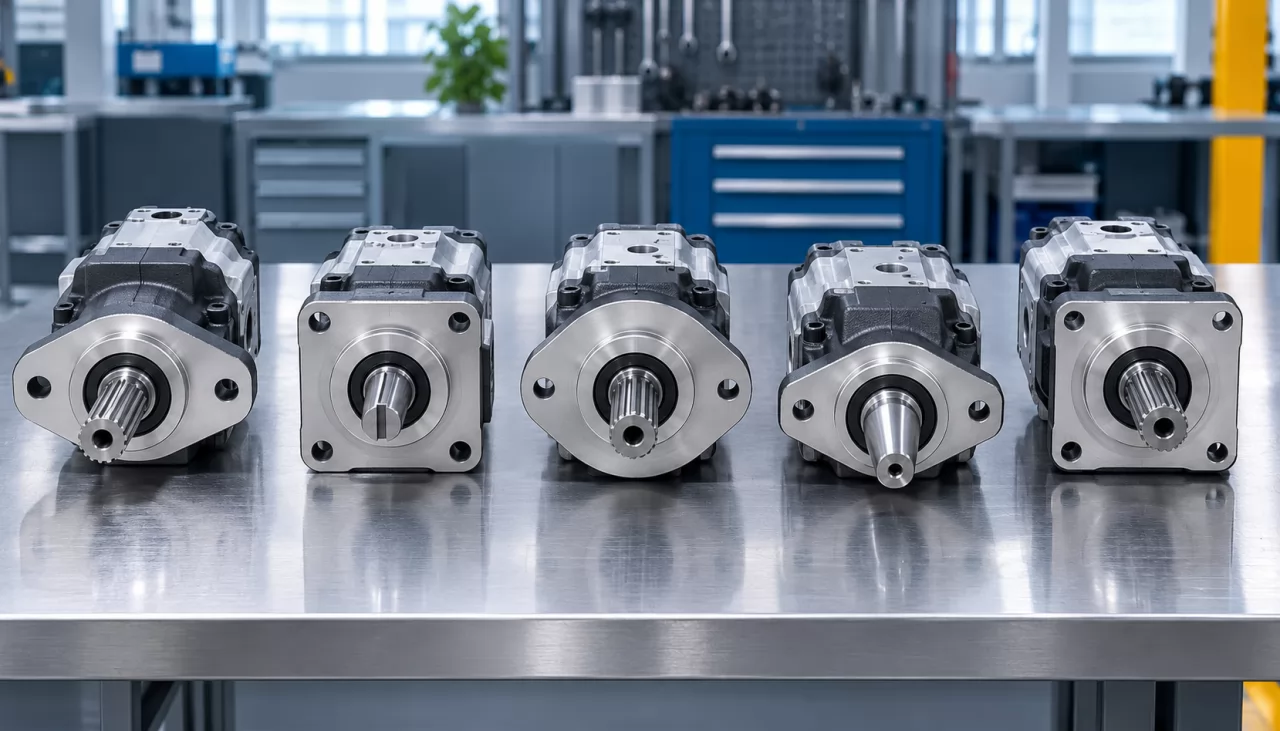
Shafts can be splined (SAE or DIN), parallel keyed, or tapered. A 1:8 taper is typical on many European group pumps. Port threads may be BSPP, metric, or SAE O-ring boss (UNF), and some pumps use flanged ports. For distributors who stock pumps for one regional fleet, custom P/T port configurations, meaning the size and position of the pressure and tank ports, can be built to order so the pumps fit without adapters.
Single, Tandem and Multi-Section Pumps
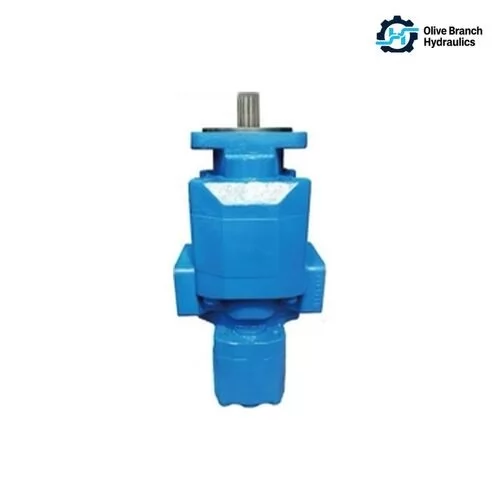
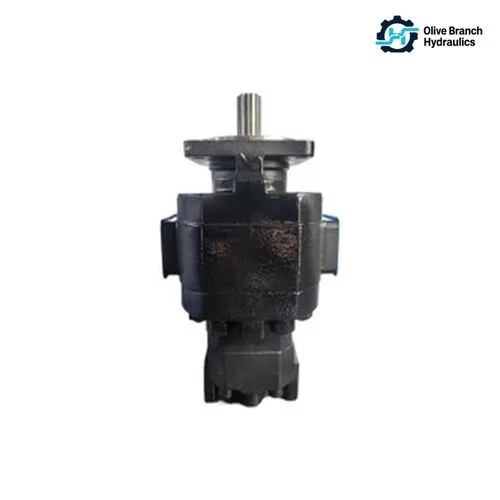
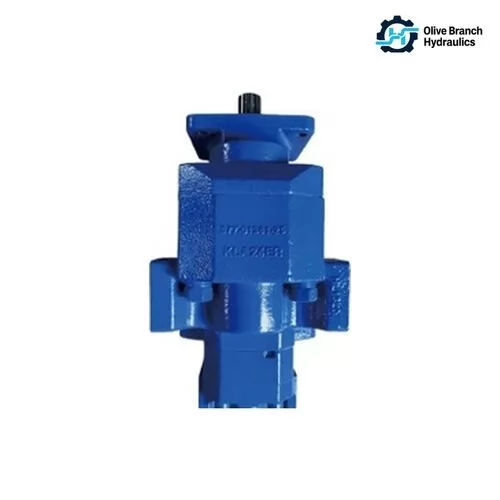
A tandem gear pump has two pumping sections on one through-shaft, each feeding its own circuit. Triple and quadruple pumps add more sections. Multi-section pumps make sense when one drive has to feed separate circuits, for example steering, working hydraulics and an oil cooler fan. Each section's displacement, rotation and porting must be specified separately, and the shaft torque limit has to cover the combined load.
Where Hydraulic External Gear Pumps Work in Construction Machinery and Industry
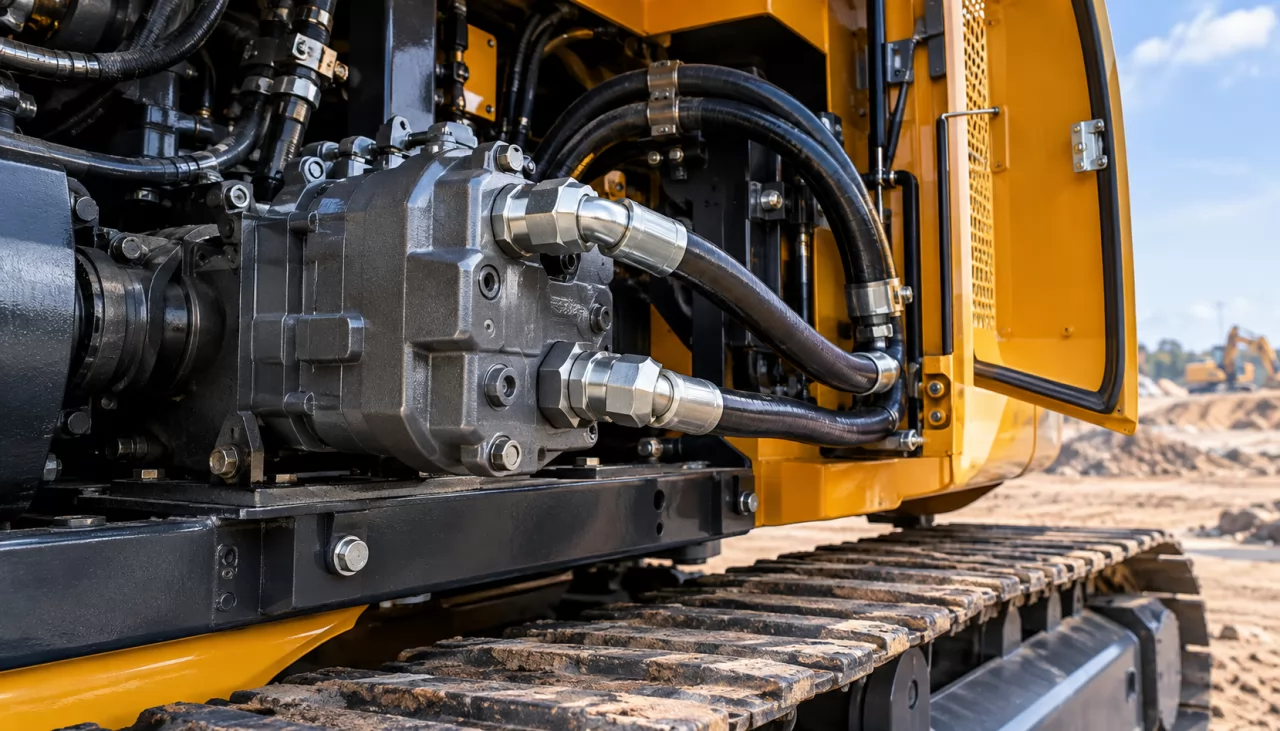
The hydraulic external gear pump for construction machinery usually drives auxiliary, steering, pilot and fan circuits, while piston pumps handle the main work functions. On industrial equipment, gear pumps supply constant-flow circuits where moderate pressure, low cost and tolerance of less-than-perfect oil count for more than variable output.
Construction Equipment Scenarios
- Excavator pilot and auxiliary supply: a parts distributor serving rental fleets needs pilot pumps that bolt directly onto the main pump's through-drive. Check the coupling spline, the flange and the low-pressure rating, which differs from main-circuit duty.
- Road roller steering and vibration: a maintenance workshop needs pumps that tolerate long hours at high pressure in the vibration circuit. Check the continuous rating and bushing design, and whether a tandem unit also covers steering.
- Pavers and concrete pump trucks: on these machines, gear pumps often work alongside piston pumps to feed agitators, conveyors, cooling and boom functions. Check the mounting position on the PTO or through-drive and the rotation as seen from that drive, not from the engine.
Tractor, Transmission and Industrial Scenarios
- Tractor hydraulic pumps: an importer supplying agricultural dealers needs pumps for lift and steering. Check the drive type (gear-driven or engine-mounted), the tapered or splined shaft, and the model-year variations within a single tractor model.
- Transmission pumps: these supply charge or lubrication oil to powershift gearboxes. Check low-pressure flow at idle speed, because that is where a worn or undersized pump first shows itself.
- Metallurgy, plastics and die-casting machinery: plant maintenance teams need fixed-flow pumps for clamping, cooling and lubrication. Check the operating temperature, the fluid type (some plants use fire-resistant fluids) and noise limits near operators.
How to Order an External Gear Pump Replacement by Model Code
External gear pump replacement by model code works when you send the full original product code, the machine model and the equipment details. Compatibility depends on the complete assembly code, not just the series name. Two pumps in the same series can differ in shaft, flange, rotation and ports, and none of these will interchange.
Reading Common Series Codes
Series names identify the pump family and frame size. Rexroth-style AZPF, AZPG, AZPN, AZPB and AZPW codes identify different frame groups. A numeric block within the code typically gives displacement in cc/rev, followed by letters for rotation, shaft, flange and ports. Parker PGP505, PGP511 and PGP517 are different frame sizes in the PGP range, and PGP315, PGP330 and PGP365 belong to the heavier-duty part of the family. Marzocchi-style ALP1–3 and GHP1–3 use the digit to indicate the group, with displacement and options added after it.
Each manufacturer has its own coding structure, so always decode the full string against the original catalogue. Brand names and model numbers are given for replacement identification only. They do not imply any affiliation with the original manufacturer.
Olive Branch Hydraulics covers gear pump series compatible with Rexroth, Parker, Marzocchi, Shimadzu, Casappa and Sunny. These include AZPF, AZPG, AZPN, AZPB, AZPW, 1PF2G, ALP1-3, GHP1-3, PGP505, PGP511, PGP517, PGP315, PGP330 and PGP365. The range also includes high-pressure, tandem, triple and quadruple gear pumps, transmission pumps and tractor hydraulic pumps.
Pre-RFQ Checklist for Gear Pump Replacement Parts
- Copy the complete nameplate code, character by character, including suffixes.
- Photograph the shaft end, the mounting flange, both ports, and the nameplate in sharp focus.
- Confirm the rotation direction as viewed from the shaft end.
- State the displacement in cc/rev and the actual operating pressure of the circuit.
- Record the machine make, model, serial range and which circuit the pump feeds.
- Measure the shaft diameter, spline count, flange pilot and bolt spacing if the nameplate is missing or unreadable.
- List the quantity per code and the destination port.
How Do Quality Checks, Lead Time and Cost Drivers Affect Your Order?
Gear pump price and lead time depend mostly on series, displacement, multi-section configuration, and how much custom shaft, flange and port work is needed. A standard single-section pump sits at the simple end. A custom tandem or quadruple unit with non-standard porting needs drawings, a sample and longer production. Agree the QC scope in the quotation.
Typical checks include dimensional inspection of the flange, shaft and ports, leak inspection, and pressure and flow testing where applicable. The specific checks and any required documents should be written into the quotation, not assumed. At Olive Branch Hydraulics, every pump gets a 100% final inspection before packaging. Production is carried out by a manufacturing partner in Ningjin, established in August 2010, about 9 km from the Xinji sales office.
For custom or first-time orders, the sequence runs as follows:
- Inquiry with code, drawings or samples
- Design drafts and 3D renders for your approval
- Sampling
- Production with in-process quality control
- 100% final inspection, then packaging and shipping
Three pitfalls cause most problems. The first is ordering by series name only. The second is ignoring rotation, which is easy to miss when a pump is driven from a PTO. The third is skipping sample approval to save a few weeks, which can leave you with a full batch that fits nothing.
FAQ
Can an external gear pump replace a piston pump?
Sometimes, in fixed-flow circuits. A gear pump can take over where the piston pump runs at constant displacement and the pressure is within the gear pump's rating. It does not suit circuits that need variable displacement, pressure compensation or load-sensing control.
What usually causes early gear pump failure?
Usually contaminated oil, cavitation, overpressure or drive misalignment. Cavitation is typically caused by restricted inlets or undersized suction lines. Scored bushings and housing wear on the inlet side are the usual signs.
Do I need the original nameplate code to get a matching pump?
It is the most reliable starting point. Without the code, send the machine model, equipment details, photos and measured shaft, flange and port dimensions so the pump can be identified.
Can gear pumps be made to custom specifications?
Yes. Hydraulic gear pumps can be built to customer specifications for OEM and aftermarket use, including custom P/T port configurations. Design drafts and 3D renders are approved before sampling.
Next Step: Request a Quote or a Replacement Match
Send the model, quantity and destination port for a reply within 24 hours. For replacement parts, also include the original product code, machine model and equipment details. Email [email protected], call +8615075996564, or visit https://www.hydrogeartech.com/.